Facts
The applicant sought regular bail under Section 483 of the Bharatiya Nagarik Suraksha Sanhita, 2023 (BNSS) regarding Crime No. 766/2025.
Source reference: p. 1The prosecution alleged that the applicant, with co-accused Lalaram and Chhotu Silawat, assaulted Satish Rajak with an axe and wooden stick.
Source reference: para. 3This second bail application was filed on the ground that the injured witness, Satish Rajak, was declared "hostile" by the prosecution during trial, allegedly rendering his testimony ineffective.
Source reference: para. 4Previously, the applicant’s first bail application was dismissed as withdrawn on 13.01.2026.
Source reference: para. 2Issues
1. Whether a witness must be formally "declared hostile" before a party can seek permission to put leading questions or cross-examine their own witness under the Bharatiya Sakshya Adhiniyam, 2023.
Source reference: para. 122. Whether the hostility of a witness per se entitles an accused to bail or results in the total effacement of that witness's testimony.
Source reference: para. 15Law Applied
The Court applied Sections 142, 143, 146, and 157 of the Bharatiya Sakshya Adhiniyam, 2023 (BSA).
Source reference: paras. 7-9Section 146 (equivalent to S. 142 of the Evidence Act) governs leading questions, while Section 157 (equivalent to S. 154 of the Evidence Act) permits the Court to allow a party to cross-examine its own witness.
Source reference: para. 9The Court relied on Sat Paul v. Delhi Administration (1976), which held that the expression "hostile witness" is not found in the statute and that evidence of such a witness is not washed off the record but remains subject to judicial assessment.
Source reference: para. 15The court's discretion to permit cross-examination is untrammeled by the concept of "hostility" as established in Baikuntha Nath v. Prasannamoyi (1922).
Source reference: para. 12, 15Reasoning
The Court observed that trial courts and prosecutors often suffer from a "misconception" that a witness must be declared hostile to be asked leading questions.
Source reference: para. 6, 19Analyzing the deposition of Satish Rajak, the Court found he had "substantially supported" the prosecution case in his examination-in-chief, only omitting technical details regarding the Dehati Nalishi.
Source reference: para. 19The court reasoned that under Section 157 of the BSA, the trial court can permit leading questions to elicit the truth without adjudicating the witness’s veracity or effacing their prior supportive statements.
Source reference: para. 14, 17Since the witness did not actually resile from the core version of the assault, the applicant’s argument that "hostility" nullified the prosecution case for the purpose of bail was legally flawed.
Source reference: para. 20Holding
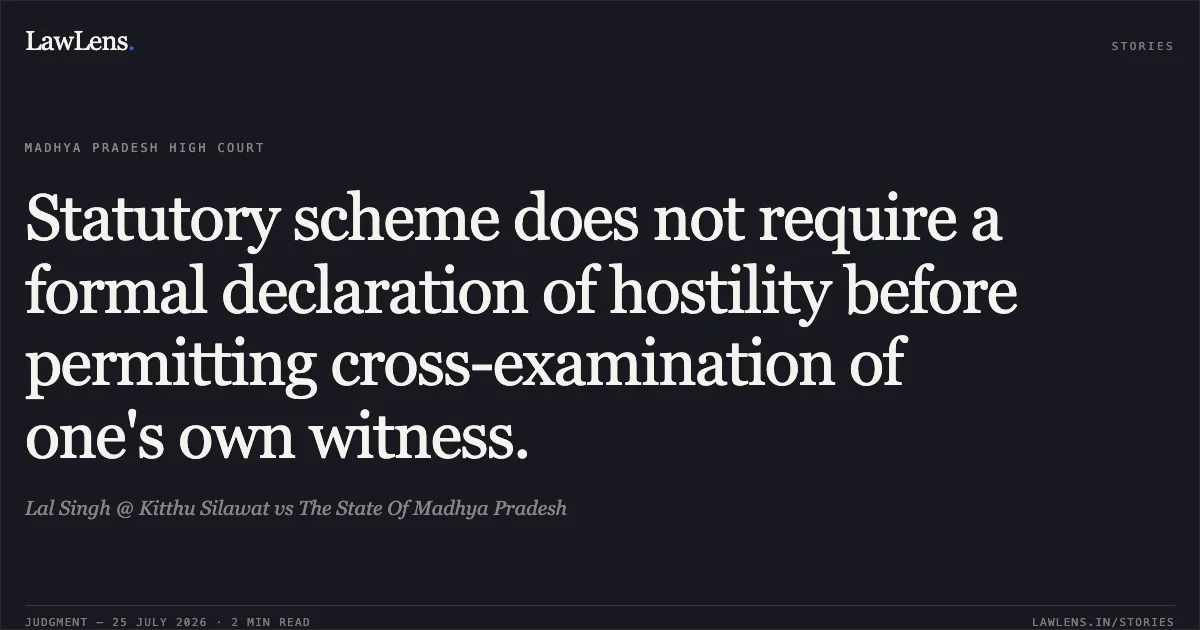
The Court held that the statute does not contemplate a formal declaration of hostility as a condition precedent for exercising discretion under Section 157 of the BSA.
The Court further clarified that even if a witness is cross-examined by the party calling them, the evidence is not automatically discarded; the judge may still rely on creditworthy parts of the testimony.
Source reference: para. 15Finding no merit in the ground of hostility for the grant of bail, the Court permitted the applicant to withdraw the application and subsequently dismissed the case as withdrawn.
Source reference: para. 20Acts & Sections Cited
10 provisions across 3 statutes referred to in this judgment. Each provision opens on LawLens.
Bharatiya Nagarik Suraksha Sanhita, 20231
Bharatiya Nyaya Sanhita, 20234
Bharatiya Sakshya Adhiniyam, 20235
Original Court PDF
Lal Singh @ Kitthu SilawatvsThe State Of Madhya Pradesh
Click to open original judgment
Original judgment, available to read, download and summarize on LawLens.in


![Subsequent exoneration does not retrospectively invalidate a finalized promotion select list.. UNNIKRISHNAN M vs M/o Environment And Forests. CAT - ['Ernakulam']. LawLens](/stories/thumbnails/subsequent-exoneration-does-not-retrospectively-invalidate-a-finalized-promotion-select-li-ce80a0e84f2f4887857271e8b4341c42.webp)