Facts
The appellant, Terai Tea Co. Ltd., held a lease over tea-garden land under the West Bengal Estate Acquisition Act, 1953.
Source reference: paras. 20–27The lease was due to expire on 24 August 2002, but the appellant applied for renewal on 16 March 2002, which was received on 21 March 2002.
Source reference: paras. 20–27A fresh lease was subsequently granted with retrospective effect and remained subsisting.
Source reference: paras. 20–27The land was acquired for the Airport Authority of India pursuant to a notification under Section 4(1) of the Land Acquisition Act, 1894, published on 29 May 1999.
Source reference: para. 19Dissatisfied with the compensation assessed by the Collector, the appellant sought a reference under Section 18 of the 1894 Act.
Source reference: paras. 22–24The reference court declined to calculate the market value of the land, excluded the vacant portion of the tea garden, and awarded loss of earning only until the original lease’s expiry on 24 August 2002.
Source reference: paras. 22–24, 34–36The matter ultimately returned to the High Court for determination of compensation under the Land Acquisition Act, 1894.
Source reference: paras. 1–3, 19Issues
Whether the reference court erred in refusing to determine the market value of the acquired land under the first component of Section 23 of the Land Acquisition Act, 1894, on the ground that the appellant’s lease had expired.
Source reference: paras. 22–29Whether the entire subject land, including its vacant portions, was required to be included while determining the market value and compensation.
Source reference: paras. 30–33Whether compensation for loss of earning under the West Bengal amendment to Section 23 was wrongly restricted to the original lease period ending on 24 August 2002.
Source reference: paras. 34–36Whether the market-value component of compensation payable to the lessee and the State was required to be apportioned in the ratio of 75:25.
Source reference: paras. 37–40Law Applied
The court applied Section 23 of the Land Acquisition Act, 1894, under which market value must be determined as on the date of publication of the Section 4(1) notification, together with the additional statutory components of compensation, including those introduced by the West Bengal amendment and Sections 23(1A) and 23(2).
Source reference: paras. 22, 33–40Section 6(3) of the West Bengal Estate Acquisition Act, 1953, read with Rule 4, Schedule-F and Form-I of the West Bengal Estate Acquisition Rules, 1954, was construed as conferring a perpetual or substantially continuing right of renewal on the statutory lessee, subject to the State’s limited right of resumption upon breach of lease conditions.
Source reference: paras. 25–26The court relied on Tandon Brothers v. State of West Bengal, (2001) 5 SCC 664, concerning leases within Section 6(3) of the 1953 Act.
Source reference: paras. 13–14The court relied on Inder Prashad v. Union of India, (1994) 5 SCC 239, and Brij Behari Sahai v. State of U.P., (2004) 1 SCC 641, for the principle that the market-value compensation should ordinarily be apportioned 75% to the lessee and 25% to the lessor-State.
Source reference: paras. 13–14, 37–38Under Section 50(2) of the Land Acquisition Act, the acquiring body was entitled to appear and adduce evidence regarding the quantum of compensation.
Source reference: para. 44Reasoning
The court held that the lease was subsisting when the acquisition proceedings commenced and that the appellant’s timely renewal application created a valuable right of renewal; the subsequent retrospective renewal further confirmed the appellant’s continuing leasehold interest.
Source reference: paras. 20–28Consequently, the reference court had erred in refusing to determine market value under Section 23 as on the date of the Section 4(1) notification.
Source reference: paras. 28–29The reference court also exceeded the limited scope of a Section 18 reference by interpreting the lease and treating the vacant portion as land not used for the tea garden.
Source reference: paras. 30–33Since the lease contained no prohibition against leaving part of the property vacant and the State had alleged no breach, the entire acquired property had to be valued, including its vacant portions.
Source reference: paras. 30–33Because the lease continued beyond 24 August 2002, loss of earning could not be confined to the original lease term and had to be computed for the entire legally relevant period.
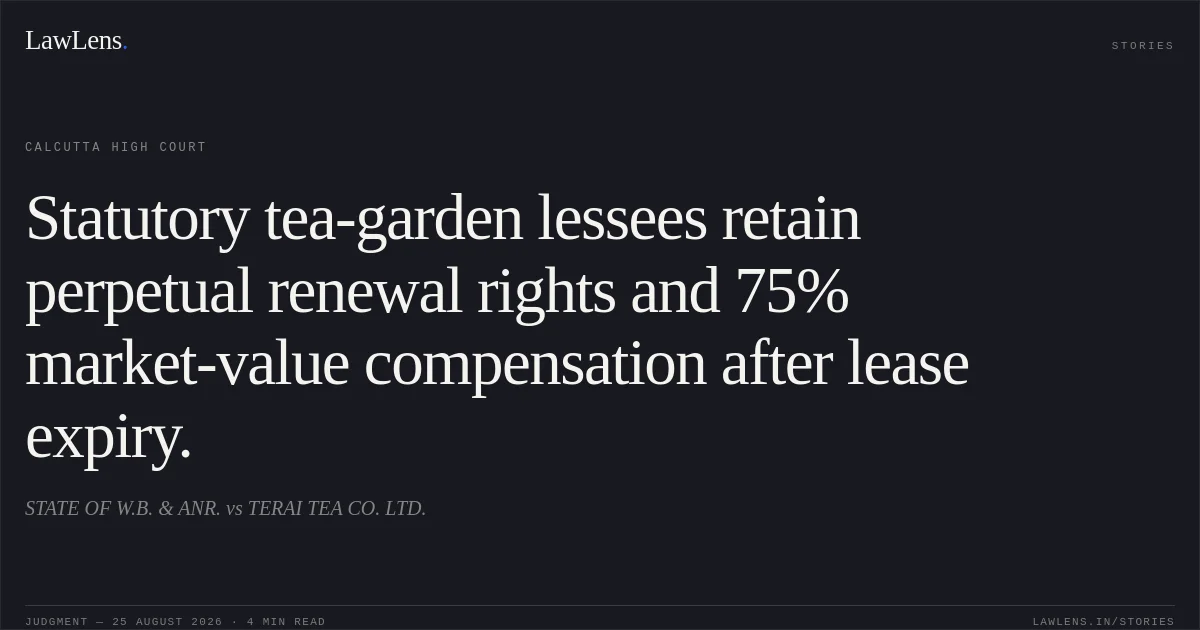
Source reference: paras. 34–36Applying the principles in Inder Prashad and Brij Behari Sahai, the court directed that 75% of the market-value component be paid to the appellant and 25% to the State, while the remaining statutory components be paid entirely to the appellant.
Source reference: paras. 37–40Holding
FA No. 77 of 2012 was allowed, and the reference court’s judgment and decree dated 23 October 2003 were set aside.
The matter was remanded for computation of compensation under the Land Acquisition Act, 1894, on the following basis: the market value must be determined as on the date of publication of the Section 4(1) notification for the entire land, including vacant portions; 75% of that market-value component must be awarded to the appellant and 25% to the State; and all other components under Section 23, including the West Bengal amendments and Sections 23(1A) and 23(2), must be calculated for the entire applicable period without restricting them to 24 August 2002.
Source reference: para. 40The exercise was directed to be completed preferably within six months, with immediate disbursement of the Collector’s assessed amount to the appellant subject to adjustment against the final compensation.
Source reference: paras. 41–43The Airport Authority of India was permitted to participate and adduce evidence under Section 50(2), and the connected matters were disposed of consequentially without any order as to costs.
Source reference: paras. 44–47Acts & Sections Cited
5 provisions across 2 statutes referred to in this judgment. Linked provisions open on LawLens.
Fair Compensation, and Transparency in Land Acquisition, Rehabilitation and Resettlement Act, 20134
Land Acquisition (West Bengal Amendment) Act, 19631
Original Court PDF
STATE OF W.B. & ANR.vsTERAI TEA CO. LTD.
Click to open original judgment
Original judgment, available to read, download and summarize on LawLens.in
![Courts will not interfere with transfers absent mala fides or violation of statutory rules.. M Ramya vs EMPLOYEES STATE INSURANCE CORPORATION (ESIC). CAT - ['Chennai']. LawLens](/stories/thumbnails/courts-will-not-interfere-with-transfers-absent-mala-fides-or-violation-of-statutory-rules-a6845e9ca6f548fca284c51c8351957f.webp)
![Courts cannot direct one-time recruitment age relaxation absent authority in the governing rules or advertisement.. UT OF PUDUCHERRY vs M ANDAL. CAT - ['Chennai']. LawLens](/stories/thumbnails/courts-cannot-direct-one-time-recruitment-age-relaxation-absent-authority-in-the-governing-895d78fde47143e2a8ed0207c4b6a44f.webp)
![A review cannot correct an allegedly erroneous decision absent an error apparent on the record.. Ajit Kumar Jha vs RAILWAY BOARD. CAT - ['Delhi']. LawLens](/stories/thumbnails/a-review-cannot-correct-an-allegedly-erroneous-decision-absent-an-error-apparent-on-the-re-8ac952fd4eba470c92f7da20af72a220.webp)