Facts
The Respondent (Plaintiff) is the owner of property Municipal No. V-12, Green Park, New Delhi, via a 2007 Sale Deed.
Source reference: p. 2, para 2The Appellant’s father, Late Sh. Gopi Ram Goel, was a tenant in the premises at a monthly rent of Rs. 450/-.
Source reference: p. 2, para 2The Respondent terminated the tenancy via legal notice on 31.05.2009, after which Gopi Ram Goel continued as a statutory tenant under the Delhi Rent Control (DRC) Act.
Source reference: p. 2, paras 3-4Following Gopi Ram’s death on 26.01.2013, the Respondent filed a suit for possession and mesne profits, asserting that the Appellant was not financially dependent on the deceased and thus only had a limited right to stay for one year under the DRC Act.
Source reference: p. 3, paras 7-9The Appellant contested this, claiming dependency and asserting that the suit was barred by limitation and res judicata due to previous dismissed eviction petitions.
Source reference: p. 4, paras 11-13The Trial Court decreed the suit in favor of the Respondent under Order XII Rule 6 of the CPC (Judgment on Admissions).
Source reference: p. 5, para 18Issues
1. Whether the Appellant, as the heir of a statutory tenant, was financially dependent on the deceased and thus entitled to continued protection under the Delhi Rent Control Act beyond the one-year statutory period.
Source reference: p. 7, para 24; p. 9, para 262. Whether the suit for possession was barred by the principles of res judicata, Section 50 of the DRC Act, or the Law of Limitation.
Source reference: p. 6, para 20; p. 10, paras 28-29Law Applied
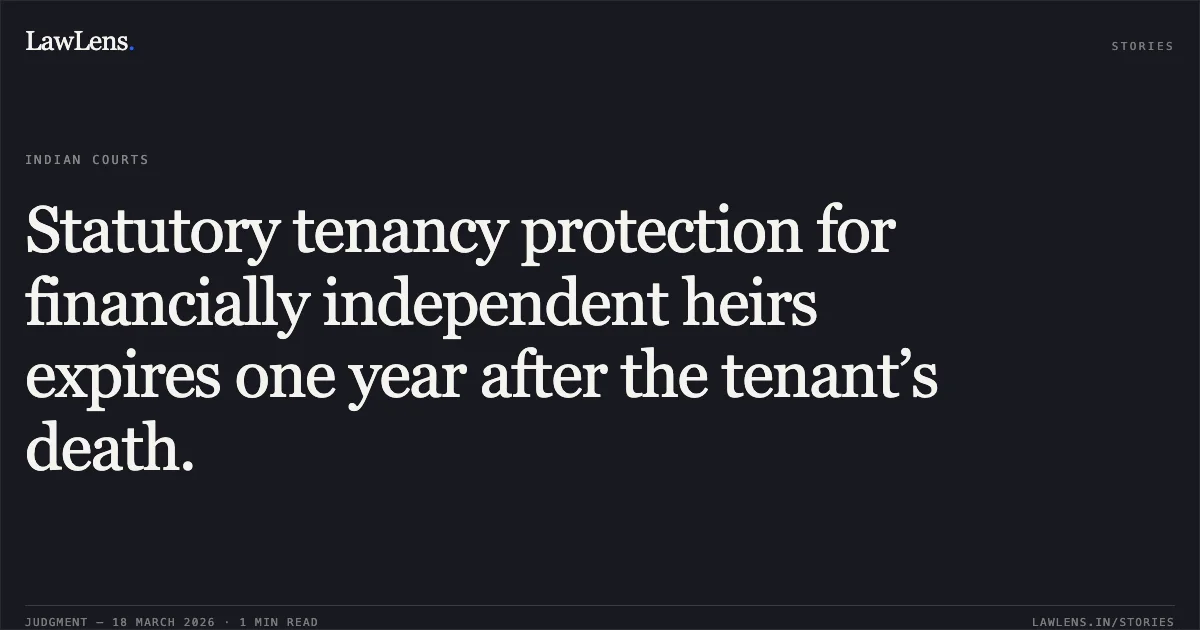
Section 2(l) of the Delhi Rent Control Act, specifically Explanation II, which stipulates that if an heir who succeeds a statutory tenancy was not financially dependent on the deceased at the time of death, their right to possession extinguishes after one year.
Source reference: p. 8, para 24Order XII Rule 6 of the Civil Procedure Code (CPC), which empowers the court to pass a judgment based on admissions of fact made in pleadings or otherwise.
Source reference: p. 5, para 16Principles of the Transfer of Property Act, 1882, regarding unauthorized occupants once statutory protection under rent laws ceases.
Source reference: p. 10, para 27Reasoning
The Court observed that the Appellant had himself relied upon a Partnership Deed dated 13.11.2012 in previous proceedings, which established his status as a partner in a business, thereby proving he had an independent source of income and was not financially dependent on his father at the time of the latter’s death.
Source reference: p. 9, para 26Consequently, under Explanation II to Section 2(l) of the DRC Act, the Appellant’s protection from eviction was limited to one year post-January 2013, expiring in January 2014.
Source reference: p. 9, para 26The Court rejected the plea of res judicata, noting that the dismissal of previous eviction petitions under the DRC Act did not affect a fresh cause of action arising under the Transfer of Property Act once the statutory protection expired.
Source reference: p. 10, para 28Regarding limitation, the Court held that unauthorized occupancy constitutes a continuous cause of action, and the Appellant could not claim the suit was time-barred while remaining in unlawful possession.
Source reference: p. 10, para 29Holding
The High Court dismissed the appeal and upheld the Trial Court’s decree for possession.
The Court held that the Appellant became an unauthorized occupant in January 2014 upon the expiry of the one-year grace period provided to non-dependent heirs under the DRC Act.
Source reference: p. 10, para 27The Court affirmed that the judgment on admissions under Order XII Rule 6 was proper as the Appellant’s own documents (the Partnership Deed) refuted his claim of financial dependency.
Source reference: p. 9, para 26; p. 10, para 30All pending applications were disposed of accordingly.
Source reference: p. 10, para 32Acts & Sections Cited
8 provisions across 4 statutes referred to in this judgment. Each provision opens on LawLens.
delhi rent control act, 19584
Code of Civil Procedure, 19082
Indian Easements Act, 18821
Delhi Municipal Corporation Act, 19571
Original Court PDF
Shri Pawan Kumar GoelvsShrimati Jyoti Sikka
Click to open original judgment
Original judgment, available to read, download and summarize on LawLens.in


