Facts
The opposite parties (landlords) filed Ejectment Suit No. 06 of 2025 against the petitioners (tenants) for eviction based on negligence and default
Source reference: p. 1-2Summons were served on January 31, 2025, and petitioners appeared on February 27, 2025, filing applications under Sections 7(1) and 7(2) of the West Bengal Premises Tenancy Act, 1997 ("1997 Act")
Source reference: p. 2The Trial Court allowed the Section 7(1) application on the same day, permitting deposit of current monthly rents
Source reference: p. 2The petitioners failed to deposit the rent within the statutory period, subsequently filing applications under Section 151 of the CPC on March 19 and 20, 2025, seeking permission to deposit arrears
Source reference: p. 2They claimed they were unaware of the February 27 order as it was not uploaded on the e-portal and because their counsel suffered a family bereavement
Source reference: p. 3The Trial Court rejected these applications and invoked Section 7(3) of the 1997 Act to strike out the defense
Source reference: p. 1Issues
1. Whether the Court has the power to extend the mandatory time limits for depositing rent prescribed under Section 7(1) of the West Bengal Premises Tenancy Act, 1997
Source reference: p. 7 / para. 212. Whether the petitioners’ plea of ignorance of the court order and advocates' personal difficulties constitute sufficient grounds to bypass the statutory mandate
Source reference: p. 6 / para. 18-19Law Applied
The court primarily applied Section 7 of the West Bengal Premises Tenancy Act, 1997, specifically Section 7(1) regarding the mandatory deposit of rent, Section 7(2) regarding determination of arrears, and Section 7(3) regarding the striking out of defense for non-compliance
Source reference: p. 5, 10Seventh Day Adventist Senior Secondary School v. Ismat Ahmed & Others (2025), which established that the time limits in Section 7(1) are mandatory and cannot be extended under Section 5 of the Limitation Act
Source reference: p. 7-10Modula India v. Kamakshya Singh Deo regarding the residual rights of a tenant whose defense is struck out
Source reference: p. 11Reasoning
The Court found the petitioners' claim of being unaware of the February 27 order unconvincing. Evidence showed the order was endorsed on the application itself on the date of hearing
Source reference: p. 5-6, para. 17Furthermore, the petitioners’ counsel filed an adjournment petition on March 03, 2025, which did not mention the bereavement but requested time for a written statement, contradicting the claim that the advocate was unable to attend court
Source reference: p. 6-7, para. 20Applying the Seventh Day Adventist ruling, the Court held that the word "shall" in Section 7(1) imposes a strict obligation to pay or deposit rent within the specified time to enjoy protection from eviction
Source reference: p. 8, para. 28The Court reasoned that statutory protections for tenants are conditional upon strict adherence to rent payment timelines, and even if there were an absence of correct legal advice or administrative delay in uploading orders, the legal consequences of non-compliance must flow
Source reference: p. 9-10Holding
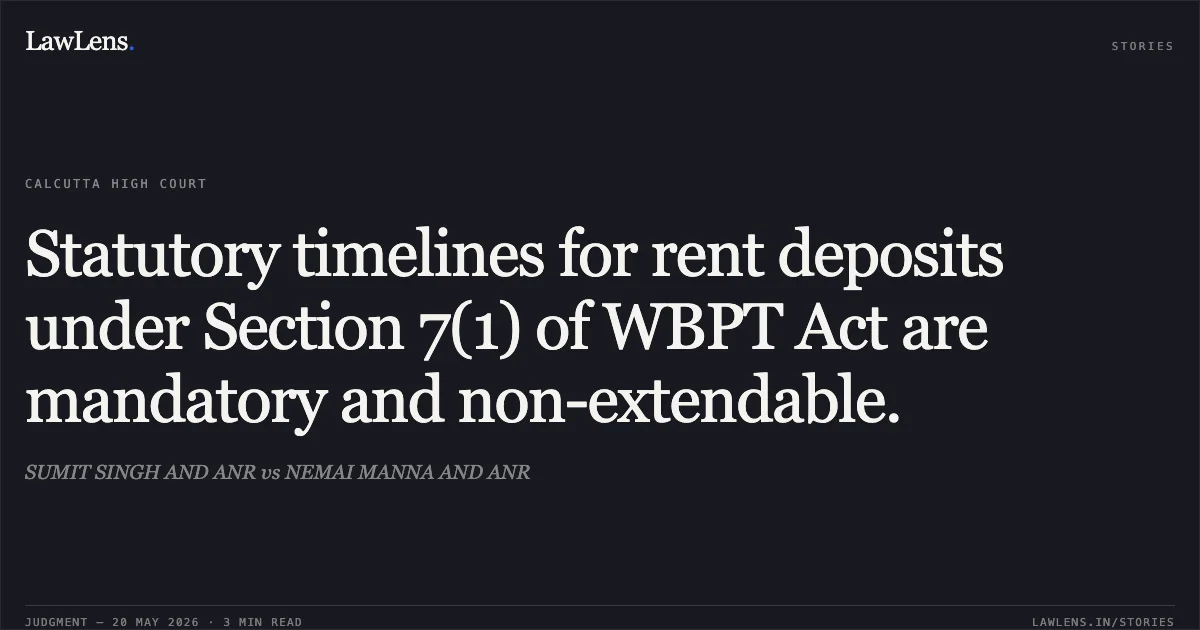
The Court answered the issues in the negative, holding that the statutory timelines under Section 7(1) of the 1997 Act are non-extendable
The Revisional Application was dismissed, affirming the Trial Court's order to strike out the petitioners' defense
Source reference: p. 11, para. 24the petitioners remain entitled to cross-examine the plaintiffs' witnesses and advance arguments on the points of law, as per the Modula India principle
Source reference: p. 11, para. 23All connected applications (CAN 1 and CAN 3 of 2025) were disposed of accordingly
Source reference: p. 11Acts & Sections Cited
3 provisions across 3 statutes referred to in this judgment. Each provision opens on LawLens.
Code of Civil Procedure, 19081
West Bengal Premises Tenancy Act, 19971
Limitation Act, 19631
Original Court PDF
SUMIT SINGH AND ANRvsNEMAI MANNA AND ANR
Click to open original judgment
Original judgment, available to read, download and summarize on LawLens.in


