Facts
The appellants challenged an adjudication order concerning three consignments declared as stainless-steel scrap under CTH 7204 2190.
Source reference: p. 2–4Customs reclassified the goods as prime steel under CTH 7220 2090, enhanced their values, ordered absolute confiscation and imposed penalties.
Source reference: p. 2–4The first consignment—about 99.03 MT—had been examined by Customs and a Chartered Engineer, both of whom recorded it as scrap, and was cleared.
Source reference: p. 2–4The second consignment—151.69 MT—was the subject of a live bill of entry; the Chartered Engineer recommended laboratory testing, while the Customs laboratory report did not specify the tests or parameters supporting its conclusion that the goods were prime material.
Source reference: p. 2–4For the third consignment—about 150 MT—no bill of entry had been filed, but Customs examined the goods and proceeded against them.
Source reference: p. 2–4The adjudicating authority also imposed penalties on the company’s directors.
Source reference: p. 14–15Issues
Whether the evidence justified classifying the three consignments as prime steel rather than scrap, and consequently enhancing their values and ordering confiscation
Source reference: p. 14–15, 24–28, 32–45, 49–54Whether confiscation or redemption fine could be imposed on the first consignment after it had been cleared and was unavailable for confiscation
Source reference: p. 14–15, 31–32Whether penalties on the company and its directors were sustainable, including in relation to the third consignment for which no bill of entry had been filed
Source reference: p. 49, 53–54Whether the appellants were entitled to relief from demurrage and detention charges for the detained consignments
Source reference: p. 55–58Law Applied
Foreign Trade Policy para 2.32 permits import of metallic waste and scrap in any form, subject to the stated restrictions; Handbook of Procedures para 2.51(d) governs unshredded, compressed and loose scrap and requires the prescribed pre-shipment inspection documentation, including that the goods qualify as waste, scrap, seconds or defective material under internationally accepted parameters.
Source reference: p. 15–20Under Customs Valuation Rules 3 and 12, transaction value is the starting point, and rejection of declared value requires a reasoned basis to doubt its truth or accuracy.
Source reference: p. 45–46A test report relating to one consignment cannot, without evidence, determine the classification of another consignment; the Tribunal relied on Shalimar Paints Ltd. and Commissioner of Customs (Preventive) v. Marks Marketing Pvt. Ltd.
Source reference: p. 29–31Under Shiv Kripa Ispat Pvt. Ltd., redemption fine cannot be imposed where goods are unavailable for confiscation and were not cleared under bond or undertaking.
Source reference: p. 31–32Statements cannot establish the truth of their contents unless the procedure under Section 138B of the Customs Act is followed, as explained in G-Tech Industries v. Union of India.
Source reference: p. 27–28Regulation 6(1)(l) of the Handling of Cargo in Customs Areas Regulations, 2009 prohibits a Customs Cargo Service Provider from charging rent or demurrage on goods seized, detained or confiscated by the proper officer, subject to other applicable law.
Source reference: p. 55–56Reasoning
The Tribunal held that the first consignment had been examined by Customs and a Chartered Engineer and cleared as scrap; the Revenue produced no corroborative chemical or laboratory evidence to displace that conclusion, and statements not tested under Section 138B could not independently prove that the goods were prime material.
Source reference: p. 24–28The later consignments could not be treated as prime merely because of their appearance, dimensions or orderly stacking.
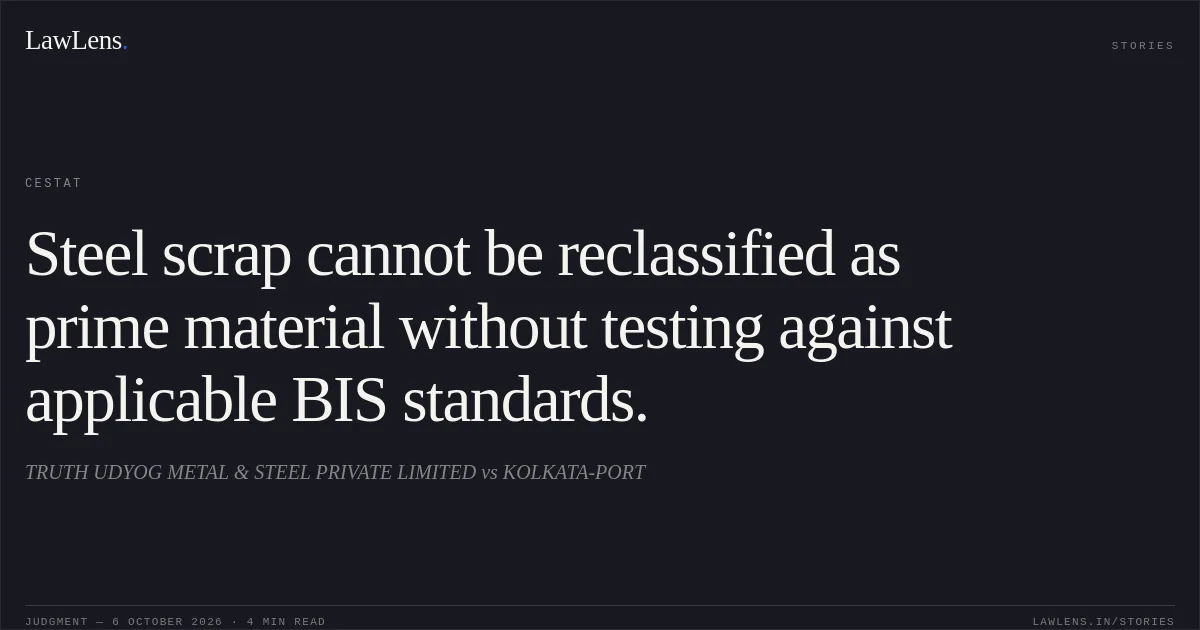
Source reference: p. 32–45For the second consignment, the Chartered Engineer called for laboratory testing, while the Customs laboratory report did not identify the tests or BIS parameters applied; the Revenue therefore failed to establish that the goods met the standards for prime material.
Source reference: p. 32–45The appellants’ pre-shipment certificates identifying the goods as scrap had not been shown to be false or fabricated.
Source reference: p. 32–45The Tribunal also found no evidence supporting the enhanced values or establishing that the declared transaction values were inaccurate.
Source reference: p. 43–46It applied the same evidentiary reasoning to the third consignment.
Source reference: p. 49–54As to the first consignment, it further held that confiscation and redemption fine could not stand because the goods had already been released and were unavailable for confiscation.
Source reference: p. 31–32Since the underlying allegations against the company failed and no specific culpable role of the directors was established, their penalties also failed.
Source reference: p. 54Finally, applying Regulation 6(1)(l), the Tribunal directed waiver of demurrage and detention charges for the consignments detained by Customs.
Source reference: p. 55–58Holding
The appeals were allowed.
The Tribunal held that all three consignments were stainless-steel scrap classifiable under CTH 7204 2190, set aside the enhanced values, confiscation orders and penalties, and quashed the penalties imposed on the directors.
Source reference: p. 53–54, 57–60It permitted the appellants to file a bill of entry for the third consignment and directed the Revenue to issue a complete waiver of demurrage and detention charges for the consignments held with Customs.
Source reference: p. 54, 56–60Acts & Sections Cited
6 provisions across 2 statutes referred to in this judgment. Each provision opens on LawLens.
Customs Act,19625
Central Excise Act, 19441
Original Court PDF
TRUTH UDYOG METAL & STEEL PRIVATE LIMITEDvsKOLKATA-PORT
Click to open original judgment
Original judgment, available to read, download and summarize on LawLens.in