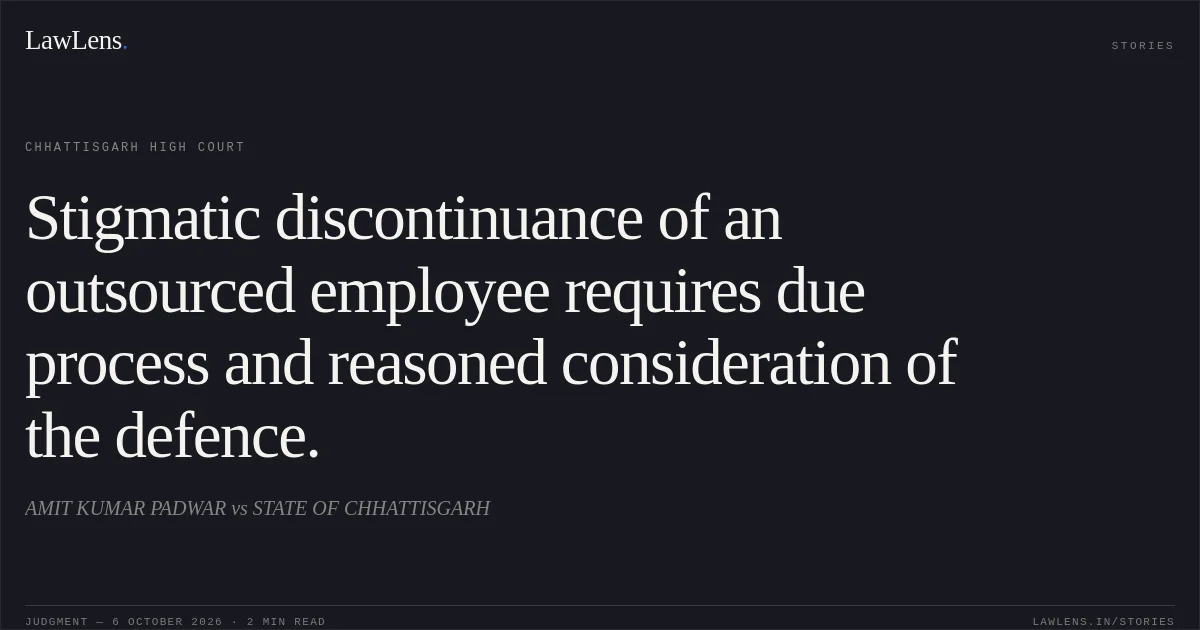
Facts
The petitioner had been deployed by National Informatics Centre Services Incorporated (NICSI) and worked as an Assistant Programmer in the Samagra Shiksha office for nearly 14 years
Source reference: para. 2Following a show-cause notice and the petitioner’s reply, the Collector made a recommendation recording findings concerning alleged financial irregularities.
Source reference: paras. 2–3, 5By order dated 8 September 2026, the petitioner was sent back to NICSI, referring to that recommendation
Source reference: paras. 2–3, 5The petitioner challenged the order, arguing that it was stigmatic, non-speaking, and made without due consideration of his defence. The respondents maintained that he was an outsourced employee and that the action followed consideration of his reply
Source reference: paras. 2–3The Court found that the Collector had not recommended his removal, but the impugned order relied on the recommendation’s findings; it also did not address the petitioner’s explanation
Source reference: paras. 5, 9–10Issues
Whether sending the petitioner back to NICSI, when the order relied on findings concerning alleged irregularities, amounted to a stigmatic action requiring due process and an effective opportunity of hearing
Source reference: paras. 7–9Whether the impugned order was legally unsustainable because it did not disclose consideration of the petitioner’s reply or provide reasons for the decision
Source reference: paras. 10–13Law Applied
A stigmatic termination or discontinuance cannot be imposed even on a contractual or outsourced employee without following the principles of natural justice and affording a due opportunity of hearing; the nature and effect of the action, rather than the employee’s mode of engagement alone, are relevant
Source reference: paras. 6–8The Court relied on Swati Priyadarshini v. State of Madhya Pradesh, 2024 SCC OnLine SC 2139, and Digambar Chandrakar v. State of Chhattisgarh, WPS No. 4969 of 2015, decided 22 August 2024, on procedural fairness in stigmatic orders
Source reference: para. 6It also applied East Coast Railway v. Mahadev Appa Rao, (2010) 7 SCC 678, which requires public authorities’ orders to demonstrate application of mind, ordinarily through reasons, and Assistant Commissioner, Commercial Tax Department v. Shukla and Brothers, (2010) 4 SCC 785, which recognises reason-giving as an essential feature of justice
Source reference: paras. 11–12Reasoning
Although the petitioner was deployed through NICSI, the Court held that the impugned action could not be treated as a mere administrative return to the deploying agency because it referred to findings of alleged financial irregularities, thereby casting stigma on him
Source reference: paras. 7, 9The authority neither recorded an independent finding after considering the petitioner’s defence nor explained why his reply was unacceptable. The absence of reasons and demonstrated application of mind made the order non-speaking and arbitrary, and the process therefore failed the requirements governing stigmatic action
Source reference: paras. 10–13Holding
The Court quashed the order dated 8 September 2026 and held that the petitioner was entitled to consequential benefits flowing from its quashment
The writ petition was allowed to that extent, with liberty reserved to the respondents to pass an appropriate fresh order in accordance with law and after affording the petitioner due opportunity of hearing
Source reference: paras. 15–16Original Court PDF
AMIT KUMAR PADWARvsSTATE OF CHHATTISGARH
Click to open original judgment
Original judgment, available to read, download and summarize on LawLens.in
![HRA parity claims must be assessed against similarly situated employees, with reasoned orders where parity is denied.. Shaphaba Thokchom vs DY. COMPTROLLER AND AUDITOR GENERAL OF INDIA. CAT - ['Guwahati']. LawLens](/stories/thumbnails/hra-parity-claims-must-be-assessed-against-similarly-situated-employees-with-reasoned-orde-a9c45995b0704be18e4bcf7b91c8e507.webp)
![Article 311(2)(c) dismissal is valid where relevant material shows an inquiry would endanger security sources.. Mohd Rafi vs GENERAL ADMINITRATIVE DEPARTMENT. CAT - ['Jammu']. LawLens](/stories/thumbnails/article-311-2-c-dismissal-is-valid-where-relevant-material-shows-an-inquiry-would-endanger-58dabaa9372a4b41bd304e91e9ebe890.webp)