Facts
The petitioners were daily-wage or temporary employees of Municipal Councils, including the petitioner in W.P. No. 12242/2023, who had been appointed as a Computer Operator in 2017 and had served continuously without adverse record until termination.
Source reference: para. 3Show-cause notices were issued alleging misconduct, including fraudulent transfer of ₹2,00,000 to the account of a third party. The petitioners submitted replies, after which their services were terminated by orders such as the order dated 08.06.2022.
Source reference: paras. 2, 3.1–3.4The Municipal Council relied upon an inquiry conducted by an Inquiry Committee. However, the record showed that the petitioners were not called to participate in the inquiry, the inquiry reports were not supplied to them, and they were not given an opportunity to respond to the findings before the termination orders were passed.
Source reference: para. 7In W.P. No. 12237/2023, the petitioner additionally contended that the inquiry report had exonerated him, yet his services were terminated.
Source reference: pp. 18–19 / paras. 19–20In W.P. Nos. 20761/2023 and 20633/2023, although the petitioners had not been terminated, the Municipal Council had forwarded communications dated 16.06.2023 to the police seeking registration of FIRs on the basis of the inquiry reports.
Source reference: pp. 19–20Issues
1. Whether termination of temporary or daily-wage employees on allegations of misconduct, without supplying the inquiry report and providing an effective opportunity of hearing, violates the principles of natural justice?
Source reference: paras. 7–10, 16–182. Whether an order expressly founded on allegations of misconduct is a stigmatic and punitive termination rather than termination simpliciter, thereby requiring a proper disciplinary inquiry even where the employee is temporary or a daily wager?
Source reference: paras. 9–12, 16–173. Whether the existence of disputed facts or the availability of a remedy before the Labour Court justified refusal to entertain the writ petitions challenging the violation of natural justice?
Source reference: para. 184. Whether the communications seeking registration of FIRs, being based on inquiry findings reached in breach of natural justice, were liable to be quashed?
Source reference: pp. 19–20Law Applied
The Court applied the principles of audi alteram partem and fair procedure, holding that an employee must receive precise notice, a meaningful opportunity to participate in the inquiry, access to relevant material and the inquiry report, and an opportunity to respond before adverse action is taken.
Source reference: paras. 8, 13–14Under Article 311(2) and the general principles of administrative law, even a temporary employee or probationer is entitled to protection against punitive action founded on misconduct.
Source reference: no citationRelying on Chandra Prakash Shahi v. State of U.P., (2000) 5 SCC 152, and Radhey Shyam Gupta v. U.P. State Agro Industries Corpn. Ltd., (1999) 2 SCC 21, the Court distinguished between “motive” and “foundation”: an order based on proved or presumed misconduct is punitive and cannot be disguised as termination simpliciter.
Source reference: paras. 10–11The Court further relied on Hari Ram Maurya v. Union of India, (2006) 9 SCC 167, State of U.P. v. Saroj Kumar Sinha, (2010) 2 SCC 772, Canara Bank v. Debasis Das, (2003) 4 SCC 557, and Managing Director, ECIL v. B. Karunakar, (1993) 4 SCC 727, for the requirements of an unbiased inquiry, disclosure of relied-upon material and the inquiry report, and a reasonable opportunity to defend.
Source reference: paras. 12–14It also followed the principles recognised in Jitendra v. State of Madhya Pradesh, 2008 (4) MPLJ 670, Rahul Tripathi v. Rajeev Gandhi Shiksha Mission, 2001 (3) MPLJ 616, and Yatish Pandey v. Commissioner, Indore Municipal Corporation that a stigmatic termination of a temporary or daily-wage employee requires compliance with natural justice.
Source reference: paras. 4.1–4.2, 15–17Reasoning
The Court found that the Municipal Council had conducted an inquiry and recorded adverse findings against the petitioners, but had neither summoned them for participation nor supplied the inquiry reports or afforded an opportunity to answer the findings.
Source reference: para. 7A show-cause notice and reply alone were insufficient because the subsequent inquiry generated findings that materially influenced the termination decisions; the petitioners therefore had to be given the inquiry material and a further opportunity to defend themselves.
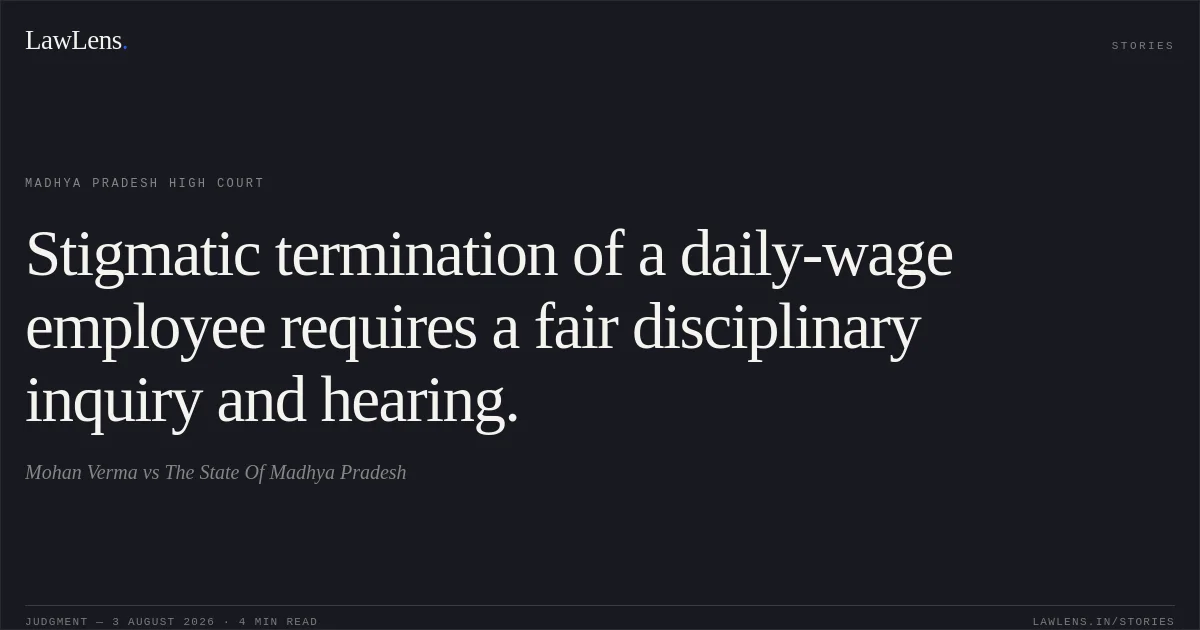
Source reference: paras. 8–9Since the termination orders referred to specific allegations of fraud and misconduct, they carried a stigma and were founded on misconduct rather than being ordinary termination simpliciter.
Source reference: para. 10The petitioners’ status as daily-wage employees did not permit the State or the Municipal Council to impose such punitive consequences without fair procedure, particularly because the stigma could adversely affect future employment.
Source reference: paras. 16–17The Court also held that the challenge concerned a question of procedural fairness capable of determination in writ jurisdiction, and did not require relegation to the Labour Court merely because the petitioners were daily wagers or disputed facts were alleged.
Source reference: para. 18In the cases involving police communications, the FIR requests were likewise founded on inquiry findings reached without natural justice and were therefore unsustainable.
Source reference: pp. 19–20Holding
The Court allowed the connected petitions and quashed the termination orders, including the order dated 08.06.2022, for violation of the principles of natural justice.
The respondents were directed to reinstate the petitioners forthwith with consequential benefits, including arrears of back wages; however, the petitioners were limited to 50% of the back wages.
Source reference: para. 19The Municipal Council was granted liberty to conduct a fresh inquiry and pass fresh orders in accordance with law after providing proper procedural safeguards.
Source reference: para. 20In W.P. No. 12237/2023, the authorities were specifically directed to consider the petitioner’s alleged exoneration before deciding whether any fresh action was warranted.
Source reference: pp. 18–19In W.P. Nos. 20761/2023 and 20633/2023, the communications dated 16.06.2023 seeking registration of FIRs were quashed, with liberty to the Municipal Councils to take appropriate action afresh in accordance with law and natural justice.
Source reference: pp. 19–20Original Court PDF
Mohan VermavsThe State Of Madhya Pradesh
Click to open original judgment
Original judgment, available to read, download and summarize on LawLens.in