Facts
The petitioner was appointed as an Anganwadi Worker on 22-01-2011 and was stationed at Centre Chabra, District Shivpuri
Source reference: para. 2On 20-11-2025, she received a show-cause notice via mobile phone regarding alleged irregularities in food distribution and departmental duties
Source reference: para. 2, 5Despite submitting a reply with evidence, her services were terminated by Respondent No. 3 on 24-11-2025 via an order describing her conduct as negligent and non-compliant
Source reference: para. 2, 5The petitioner’s appeal was subsequently rejected by the appellate authority on 25-06-2026
Source reference: para. 2The petitioner challenged these orders under Article 226, contending they were stigmatic and passed without a regular departmental inquiry
Source reference: para. 2Issues
1. Whether the termination order dated 24-11-2025 is stigmatic in nature and requires a regular departmental inquiry
Source reference: para. 6, 8, 102. Whether the services of an Anganwadi Worker can be terminated without following the principles of natural justice and the specific inquiry procedures mandated by State policy
Source reference: para. 12, 13Law Applied
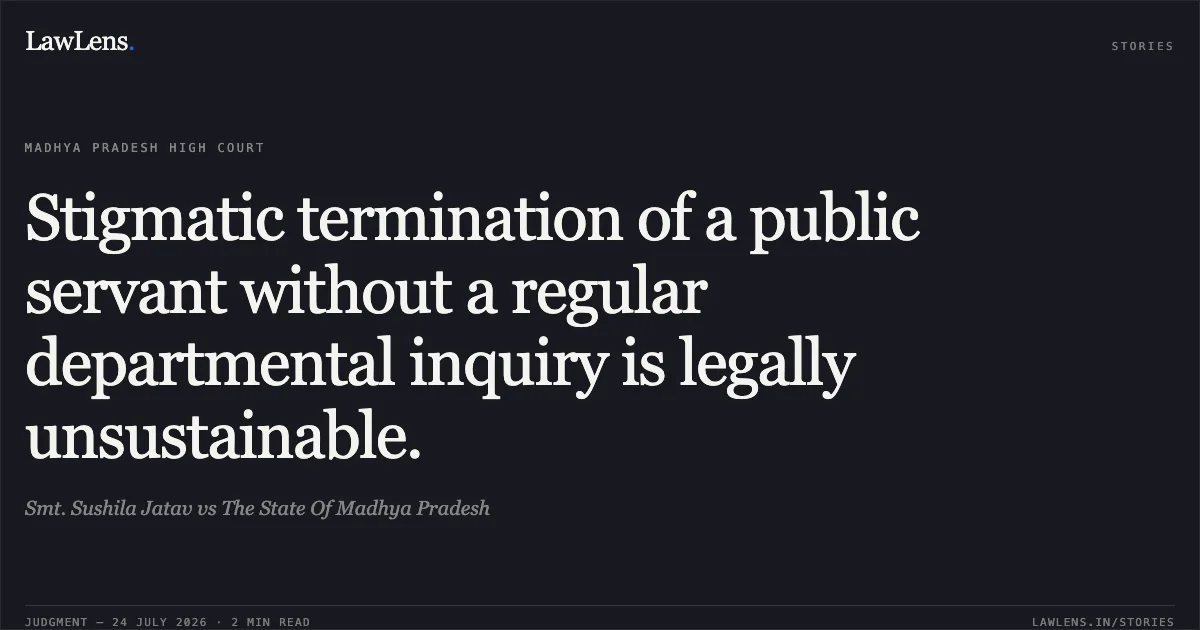
A "stigmatic" termination order, which entails serious consequences for future prospects, cannot be passed without a regular departmental inquiry and a reasonable opportunity to be heard
Source reference: para. 7, 8, 9The Court relied on the Division Bench rulings in Rahul Tripathi v. Rajeev Gandhi Shiksha Mission [2001(3) MPLJ 616] and Malkhan Singh Malviya v. State of M.P. [ILR(2018) MP 660], emphasizing the necessity of an inquiry for orders founded on misconduct
Source reference: para. 7State Government Policy dated 23-05-2025 (Clause G.1.1.1), which expressly mandates a formal inquiry and hearing before the removal of an Anganwadi Worker
Source reference: para. 12The Supreme Court's summary of "reasonable opportunity" in Khem Chand v. Union of India [AIR 1958 SC 300] was invoked to define the standard of a fair defense
Source reference: para. 7Reasoning
The Court observed that the termination order dated 24-11-2025 was not a termination simpliciter but contained specific allegations of dereliction of duty, negligence in distributing nutrition (THR), and failure to conduct "Weight Campaigns," thereby making it stigmatic
Source reference: para. 5, 10The Court found that the respondents failed to conduct a regular departmental inquiry or provide a proper opportunity for hearing as required by both judicial precedents and the State’s own policy of 2025
Source reference: para. 8, 12, 13The Court rejected the Government’s argument that appointment conditions allowed termination without notice, holding that once an order casts a stigma on the character or work of an employee, the principles of natural justice and a formal inquiry become mandatory requirements of law
Source reference: para. 3, 10Holding
The Court allowed the petition, holding that a stigmatic order cannot be sustained without a regular departmental inquiry
The Court quashed the impugned termination order dated 24-11-2025 and the appellate order dated 25-06-2026. The respondents were directed to reinstate the petitioner forthwith with all consequential benefits, except back wages based on the "no work no pay" principle, with liberty granted to the State to proceed against the petitioner afresh in accordance with the law
Source reference: para. 16(i), 16(ii), 16(iii)Original Court PDF
Smt. Sushila JatavvsThe State Of Madhya Pradesh
Click to open original judgment
Original judgment, available to read, download and summarize on LawLens.in