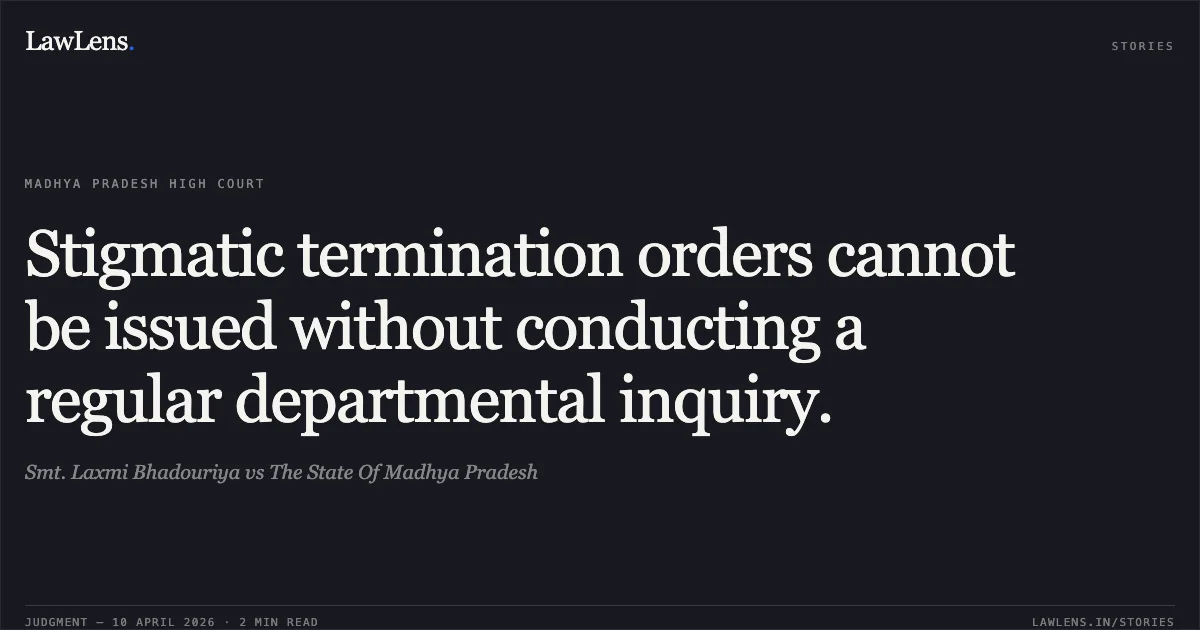
Facts
The Petitioner was appointed as an Aanganwadi Worker on August 31, 1998, and served for approximately 19 years
Source reference: para. 2On June 13, 2017, the Respondent No. 2 issued an order (Annexure P/1) terminating her services based on a supervisor's report alleging she was absent from the Aaganwadi Center and did not reside in the village
Source reference: para. 3The Petitioner challenged the termination, asserting it was a stigmatic and non-speaking order passed without a regular departmental enquiry or a show-cause notice, thereby violating the principles of natural justice
Source reference: para. 2The State contended that the Petitioner had an alternative remedy of revision and that she had failed to reply to previous notices regarding her absence
Source reference: para. 3Issues
1. Whether the termination of a long-term employee via a stigmatic order without conducting a regular departmental enquiry or providing an opportunity for a hearing is legally sustainable
Source reference: para. 7, 8, 112. Whether the respondents complied with the mandatory procedural requirements stipulated in the State Government policy dated July 10, 2007, regarding the removal of Aanganwadi Workers
Source reference: para. 5, 6Law Applied
The court primarily applied the State Government Policy dated July 10, 2007, which mandates a specific procedure for the removal of Aanganwadi Workers, including the compulsory provision of an opportunity for a hearing (sunwai ka avsar)
Source reference: para. 5It relied on the Division Bench rulings in Rahul Tripathi v. Rajeev Gandhi Shiksha Mission and Malkhan Singh Malviya v. State of M.P., which establish that stigmatic termination orders require a full inquiry due to their impact on future prospects.
Source reference: para. 9Furthermore, the court cited Khem Chand v. The Union of India, defining "reasonable opportunity" as the right to deny guilt, defend via cross-examination, and represent against proposed punishments
Source reference: para. 9Regarding alternative remedies, it applied Whirlpool Corporation v. Registrar Trade Mark, holding that a petition under Article 226 is maintainable despite alternative remedies if natural justice is violated
Source reference: para. 16Reasoning
The court observed that the termination order was explicitly "stigmatic" as it characterized the Petitioner’s alleged absence as a "serious nature" of misconduct
Source reference: para. 10, 11Under the mandatory Policy of 2007, the respondents were required to conduct an inquiry and provide a hearing before removal; however, the record revealed that no show-cause notice was issued and no inquiry was held
Source reference: para. 6, 7The court reasoned that because the order carried a stigma, it entailed serious consequences for the Petitioner’s future employment prospects, necessitating a regular departmental enquiry as per settled law
Source reference: para. 9, 12, 13The court dismissed the State’s argument regarding alternative remedies, noting that the total disregard for the principles of natural justice and the prescribed statutory procedure rendered the impugned order void
Source reference: para. 16, 17Holding
The court allowed the writ petition and quashed the impugned termination order dated June 13, 2017
It directed the respondents to reinstate the Petitioner with all consequential benefits, excluding backwages on the principle of "no work no pay"
Source reference: para. 18The court granted the respondents liberty to initiate fresh proceedings against the Petitioner in accordance with the law if deemed necessary
Source reference: para. 18Original Court PDF
Smt. Laxmi BhadouriyavsThe State Of Madhya Pradesh
Click to open original judgment
Original judgment, available to read, download and summarize on LawLens.in


![Subsequent exoneration does not retrospectively invalidate a finalized promotion select list.. UNNIKRISHNAN M vs M/o Environment And Forests. CAT - ['Ernakulam']. LawLens](/stories/thumbnails/subsequent-exoneration-does-not-retrospectively-invalidate-a-finalized-promotion-select-li-ce80a0e84f2f4887857271e8b4341c42.webp)