Facts
The appeals challenged proceedings initiated against the appellants under the Uttar Pradesh Gangsters and Anti-Social Activities (Prevention) Act, 1986 (“U.P. Act”) and the Uttar Pradesh Gangsters and Anti-Social Activities (Prevention) Rules, 2021 (“U.P. Rules”).
Source reference: paras. 2–3In the first appeal, Shiv Pratap Singh, an advocate involved in disputes concerning elections of the Fatehgarh Bar Association, was named as an accused in FIR No. 41 of 2024 under the U.P. Act on the basis of a gang chart alleging that he and two others constituted a criminal gang.
Source reference: paras. 4–9After a chargesheet was filed under Section 2 of the U.P. Act, his application under Section 482 CrPC was rejected by the High Court.
Source reference: para. 9In the second appeal, Himanshu Srivastava and his family members were proceeded against under Sections 2/3 of the U.P. Act on the basis of prior criminal cases and a gang chart alleging that his father was the gang leader and that the appellant and his brother were gang members.
Source reference: paras. 13–16The Supreme Court clarified that it was not examining the merits of the predicate offences registered under the IPC or other penal statutes, but only the validity of the proceedings under the U.P. Act.
Source reference: para. 17Issues
1. Whether the U.P. Act creates a distinct criminal offence punishable under Section 3, or merely defines the status of a person as a “gangster” by reference to offences punishable under other penal laws?
Source reference: paras. 17, 26, 29, 37–392. Whether the U.P. Rules, particularly the procedure relating to preparation and approval of a gang chart, can create criminal liability and determine a person’s status as a gangster in the absence of an offence created by the parent statute?
Source reference: paras. 23–26, 52–543. Whether proceedings under the U.P. Act based merely on a gang chart could validly result in arrest, extended pre-trial incarceration and punishment, independently of adjudication under the applicable predicate penal laws?
Source reference: paras. 38–39, 54–57Law Applied
The Court applied the principle of nullum crimen, nulla poena sine lege—no crime or punishment without a penal law—which is reflected in Article 20(1) of the Constitution and the definition of “offence” in the General Clauses Act as an act or omission made punishable by law.
Source reference: paras. 29, 36–38, 44, 51–52Sections 2(b) and 2(c) of the U.P. Act define “gang” and “gangster”, while Section 3 prescribes punishment for a gangster, but the Act does not expressly create a distinct offence consisting of gang membership or gang-related conduct.
Source reference: paras. 18–21, 37–39Section 23 authorises rule-making only to carry out the purposes of the Act and cannot be used to create a substantive offence or enlarge penal liability.
Source reference: paras. 22–24, 52–54The Court relied on S.A. Venkataraman v. Union of India, which held that prosecution and punishment must relate to an offence created by law; Rao Shiv Bahadur Singh v. State of Vindhya Pradesh, Soni Devrajbhai Babubhai v. State of Gujarat, Mahipal Singh v. CBI, Union of India v. Ganpati Dealcom Pvt. Ltd., and CBI v. R.R. Kishore, which reaffirmed the constitutional prohibition against retrospective or unsupported criminal liability.
Source reference: paras. 33–38, 45–50The Court distinguished statutes such as the Maharashtra Control of Organised Crime Act and the Gujarat Control of Terrorism and Organised Crime Act because those enactments expressly create offences such as organised crime, abetment and conspiracy.
Source reference: paras. 41–43Reasoning
The Court held that Section 2(b) of the U.P. Act is only a definition provision. It identifies various anti-social activities by referring to offences under the IPC and other penal statutes, but does not itself make those activities, or the status of being a gang member, a separate offence under the U.P. Act.
Source reference: paras. 26, 37–38Section 3 merely prescribes punishment for a “gangster”; it does not supply the missing ingredients of an offence or establish an independent actus reus.
Source reference: paras. 19, 37–39Consequently, prosecution under the U.P. Act would amount to imposing an additional punishment for conduct already punishable under other laws, while treating the accused’s alleged status as a gangster as the basis of criminal liability.
Source reference: para. 39The gang-chart mechanism under the U.P. Rules did not cure this defect. The Rules enabled police and executive authorities to identify and classify persons as gangsters through a process of preparation, recommendation and administrative approval, although the parent Act contained no substantive offence corresponding to that determination.
Source reference: paras. 23–24, 52–54In the Court’s view, subordinate legislation cannot perform the essentially legislative function of creating a crime or attaching penal consequences to conduct.
Source reference: para. 54This arrangement also permitted arrest, extended detention and trial on the basis of the gang chart, with the risk that punishment under the U.P. Act could follow even if the accused were acquitted in the predicate case.
Source reference: paras. 38–39, 56–57The resulting process was therefore incompatible with Article 20(1) and the basic requirement that conviction must follow only from a legally created offence supported by evidence.
Source reference: paras. 28–29, 51–57The Court expressly stated that it was not deciding the constitutional validity of the U.P. Act in the broader sense, nor was it affecting prosecutions for the underlying offences under the IPC or other penal enactments.
Source reference: paras. 40–41, 58–59Holding
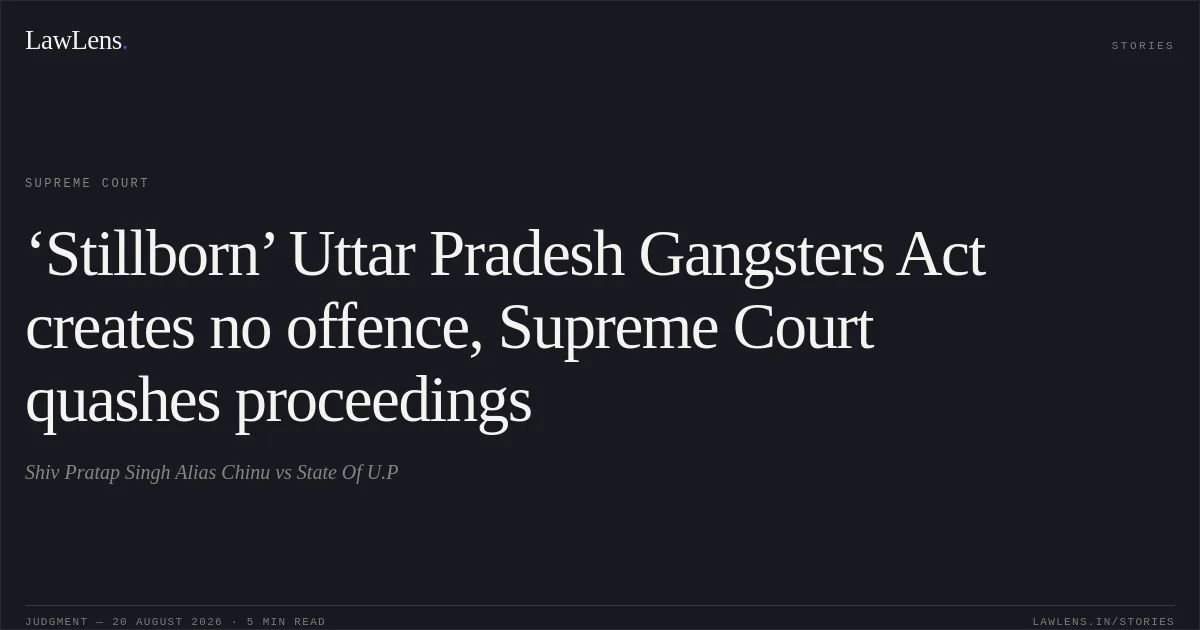
The Supreme Court held that the U.P. Act, as presently structured, does not create a distinct offence punishable under Section 3.
It merely defines the status of a person as a “gangster”, while the U.P. Rules impermissibly attempt to operationalise that status through the gang-chart procedure and thereby expose individuals to penal consequences.
Source reference: paras. 52–54The proceedings under the U.P. Act were therefore held to be “stillborn” and incapable of surviving.
Source reference: para. 58Both appeals were allowed; the impugned chargesheet and proceedings arising from FIR No. 41 of 2024 in the first appeal and Sessions Case No. 73 of 2024 arising from FIR No. 740 of 2022 in the second appeal were quashed and set aside.
Source reference: para. 58The appellants were directed to be released forthwith if not required in any other case, and any existing bail bonds were cancelled.
Source reference: para. 58The Court clarified that proceedings under the other applicable penal laws would continue unaffected.
Source reference: para. 59Original Court PDF
Shiv Pratap Singh Alias ChinuvsState Of U.P
Click to open original judgment
Original judgment, available to read, download and summarize on LawLens.in