Facts
The Petitioner, a street vendor holding a Certificate of Vending (CoV) for "Food/Snacks," filed a petition under Article 226 of the Constitution seeking a direction to allow him to vend at a designated site near Spark Mall, Kamla Nagar.
Source reference: p. 1-2Although his CoV was for food items, the Petitioner conceded he was actually selling clothes.
Source reference: para. 4The Municipal Corporation of Delhi (MCD) opposed the petition, stating that Kamla Nagar is a designated "No-Vending Zone" and "No-Squatting Zone," citing a previous prohibitory order from a Single Judge in Jawahar Nagar Block Welfare Association v. UT of Delhi.
Source reference: para. 5Issues
1. Whether a street vendor can be permitted to carry out vending activities in an area designated as a ‘No-Vending’ or ‘No-Squatting’ Zone.
Source reference: para. 62. Whether the Petitioner is entitled to an alternative vending site and protection from harassment pending a decision by the Town Vending Committee (TVC).
Source reference: para. 8, 11Law Applied
The Street Vendors (Protection of Livelihood and Regulation of Street Vending) Act, 2014, specifically Section 21 regarding the authority of the Town Vending Committee to frame vending plans.
Source reference: para. 9Delhi Street Vendors (Protection of Livelihood and Regulation of Street Vending) Scheme, 2019, which mandates strict adherence to the terms and conditions of the CoV, including prohibitions on blocking footpaths and vending in unauthorized zones.
Source reference: para. 6The precedent set in Anil Kumar v. MCD (W.P. (C) 7593/2026), which balanced the enforcement of "No-Vending Zones" with the right to livelihood.
Source reference: para. 7-8Reasoning
The Court observed that while the Petitioner holds a valid CoV, the terms and conditions of such certificates must be strictly followed. Since Kamla Nagar was established as a "No-Vending Zone" by previous judicial orders, the Petitioner could not claim a right to remain at that specific spot.
Source reference: para. 6Following the reasoning in the Anil Kumar case, the Court determined that the MCD must balance urban regulation with the street vendor's rights by relocating the vendor to an authorized spot rather than merely prohibiting his activity.
Source reference: para. 8The Court noted that since the Petitioner was being assigned a specific spot, he would be exempted from the "mobile vendor" requirement of moving every 30 minutes, provided he maintained hygiene and did not obstruct pedestrians.
Source reference: para. 8Holding
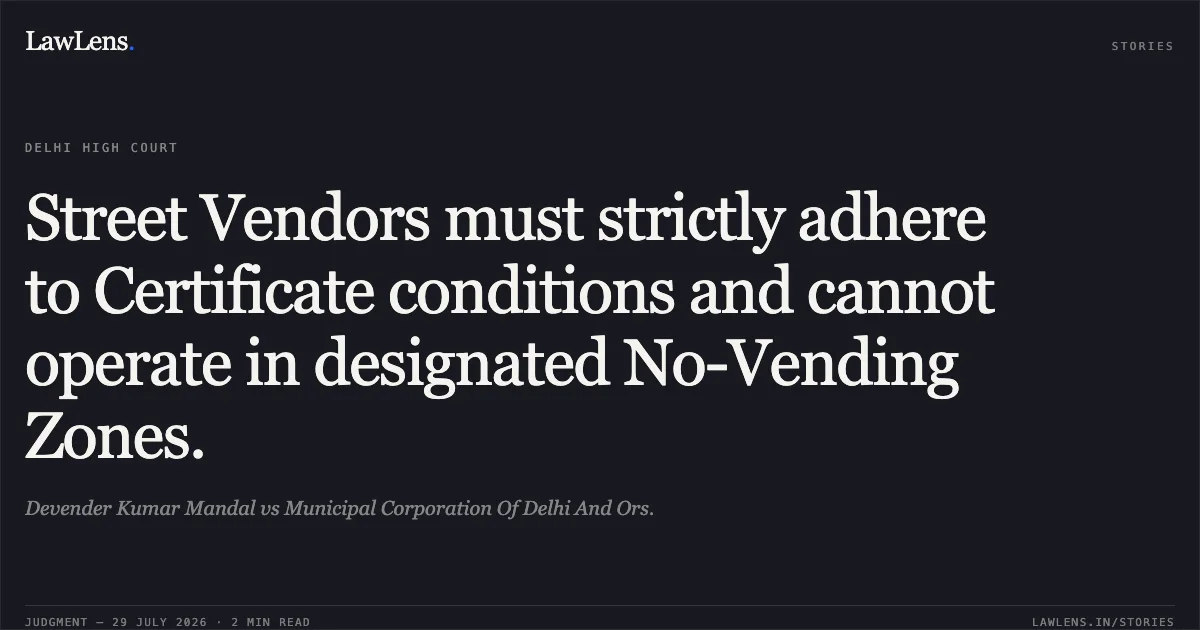
The Court held that while the Petitioner cannot vend in a "No-Vending Zone," he shall not be disturbed from carrying out activities at the newly identified site, subject to maintaining cleanliness and not erecting permanent structures.
The Court disposed of the petition by directing the Assistant Commissioner of the MCD to identify and communicate an alternative vending spot for the Petitioner within one week and directed that the Petitioner’s representation dated July 16, 2026, be decided by the Town Vending Committee–II within three months of its constitution.
Source reference: para. 8(i), 11Acts & Sections Cited
1 provisions across 1 statute referred to in this judgment. Each provision opens on LawLens.
Street Vendors (Protection of Livelihood and Regulation of Street Vending) Act, 20141
Original Court PDF
Devender Kumar MandalvsMunicipal Corporation Of Delhi And Ors.
Click to open original judgment
Original judgment, available to read, download and summarize on LawLens.in


