Facts
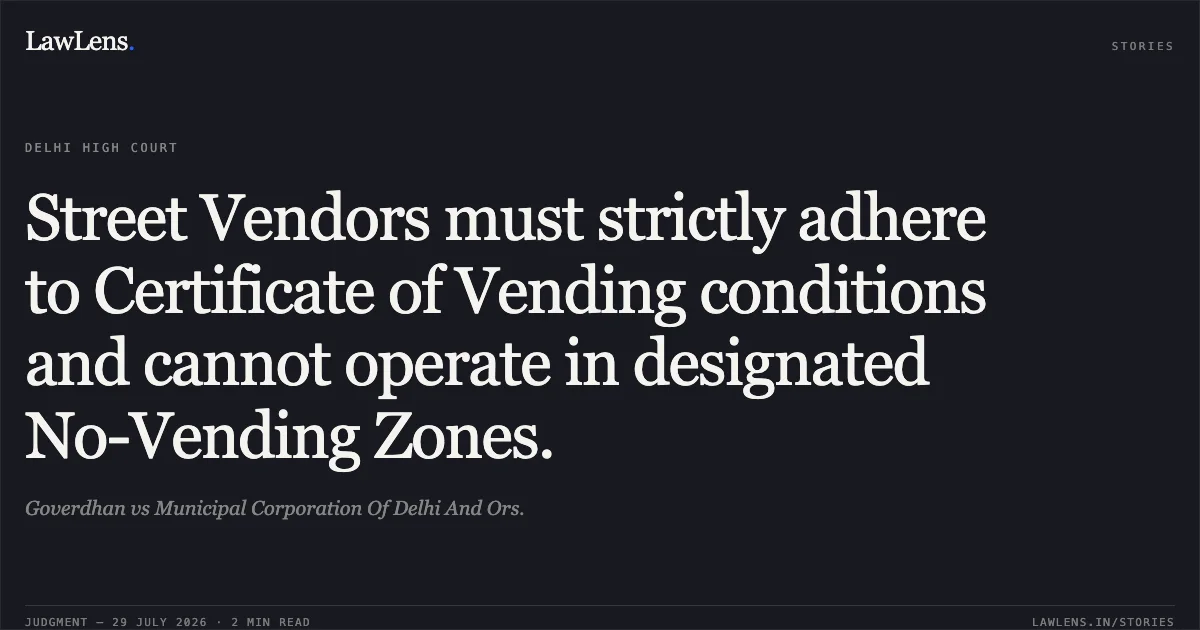
The Petitioner, a street vendor holding a provisional Certificate of Vending (CoV) No. URI:5565112 under the ‘others’ category, sought protection from alleged harassment by authorities while vending at Jawahar Nagar, Kamla Nagar, Delhi.
Source reference: p. 1-2The Municipal Corporation of Delhi (MCD) contended that the area in question is a designated ‘No-Vending Zone’ and cited a prior High Court order in Jawahar Nagar Block Welfare Association (Regd.) v. Union Territory of Delhi & Ors., which directed police to prevent unauthorized squatting in that specific 500-meter stretch.
Source reference: p. 3The Petitioner had submitted a representation to the MCD on July 21st, 2026, which remained unaddressed.
Source reference: p. 2Issues
1. Whether a street vendor holding a provisional CoV can be permitted to carry out vending activities in a designated ‘No-Squatting’ or ‘No-Vending’ zone.
Source reference: p. 32. Whether the Petitioner, as a mobile vendor, must strictly adhere to the specific terms and conditions of the CoV and statutory schemes.
Source reference: p. 4-5Law Applied
The Court applied the Street Vendors (Protection of Livelihood and Regulation of Street Vending) Act, 2014, specifically Section 21 regarding the authority of the Town Vending Committee (TVC) to frame vending plans.
Source reference: p. 6The Court relied on the Delhi Street Vendors (Protection of Livelihood and Regulation of Street Vending) Scheme, 2019, which mandates that vendors follow designated zones and periods.
Source reference: p. 5The Court reiterated the established legal principle that no vending or hawking is permissible in ‘No-Squatting Zones’ or ‘Non-Vending Areas’.
Source reference: p. 3Reasoning
The Court observed that while the Petitioner holds a valid CoV, it is categorized for ‘mobile vending,’ which prohibits staying in one spot for more than 30 minutes or blocking pedestrian movement.
Source reference: p. 4-5The Court noted that the Petitioner was operating in a ‘No-Vending Zone’ near Kamla Nagar, which contradicts the mandatory conditions of the CoV.
Source reference: p. 3To balance the Petitioner's right to livelihood with public order, the Court reasoned that the MCD must identify a permissible area for the Petitioner to operate as a mobile vendor.
Source reference: p. 5The Court emphasized that the Petitioner cannot claim any vested rights that override the future plans of the TVC or existing judicial directions regarding the ‘No-Squatting Zone’.
Source reference: p. 3, 6Holding
The Court disposed of the petition by directing the Assistant Commissioner, MCD, to identify a permissible area for the Petitioner’s activities.
The Petitioner is allowed to continue vending subject to strict conditions: he must remain a mobile vendor, must not encroach on pedestrian paths, must maintain hygiene, cannot sub-let the CoV, and cannot raise permanent structures. These directions are subject to the final vending plan of the Town Vending Committee-II under Section 21 of the Act.
Source reference: p. 5, 6Acts & Sections Cited
1 provisions across 1 statute referred to in this judgment. Each provision opens on LawLens.
Street Vendors (Protection of Livelihood and Regulation of Street Vending) Act, 20141
Original Court PDF
GoverdhanvsMunicipal Corporation Of Delhi And Ors.
Click to open original judgment
Original judgment, available to read, download and summarize on LawLens.in