Facts
The petitioners, including a Senior Advocate, challenged the constitutional validity of Section 4 of the Code of Civil Procedure (Karnataka Amendment) Act, 2024 (Act No. 40 of 2025)
Source reference: p. 6This amendment introduced a third proviso to Order V Rule 1 and amendments to Order VIII Rules 1 and 10, prescribing a rigid 120-day outer limit for filing written statements
Source reference: p. 11Under this regime, failure to file within 120 days resulted in the mandatory forfeiture of the right to defend, with a prohibition on courts taking such statements on record
Source reference: p. 12The petitioners argued this nullified the inherent powers of the court and the law declared by the Supreme Court in Salem Advocate Bar Association
Source reference: p. 14Issues
1. Whether Section 4 of the Amendment Act is an attempt to override the law declared by the Supreme Court in Salem Advocate Bar Association regarding judicial discretion to extend timelines?
Source reference: p. 20, para. 23(i)2. Whether the State Legislature can impose an absolute embargo upon the inherent powers of the Civil Court preserved under Section 151 and Order VIII Rule 10?
Source reference: p. 21, para. 23(iii)3. Whether Section 158A of the Amendment Act impermissibly trenches upon the Rule-making powers of the High Court?
Source reference: p. 22, para. 23(vii)4. Whether the amendment deserves to be "read down" to preserve its constitutionality?
Source reference: p. 22, para. 23(viii)Law Applied
The Court applied Article 141 of the Constitution, which makes the law declared by the Supreme Court binding on all courts
Source reference: p. 6It relied on Salem Advocate Bar Association v. Union of India, which held that procedural timelines for written statements are directory, not mandatory, to prevent a miscarriage of justice
Source reference: p. 9-10The Court invoked the principle from Sangram Singh v. Election Tribunal, stating procedural law is a "handmaid of justice," not its mistress
Source reference: p. 25-33It also applied the Doctrine of Reading Down to save legislation from unconstitutionality by assigning a construction consistent with fundamental rights and existing statutory frameworks like Section 151 (inherent powers) and Sections 122-127 (Rule-making power of High Courts) of the CPC
Source reference: p. 75-80Reasoning
The Court reasoned that while the State has the competence to amend the CPC under Entry 13 of the Concurrent List, it cannot legislatively nullify the "basis" of a Supreme Court judgment—which in Salem Bar was the preservation of judicial discretion to ensure fair trials
Source reference: p. 50, 52-53The Court found that a literal reading of the 120-day forfeiture clause would be "manifestly arbitrary" under Article 14, as it treats dilatory litigants the same as those facing genuine impossibilities (e.g., rural litigants unable to secure revenue records)
Source reference: p. 68-70, 107Significantly, the Court noted the Legislature failed to amend the substantive portion of Order VIII Rule 10, which still allows the Court to "make such order as it thinks fit," creating an internal inconsistency
Source reference: p. 55-56, 92By reading the forfeiture clause as "directory" in exceptional cases, the Court harmonized the amendment with Section 151 and the binding precedents of the Apex Court
Source reference: p. 119-120Holding
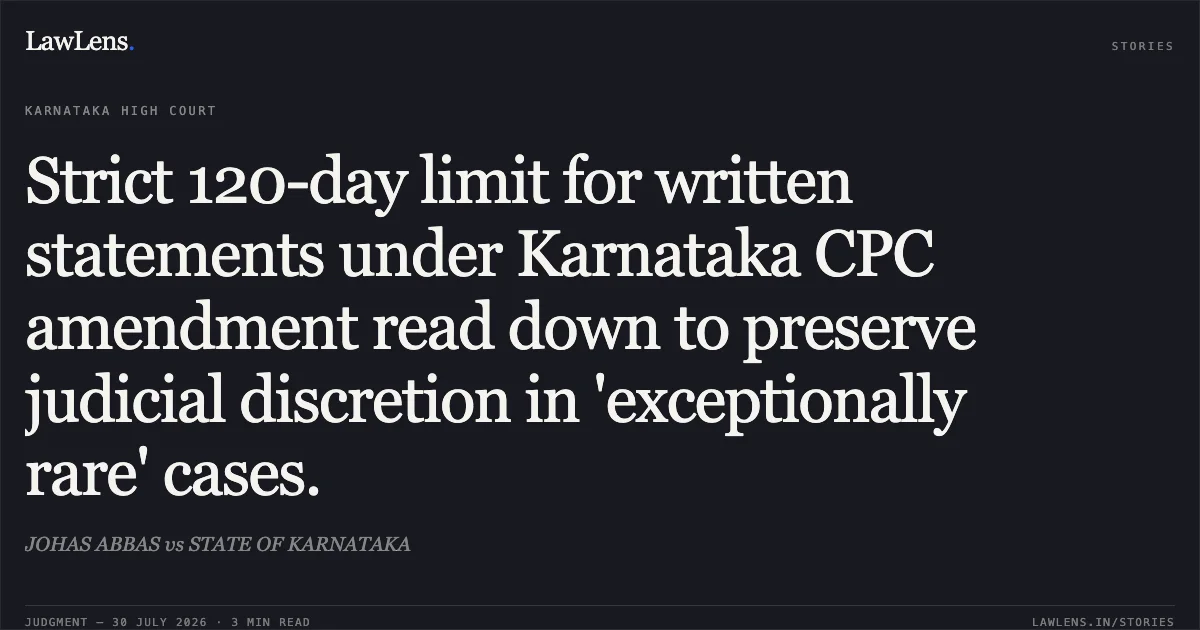
The Court allowed the petitions in part, upholding the 120-day limit as the "ordinary rule" but Reading Down the forfeiture clauses
It held that the expressions "shall forfeit the right" and "shall not allow... on record" are directory, preserving a narrow, exceptional judicial discretion to receive written statements beyond 120 days in "exceptionally rare and deserving cases" where grave injustice would otherwise result
Source reference: p. 139-140The Court further held that Section 158-A cannot override the High Court's rule-making powers under Sections 122-127. It clarified the Amendment Act is prospective and does not apply to suits instituted before its commencement
Source reference: p. 146, 148, 149Original Court PDF
JOHAS ABBASvsSTATE OF KARNATAKA
Click to open original judgment
Original judgment, available to read, download and summarize on LawLens.in