Facts
The Appellant challenged an order dated 08.05.2025 passed by the Appellate Tribunal under SAFEMA, which directed the partial release of documents and digital devices seized under the Prevention of Money Laundering Act, 2002 (PMLA).
Source reference: p. 1-2Specifically, the Tribunal ordered the return of items not included in the prosecution complaint within one month, while allowing the Enforcement Directorate (ED) to retain items forming part of the complaint.
Source reference: p. 3-4The Appellant filed the present appeal with a 225-day delay in re-filing, citing the need to transcribe illegible documents and difficulties in obtaining records as he was not a named accused in the ECIR.
Source reference: p. 2Issues
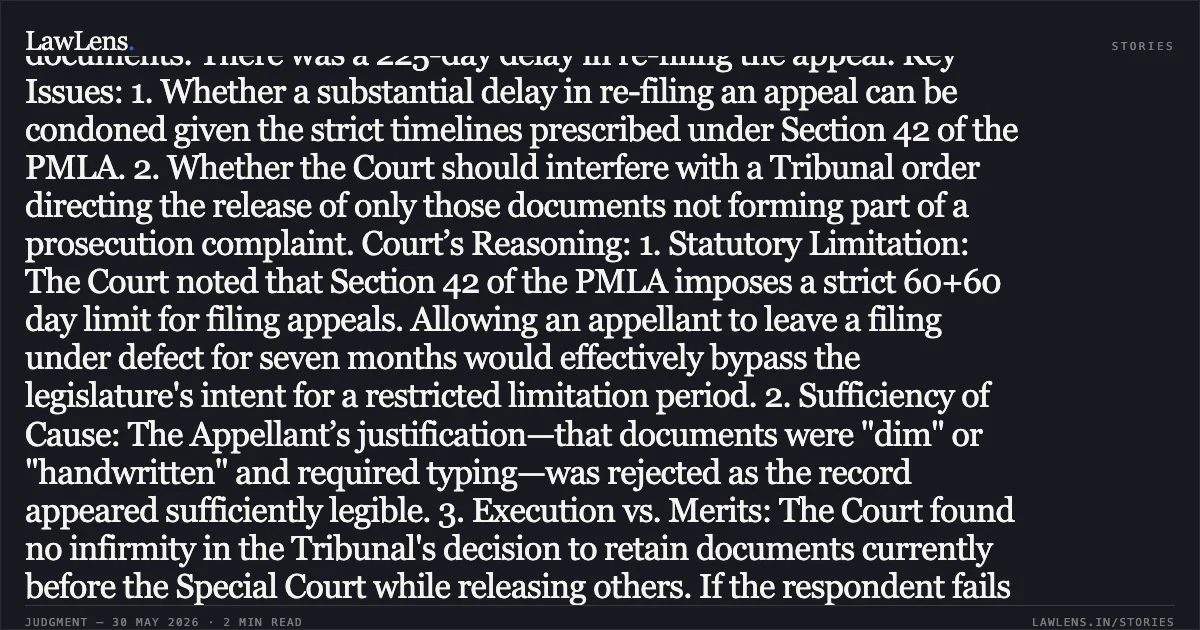
1. Whether the delay of 225 days in re-filing the appeal can be condoned given the statutory limitations under Section 42 of the PMLA.
Source reference: p. 2-32. Whether the directions passed by the Appellate Tribunal regarding the retention and release of seized documents/devices were legally infirm.
Source reference: p. 3-4Law Applied
Section 42 of the PMLA, which mandates that an appeal to the High Court must be filed within 60 days, with a discretionary power to condone delay for a further period not exceeding 60 days if sufficient cause is shown.
Source reference: p. 3Section 35(3) of the PMLA regarding the enforcement of orders passed by the Tribunal.
Source reference: p. 4Historically, while courts are liberal regarding re-filing delays, such discretion is tempered by the strict timelines of special statutes like the PMLA to prevent bypassing legislative intent.
Source reference: p. 3Reasoning
The Court rejected the Appellant’s justification for the 225-day re-filing delay, noting that the annexed documents were largely legible photocopies and did not warrant a seven-month delay for "typing fair copies".
Source reference: p. 2The Court observed that Section 42 of the PMLA imposes a strict 120-day limit (60+60) for filing; allowing a 225-day delay in re-filing would effectively bypass this statutory restriction.
Source reference: p. 3On merits, the Court found no infirmity in the Tribunal’s order, noting that items forming part of a prosecution complaint must remain in the custody of the Special Court.
Source reference: p. 4The Appellant’s grievance—the non-compliance of the ED with the Tribunal's order—should be addressed via enforcement proceedings under Section 35(3) of the PMLA rather than a fresh appeal.
Source reference: p. 4Holding
The High Court dismissed the appeal and pending applications on grounds of both excessive delay in re-filing and lack of merit.
The Court held that the Tribunal’s directions were balanced and the Appellant should seek enforcement of the existing order via Section 35(3) of the PMLA.
Source reference: p. 4Liberty was granted to the Appellant to pursue appropriate legal remedies for the execution of the Tribunal's directions.
Source reference: p. 5Acts & Sections Cited
2 provisions across 1 statute referred to in this judgment. Each provision opens on LawLens.
Prevention of Money-Laundering Act, 20022
Original Court PDF
Bhuraji Mulaji PrajapativsThe Deputy Director, Directorate Of Enforcement, Delhi & Anr.
Click to open original judgment
Original judgment, available to read, download and summarize on LawLens.in