Facts
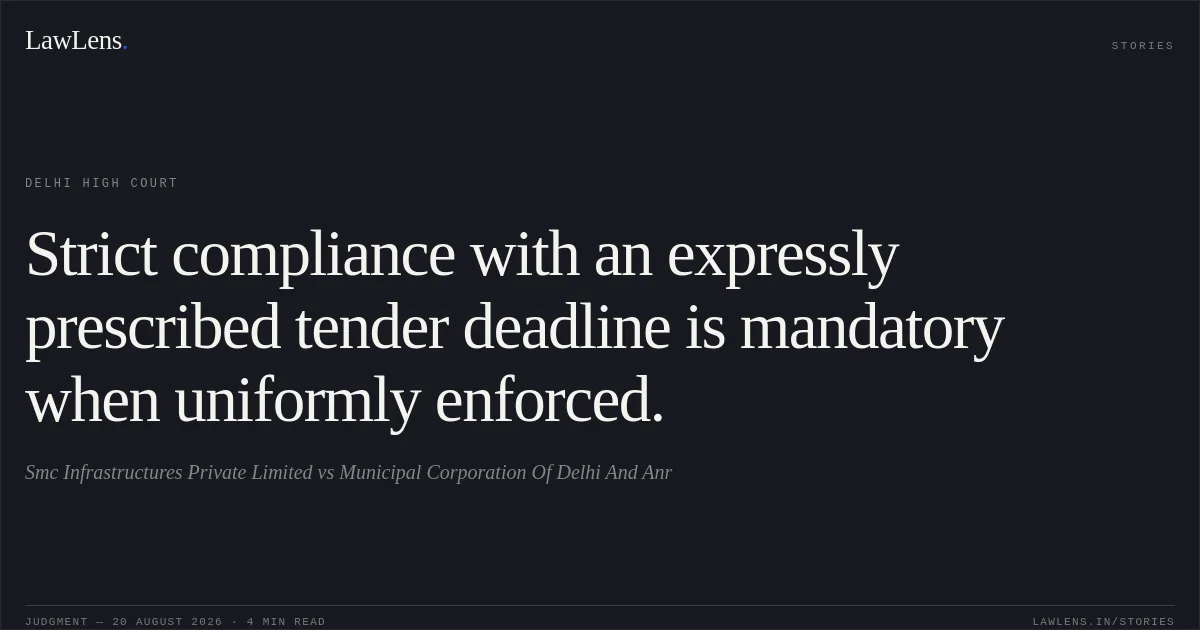
The Municipal Corporation of Delhi floated an NIT on 24 July 2026 for replacement and 10-year operation and maintenance of public lights across six zones.
Source reference: [p.2, para.3]The tender required an EMD of ₹13,87,50,520, subsequently revised to ₹13,77,50,520, comprising ₹20 lakh payable online and the balance through a bank guarantee to be deposited physically in the designated tender box by 1500 hours on 7 August 2026.
Source reference: [pp.2–3, paras.3–4]The petitioner claimed that it uploaded its technical and financial bids, paid the online EMD, uploaded a scanned copy of the bank guarantee, and completed SFMS verification before the deadline.
Source reference: [p.2, para.5]However, its representative allegedly reached the respondent’s office at approximately 1630 hours on 7 August 2026 due to heavy rainfall, waterlogging and traffic disruption, by which time the tender box had been opened.
Source reference: [pp.3–4, para.9; p.8, para.15]The petitioner made representations on 8 and 10 August 2026 seeking acceptance of the original bank guarantee and consideration of its bid.
Source reference: [p.3, paras.6–7]The respondents excluded the petitioner for failure to submit the physical bank guarantee within the prescribed time.
Source reference: no citationIssues
Whether the petitioner was rightly excluded from the tender process for failing to deposit the physical bank guarantee towards the EMD by 1500 hours on 7 August 2026.
Source reference: [p.6, para.15]Whether uploading a scanned copy of the bank guarantee and completing online/SFMS compliance before the deadline rendered physical submission of the original bank guarantee a non-essential or curable condition.
Source reference: [p.9, para.18]Whether the respondents could condone the petitioner’s delay in physical submission notwithstanding the express tender condition and the respondents’ consistent treatment of other bidders.
Source reference: [pp.9–10, paras.18–19; p.18, paras.23–24]Law Applied
The Court applied the principle that tender conditions must ordinarily be adhered to strictly, particularly where the tendering authority treats the condition as essential.
Source reference: [pp.14–17, paras.46–48, 50–53]Under Central Coalfields Limited v. SLL-SML (Joint Venture Consortium), (2016) 8 SCC 622, courts must defer to the employer’s determination regarding the essentiality of a tender condition, subject to limited judicial review where the decision is irrational, mala fide, discriminatory or one that no reasonable authority could have reached.
Source reference: [pp.14–17, paras.46–48, 50–53]The principle that where a power is prescribed to be exercised in a particular manner, it must be exercised in that manner, was applied to tender documents and bank guarantees.
Source reference: [pp.16–17, paras.52–53]Poddar Steel Corporation v. Ganesh Engineering Works, (1991) 3 SCC 273, recognises a distinction between essential eligibility conditions, which require strict compliance, and ancillary conditions, which may in appropriate cases be relaxed.
Source reference: [pp.11–12, para.20]Roadways Solutions India Infra Ltd. v. Union of India, W.P.(C) 8524/2026, decided on 3 July 2026, where insistence on a duplicative document was held unduly technical because the required information was already authentically available in another submitted document.
Source reference: [pp.12–14, para.21]Reasoning
The Court held that the NIT expressly required the original physical bank guarantee to be deposited in the tender box by 1500 hours on 7 August 2026, and the petitioner admittedly failed to comply with that condition.
Source reference: [p.9, para.18]The online upload of a scanned copy, payment of the online EMD and SFMS verification did not displace the separate contractual requirement of physical submission.
Source reference: [p.9, para.18]The Court found the petitioner’s explanation insufficiently substantiated: its representative reached only at 1630 hours, did not identify the officer allegedly met at the respondent’s office, and the petitioner’s Maharashtra office did not immediately contact the respondents to seek acceptance of the guarantee.
Source reference: [pp.8–9, paras.16–17]The Court also noted that the petitioner had received the guarantee in Delhi at 1105 hours but waited until approximately 1445 hours to collect it, leaving little time for submission.
Source reference: [p.10, para.18]Unlike Roadways Solutions, the physical document was not merely duplicative; it was expressly required by the NIT as part of the EMD submission.
Source reference: [pp.12–14, para.21; p.10, para.18]Further, the respondents stated that other bidders had also been excluded on the same or related grounds and that no relaxation had been granted to any bidder, negating allegations of selective or discriminatory treatment.
Source reference: [pp.5–6, para.14; p.18, para.24]Applying Central Coalfields, the Court declined to substitute its view for that of the tendering authority.
Source reference: no citationHolding
The Court answered the issues against the petitioner.
Failure to deposit the original physical bank guarantee by the stipulated deadline constituted non-compliance with an express and enforceable tender condition, notwithstanding prior online uploading and SFMS verification.
Source reference: [pp.17–18, paras.23–25]The respondents’ exclusion of the petitioner was neither arbitrary nor discriminatory, particularly as the same standard was applied to other bidders and no relaxation had been granted.
Source reference: [p.18, paras.24–25]The writ petition was dismissed, along with the pending application, and no direction was issued to accept or evaluate the petitioner’s bid.
Source reference: [p.18, para.25]Original Court PDF
Smc Infrastructures Private LimitedvsMunicipal Corporation Of Delhi And Anr
Click to open original judgment
Original judgment, available to read, download and summarize on LawLens.in