Facts
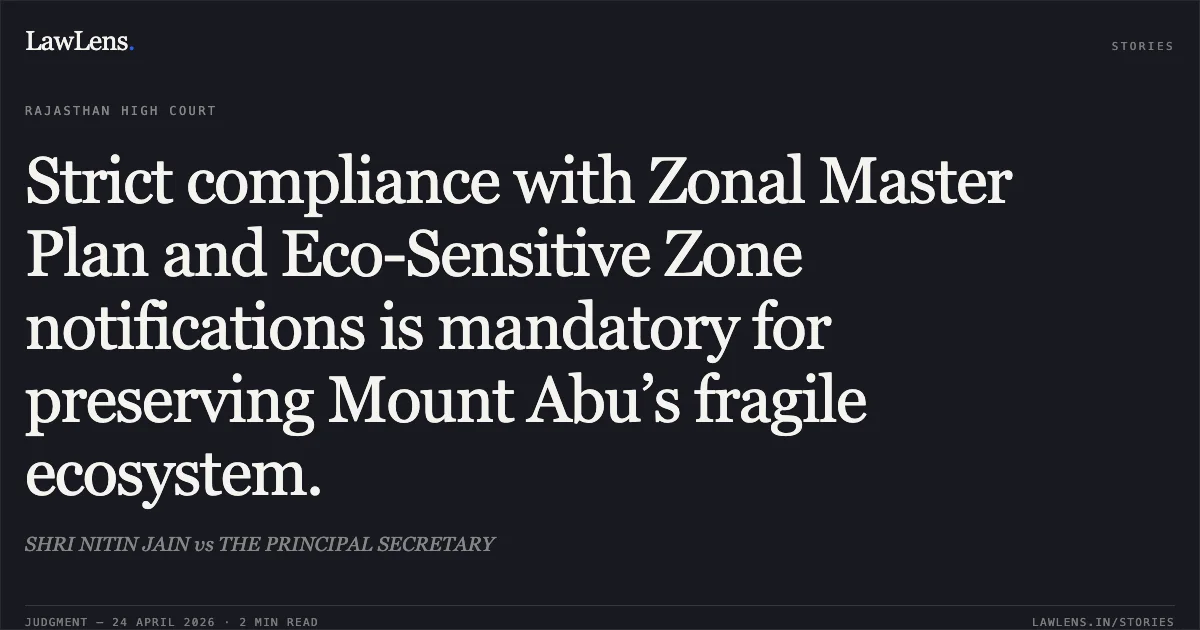
The petitioners filed a Public Interest Litigation (PIL) alleging that Respondent Nos. 11 and 12 (Brahma Kumaris Sansthan) engaged in illegal construction, excavation, and encroachment on reserved forest land and revenue land within the Eco-Sensitive Zone (ESZ) of Mount Abu.
Source reference: para. 1Specifically, petitioners claimed violations on Khasra Nos. 412, 416, and 419 (forest land) and various other Khasra numbers across Village Danvav and Umarni.
Source reference: para. 2The Forest Department countered that while minor encroachments previously existed on forest land, the structures had been sealed or demolished and the land surrendered.
Source reference: para. 5The Revenue Department clarified that constructions on revenue land were permitted prior to the 2020 ESZ notification.
Source reference: para. 6Respondents further challenged the bona fides of the petitioners, alleging a personal vendetta.
Source reference: para. 9-10Issues
1. Whether Respondent Nos. 11 and 12 are currently engaged in illegal encroachment and construction on notified forest and revenue lands within the Mount Abu Eco-Sensitive Zone.
Source reference: para. 1, 122. Whether the existing administrative and regulatory framework is sufficient to protect the fragile ecosystem of Mount Abu from unauthorized developmental activities.
Source reference: para. 17, 25Law Applied
Environment (Protection) Act, 1986, and the Eco-Sensitive Zone (ESZ) Notifications (dated 25.06.2009 and 11.11.2020), which mandate the creation of a protective buffer and the enforcement of the Zonal Master Plan 2030.
Source reference: para. 1, 21-22Articles 21, 48A, and 51A(g) of the Constitution of India, establishing the right to a clean environment as a fundamental right and the protection of the environment as a duty of both State and citizens.
Source reference: para. 28Pragnesh Shah v. Arun Kumar Sharma (2022 SC 762), which reinforced the Precautionary Principle and the Doctrine of Sustainable Development specifically concerning Mount Abu.
Source reference: para. 19-20Reasoning
The court found that the specific allegations of ongoing encroachment did not survive scrutiny because the forest land in question (Khasra Nos. 412, 416, and 419) had already been surrendered to and sealed by the Forest Department.
Source reference: para. 12Regarding revenue land, the court accepted the state's evidence that permissions were granted prior to the 2020 notification and that "Anand Sarovar" was a campus name rather than an encroached water body.
Source reference: para. 13-14the court emphasized that because Mount Abu is the state's only hill station and is ecologically fragile, environmental governance cannot be "sporadic" or dependent on private litigation.
Source reference: para. 18, 24The court reasoned that since the ESZ Notification is an "enforceable charter," the state has a continuous duty to ensure that no activity—commercial or construction-based—violates the Zonal Master Plan.
Source reference: para. 20, 23Holding
The Court disposed of the PIL, holding that while the specific grievances against the Sansthan were substantially addressed, the broader issue of ESZ protection required permanent vigilance.
The Court directed: (i) strict enforcement of the Zonal Master Plan 2030 and ESZ Notifications; (ii) the government-appointed Vigilance Committee must actively monitor and verification complaints regarding tree cutting, hill cutting, and illegal construction; and (iii) the State must ensure strict compliance with Plastic and Solid Waste Management Rules, 2016, to prevent ecological damage from tourism.
Source reference: para. 23, 25-26, 29-30Acts & Sections Cited
3 provisions across 3 statutes referred to in this judgment. Linked provisions open on LawLens.
Environment (Protection) Act, 19861
Forest (Conservation) Act, 19801
Wild Life (Protection) Act, 19721
Original Court PDF
SHRI NITIN JAINvsTHE PRINCIPAL SECRETARY
Click to open original judgment
Original judgment, available to read, download and summarize on LawLens.in