Facts
The CBI registered FIR No. RC.BD1/2015/E/0002 against M/s Sarvodaya Highways Ltd., its Directors, and the then Branch Manager of State Bank of Bikaner and Jaipur for alleged criminal conspiracy, cheating, forgery, use of forged documents, and offences under the Prevention of Corruption Act, 1988. The prosecution alleged that the petitioners submitted ten fabricated work orders valued at approximately ₹348.24 crores, false stock and receivable statements, and forged revenue records to obtain credit facilities, initially comprising a ₹20-crore cash-credit limit and a ₹5-crore bank-guarantee limit, which were subsequently enhanced
Source reference: pp. 2–3, paras. 2–3The CBI filed its charge-sheet on 30 November 2016. The petitioners thereafter entered into a One Time Settlement with the Bank and obtained an earlier order from the High Court quashing the FIR. The Supreme Court subsequently set aside that order and restored the criminal proceedings, while clarifying that its observations would not prejudice the accused at trial
Source reference: pp. 3–6, para. 4After restoration, the Special Judge, CBI, dismissed the petitioners’ discharge application and framed charges under the IPC and the Prevention of Corruption Act, holding that the investigation material disclosed sufficient grounds to presume criminal conspiracy, fraudulent procurement of credit facilities, use of forged documents, and diversion of funds
Source reference: p. 7, para. 5Issues
Whether the material collected during investigation disclosed sufficient grounds to presume that the petitioners had committed the offences alleged, thereby justifying refusal of discharge and framing of charges?
Source reference: pp. 13–18, paras. 16–21Whether the High Court, in revisional jurisdiction, could reappraise the evidentiary value of the prosecution material, test the defence pleas, or conduct a mini-trial at the stage of framing of charge?
Source reference: pp. 14–16, paras. 17–19Whether the One Time Settlement with the Bank extinguished the petitioners’ criminal liability or entitled them to discharge?
Source reference: p. 18, para. 22Whether the absence of an allegation of demand or acceptance of illegal gratification, and the alleged limited role of the Branch Manager, rendered the charge under Sections 13(1)(d) and 13(2) of the Prevention of Corruption Act unsustainable at the threshold?
Source reference: pp. 18–19, paras. 23–24Law Applied
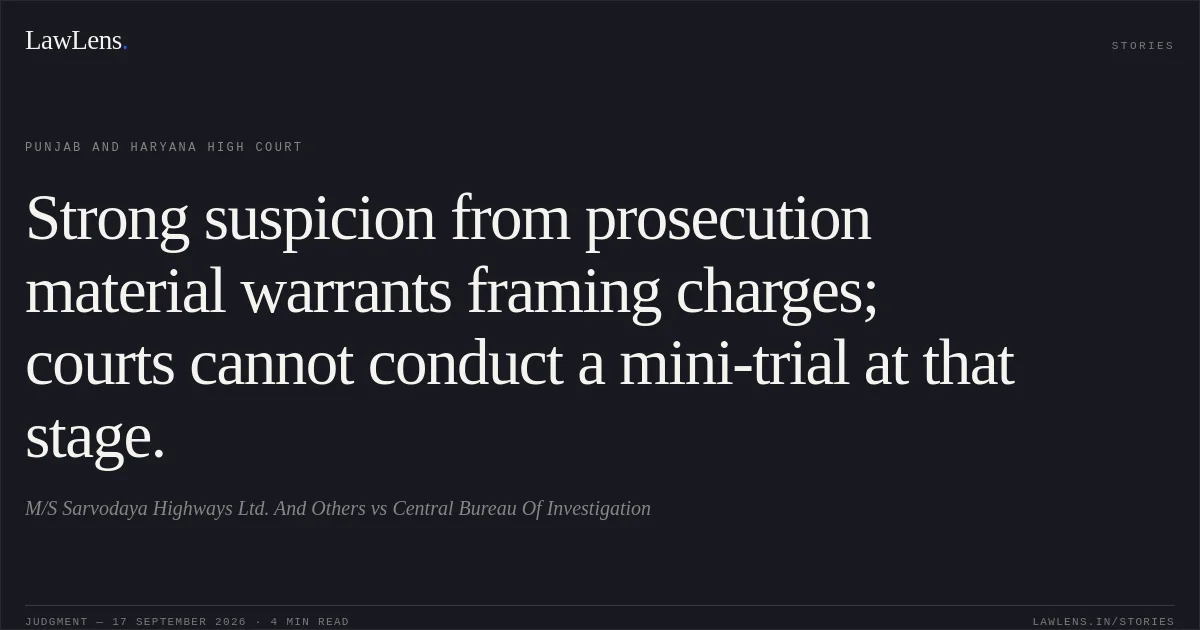
The Court applied the principles governing discharge and framing of charge under the Code of Criminal Procedure, particularly that the Court must examine whether the prosecution material, taken at face value, discloses the ingredients of an offence and gives rise to a strong suspicion or a ground for presuming that the accused committed it; proof beyond reasonable doubt is not required at this stage
Source reference: pp. 14–16, paras. 17–18Relying on Manendra Prasad Tiwari v. Amit Kumar Tiwari, (2022) 20 SCC 757, Chitresh Kumar Chopra v. State (Government of NCT of Delhi), (2009) 16 SCC 605, Niranjan Singh Karam Singh Punjabi v. Jitendra Bhimraj Bijja, (1990) 4 SCC 76, State of Maharashtra v. Som Nath Thapa, (1996) 4 SCC 659, and Amit Kapoor v. Ramesh Chander, (2012) 9 SCC 460, the Court held that revisional interference is confined to patent illegality, jurisdictional error, perversity, or absence of material, and cannot involve a meticulous appreciation of evidence or a mini-trial
Source reference: pp. 14–16, paras. 17–19The Court also applied the principle that settlement of bank dues does not, by itself, terminate prosecution for alleged economic offences involving fraud, forgery, conspiracy, public loss, or offences under the Prevention of Corruption Act
Source reference: pp. 4–6, para. 4; p. 18, para. 22Reasoning
The Court found that the charge-sheet and investigation material contained more than bare allegations: ten work orders valued at approximately ₹348.24 crores had allegedly been submitted; three were denied by the purported issuing companies; the remaining documents allegedly involved associate or group companies whose relationship with the borrower was concealed; and the CBI also relied on allegedly false financial statements, forged lien documents, inspection material, fund-flow analysis, and a CFSL report
Source reference: pp. 16–18, paras. 20–21The petitioners’ objections concerning the absence of references to work orders in the sanction letters, non-recovery of originals, use of photocopies, collateral securities, personal guarantees, the Bank’s inspection reports, and the alleged absence of individual roles required evidentiary assessment at trial and did not make the prosecution case inherently improbable
Source reference: pp. 17–18, paras. 20–21The One Time Settlement could be raised as a defence during trial but could not justify discharge, particularly since the Supreme Court had already restored the prosecution after considering the allegations of forged documents, conspiracy, Prevention of Corruption Act offences, and the shortfall between the amount due and the settlement amount
Source reference: p. 18, para. 22Similarly, the Court declined to finally determine whether the material established demand, dishonest abuse of official position, or the precise liability of the Branch Manager under the Prevention of Corruption Act; those matters were held to be issues for trial. The trial court had applied the correct threshold and had not conducted a conviction-level assessment
Source reference: pp. 18–19, paras. 23–24Holding
The High Court held that the prosecution material, if accepted at face value, raised the requisite strong suspicion and disclosed the basic ingredients of the alleged offences. The trial court’s refusal to discharge the petitioners and its decision to frame charges did not suffer from patent illegality, perversity, or jurisdictional error
Accordingly, the revision petition was dismissed, the order dated 20 July 2026 was upheld, and the prayer for stay of further proceedings was also dismissed. The trial court was directed to proceed in accordance with law, uninfluenced by the observations in the revision judgment
Source reference: p. 20, paras. 25–27Acts & Sections Cited
8 provisions across 3 statutes referred to in this judgment. Each provision opens on LawLens.
Indian Penal Code, 18605
Prevention of Corruption Act, 19881
Code of Criminal Procedure, 19732
Original Court PDF
M/S Sarvodaya Highways Ltd. And OthersvsCentral Bureau Of Investigation
Click to open original judgment
Original judgment, available to read, download and summarize on LawLens.in