Facts
The Petitioner, a Senior Police Inspector, along with several other police officers, was accused of the custodial torture and subsequent death of Agnello Valdaris (“Agnello”).
Source reference: para 5Agnello and three others were arrested on the night of 15-16 April 2014 for robbery.
Source reference: para 5On 18 April 2014, while being escorted for medical treatment, Agnello allegedly fled and was struck by a local train, resulting in his death.
Source reference: para 5.1Following High Court intervention, the investigation was transferred to the CBI, which filed charge-sheets for various offenses but excluded Section 302 (murder).
Source reference: para 5.4-5.6Respondent No. 3 (Agnello’s father) filed a protest petition, leading the Special Judge to order the framing of charges under Sections 302 and 295-A of the IPC on 17 September 2022.
Source reference: para 5.10Conflicting judgments by different Single Judges of the Bombay High Court regarding the validity of the murder charge led the Supreme Court to refer the matter to a Division Bench for a final determination.
Source reference: para 5.12-5.13Issues
1. Whether the material on record is sufficient to frame a charge for the offense of murder under Section 302 of the IPC against the police officers.
Source reference: para 22. Whether the death of Agnello can be prima facie attributed to custodial torture or conduct falling under the fourth limb of Section 300 of the IPC.
Source reference: para 13Law Applied
The court applied the standards for framing charges under Sections 227 and 228 of the Cr.P.C., which require only a "strong suspicion" rather than proof beyond reasonable doubt to proceed with a trial.
Source reference: para 12.17It relied on the principle from State of Bihar v. Ramesh Singh, asserting that if two views are possible at the initial stage, the court should frame the charge.
Source reference: para 12.17Regarding custodial deaths, the court cited Prithipal Singh v. State of Punjab, noting that direct ocular evidence is rare and the burden often shifts to the police to explain circumstances within their exclusive knowledge.
Source reference: para 14Substantively, the court considered Section 300 (4thly) of the IPC, which defines murder as an act committed with the knowledge that it is so imminently dangerous that it must, in all probability, cause death.
Source reference: para 13Reasoning
The court scrutinized the discrepancy between the initial medical report and the post-mortem findings.
Source reference: para 12.13-12.15While the police claimed Agnello had only minor, self-inflicted wounds, the post-mortem report revealed internal head injuries and multiple contusions aged 12 to 96 hours, consistent with the timeline of his illegal detention and torture.
Source reference: para 12.13-12.15The court noted that the police intentionally defied a Magistrate’s order to produce Agnello in court and ignored a doctor’s recommendation for a chest X-ray.
Source reference: para 12.6, 12.10The police allegedly coerced the father into signing a statement that the injuries were self-inflicted.
Source reference: para 12.9Although eyewitnesses claimed Agnello ran toward the train, the court reasoned that the brutal torture he endured may have left him with no choice but to flee in a desperate, dangerous manner to escape further abuse, potentially invoking Section 300 (4thly).
Source reference: para 8, 13The court emphasized that at the stage of framing charges, the evidence of the victim's associates regarding torture—supported by scientific post-mortem data—carried significant weight despite delays in their statements caused by police intimidation.
Source reference: para 12.15-12.16Holding
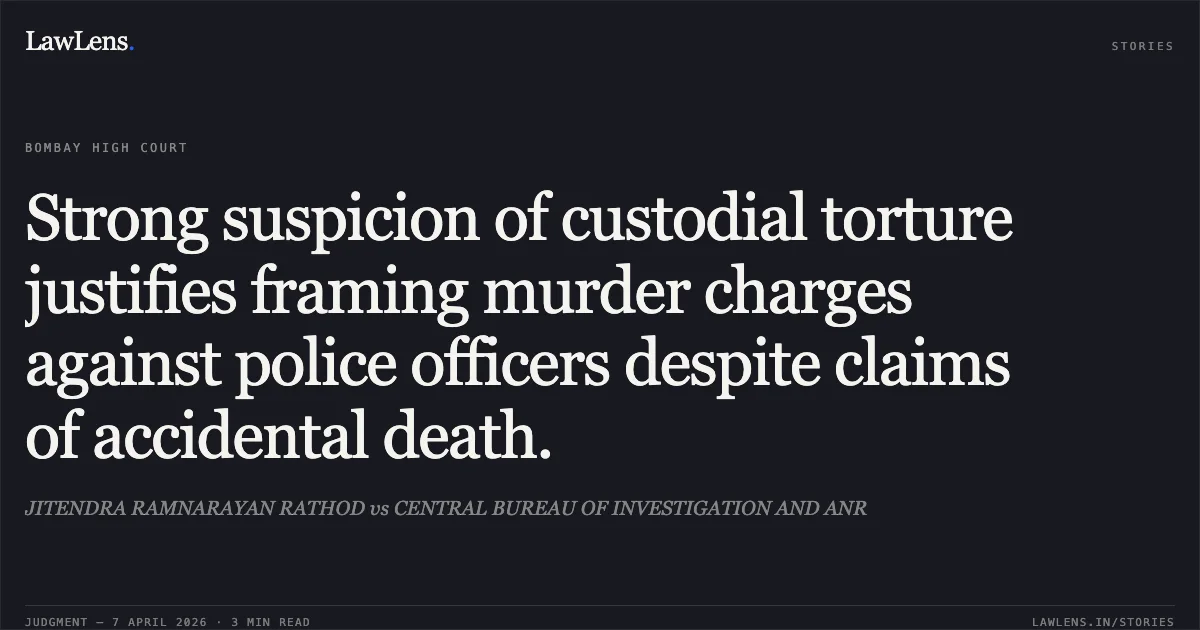
The High Court answered the reference by upholding the Trial Court’s order to frame charges under Section 302 and 295-A of the IPC.
The court held that there was sufficient material to create a "strong suspicion" of custodial murder and that the specific circumstances of the death, occurring while the victim was in police custody under suspicious movements, necessitated a full trial.
Source reference: para 13, 15The court dismissed the Petitioner's challenge, concluding that the Trial Court had applied the correct legal tests in refusing to discharge the accused from the murder charge.
Source reference: para 15Acts & Sections Cited
46 provisions across 4 statutes referred to in this judgment. Each provision opens on LawLens.
Code of Criminal Procedure, 19733
Indian Penal Code, 1860
Protection of Children from Sexual Offences Act, 20126
Police Act, 18611
Original Court PDF
JITENDRA RAMNARAYAN RATHODvsCENTRAL BUREAU OF INVESTIGATION AND ANR
Click to open original judgment
Original judgment, available to read, download and summarize on LawLens.in


