Facts
On December 8, 2022, a fatal shooting occurred at an agricultural field resulting in the death of one Sandeep. A Dehati Nalishi and subsequent FIR (Crime No. 276/2022) were registered naming 14 accused persons, including the applicants, for offenses under Sections 302, 307, 294, 147, 148, and 149 of the IPC.
Source reference: para. 3.1Initially, a charge sheet was filed only against three individuals, while investigation continued for others under Section 173(8) of the CrPC.
Source reference: para. 3.1On December 1, 2023, the complainant (PW-1) deposed in court, specifically naming the applicants and attributing specific roles to them.
Source reference: para. 3.1, 16Consequently, the prosecution moved an application under Section 319 of the CrPC to summon the applicants.
Source reference: para. 3.1Subsequently, on August 5, 2024, a supplementary charge sheet was filed which excluded the applicants' names based on investigative findings involving mobile tower locations (plea of alibi) and witness statements.
Source reference: para. 3.2, 15Despite this exclusion by the police, the Trial Court allowed the Section 319 application on August 14, 2025, summoning the applicants to face trial.
Source reference: para. 2, 3.3The applicants challenged this order via the present criminal revision.
Source reference: para. 2Issues
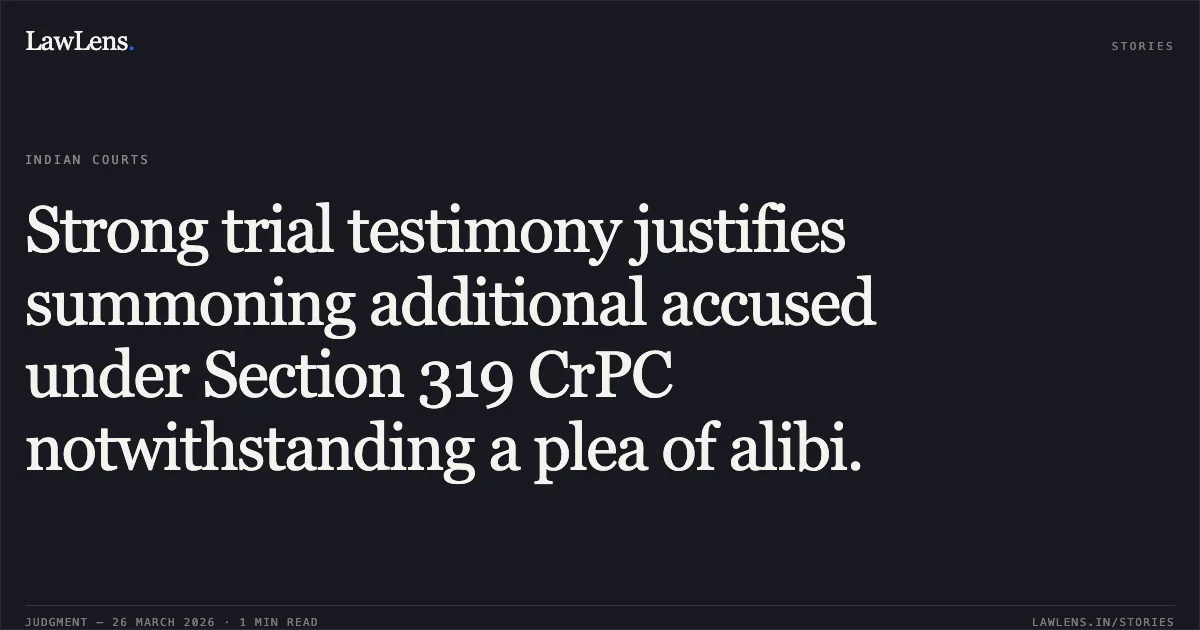
1. Whether the Trial Court can exercise power under Section 319 of the CrPC to summon persons named in the FIR but excluded from the charge sheet based on an investigative plea of alibi.
Source reference: para. 10, 132. Whether the evidence provided by the complainant (PW-1) in his examination-in-chief meets the "strong and cogent" threshold required for summoning additional accused.
Source reference: para. 12, 20, 21Law Applied
Section 319 of the Code of Criminal Procedure, 1973 (now Section 358 of the BNSS), which empowers the court to proceed against persons appearing to be guilty of an offense who are not already accused.
Source reference: para. 2, 10Constitution Bench judgment in Hardeep Singh v. Union of India (2014), which clarified that "evidence" includes examination-in-chief and that the court’s power extends to persons named in the FIR but not charge-sheeted.
Source reference: para. 11, 13The "strong and cogent" evidence standard established in Brijendra Singh v. State of Rajasthan (2017) and reaffirmed in Mohd. Kaleem v. State of U.P. (2026), distinguishing it from a mere prima facie case used at the stage of framing charges.
Source reference: para. 19, 20Mobile tower locations are not conclusive evidence of presence or absence and constitute a matter for trial.
Source reference: para. 18Reasoning
The High Court observed that the Dehati Nalishi and the FIR specifically named the applicants and assigned them distinct roles in the commission of the crime.
Source reference: para. 14Although the Investigating Officer (IO) recommended their removal based on mobile tower locations and statements of relatives, the court held that such findings are not conclusive at the pre-trial stage.
Source reference: para. 15, 17The court emphasized that the testimony of PW-1 in his examination-in-chief directly implicated the applicants, providing the "something more" than a prima facie case required under Section 319.
Source reference: para. 16, 19It reasoned that a plea of alibi is a matter of defense that must be established through evidence during trial and cannot be used to bypass the court’s discretionary power when credible testimony exists.
Source reference: para. 17, 18The court concluded that the Trial Court had appropriately balanced the investigative findings against the judicial evidence to ensure that the real culprits do not escape trial.
Source reference: para. 11, 21Holding
The High Court dismissed the criminal revision, finding no jurisdictional error in the Trial Court's order.
It held that the statements of the complainant (PW-1) recorded during trial, corroborated by the FIR, constituted "strong and cogent" material sufficient to summon the applicants under Section 319 CrPC.
Source reference: para. 21The court affirmed that investigative conclusions regarding alibis based on electronic records (mobile tower locations) do not override specific ocular testimony at the summoning stage, as such defenses must be proven during the trial itself.
Source reference: para. 18, 21Original Court PDF
Devendra Singh PariharvsThe State Of Madhya Pradesh
Click to open original judgment
Original judgment, available to read, download and summarize on LawLens.in


![Subsequent exoneration does not retrospectively invalidate a finalized promotion select list.. UNNIKRISHNAN M vs M/o Environment And Forests. CAT - ['Ernakulam']. LawLens](/stories/thumbnails/subsequent-exoneration-does-not-retrospectively-invalidate-a-finalized-promotion-select-li-ce80a0e84f2f4887857271e8b4341c42.webp)