Facts
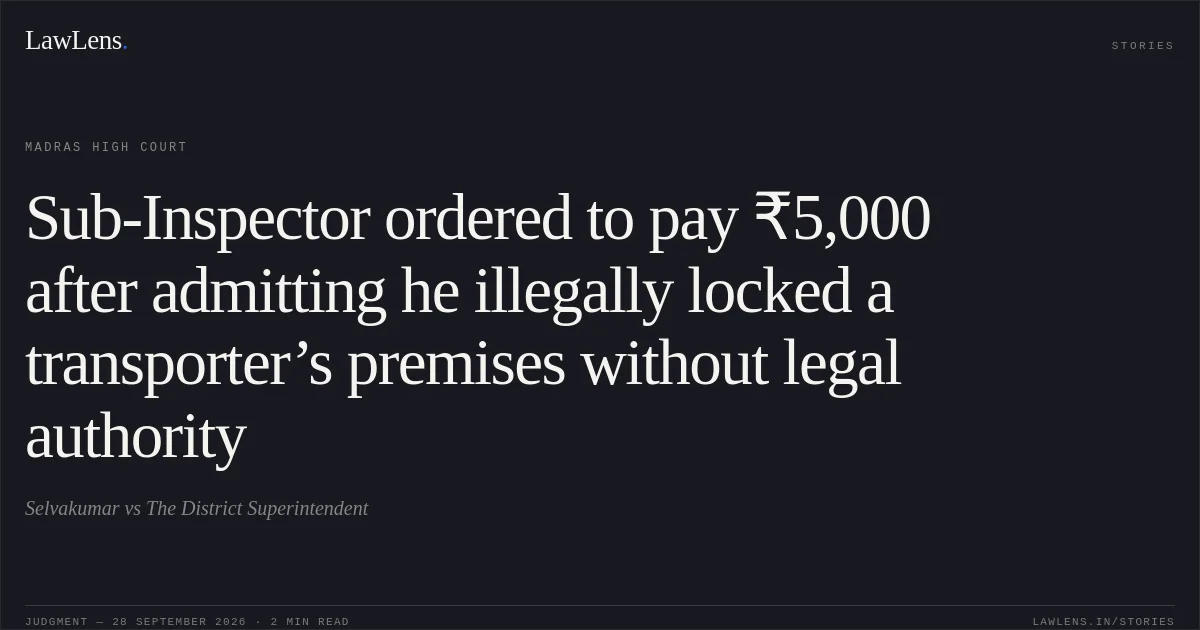
The petitioner, proprietor of a parcel-transport business, challenged the police’s locking and sealing of his godown after registering a case under Section 9-B(1)(b) of the Explosives Act, 1884, following the discovery of more than 150 cracker boxes on the premises.
Source reference: para. 3–4The police removed the seal and returned the premises to the petitioner on 11 September 2026, but retained the boxes, which had been seized under a mahazar, produced before the Judicial Magistrate No. I, Sivakasi, and registered as case property in P.R. No. 113 of 2026.
Source reference: para. 6–9, 17The petitioner then sought return of the boxes in the writ petition.
Source reference: para. 7, 15Issues
1. Whether the police had legal authority to lock and seal the petitioner’s premises.
Source reference: para. 52. Whether the High Court could direct return of the seized cracker boxes after they had been produced before and registered as case property by the jurisdictional Magistrate.
Source reference: para. 17–183. Whether the petitioner’s application for interim custody of the case property should be considered by the Magistrate within a specified period.
Source reference: para. 19–20Law Applied
The Court treated the absence of any identified legal provision or court order authorising the police to lock the premises as rendering that action improper.
Source reference: para. 5Once seized property is produced before the jurisdictional Magistrate and registered as case property, the affected person must seek its interim custody from that court; the High Court should not direct the police to return property that is subject to the Magistrate’s custody and orders.
Source reference: para. 17–18The Court referred to Section 451 of the Code of Criminal Procedure, 1973 (identified in the order as Section 497 of the Bharatiya Nagarik Suraksha Sanhita) as the provision under which the petitioner could apply for interim custody.
Source reference: para. 8, 18, 20It distinguished the cited decisions concerning release of cracker boxes because the order did not establish that those properties had been seized during investigation and registered as case property before a Magistrate.
Source reference: para. 10–16Reasoning
The police acknowledged that the premises had been locked without authority in law or an order of a court or higher authority, and the premises had already been returned to the petitioner.
Source reference: para. 6, 22–23However, the cracker boxes had been seized under a mahazar, produced before the Magistrate, and assigned a property-registration number; their interim custody was therefore for the Magistrate to determine, not the High Court to bypass by directing the police to hand them over.
Source reference: para. 17–18The Court accordingly directed the petitioner to apply to the Magistrate, who could assess the application on its merits.
Source reference: para. 19–20Holding
The writ petition was disposed of.
The petitioner was directed to apply to the Judicial Magistrate No. I, Sivakasi, for return of the property, and the Magistrate was directed to decide the application within one week of filing.
Source reference: para. 26(i)The Court accepted the Sub-Inspector’s apology for the unauthorised locking and directed him to pay costs of ₹5,000 to the specified Siddha clinic account by 11 October 2026, with proof to be produced on 12 October 2026; the payment was not to affect his service record or result in departmental proceedings.
Source reference: para. 24–26(ii)–(iii)Acts & Sections Cited
2 provisions across 2 statutes referred to in this judgment. Each provision opens on LawLens.
Code of Criminal Procedure, 19731
Bharatiya Nagarik Suraksha Sanhita, 20231
Original Court PDF
SelvakumarvsThe District Superintendent
Click to open original judgment
Original judgment, available to read, download and summarize on LawLens.in