Facts
The petitioners are GST-registered traders who deal in molasses—a by-product of the sugar industry—exclusively for non-intoxicant purposes such as the manufacture of cattle feed, poultry feed, and gudakhu (a tobacco product)
Source reference: para 5-8The State of Chhattisgarh, purportedly exercising powers under Section 8(c) and Section 62 of the Chhattisgarh Excise Act, 1915, notified the Chhattisgarh Molasses Control and Regulation Rules, 2022 ("Rules of 2022")
Source reference: para 5, 29Under these Rules, the Excise Department insisted that all molasses traders, regardless of the end-use of the product, obtain an excise license and pay a molasses duty of Rs. 200 per ton
Source reference: para 6, 37The petitioners challenged the Rules, arguing that raw molasses is not an "intoxicant" or "excisable article" and that the State lacked the legislative competence to regulate non-potable molasses under the guise of excise law
Source reference: para 7-10Issues
1. Whether the Chhattisgarh Molasses Control and Regulation Rules, 2022, are ultra vires the parent Chhattisgarh Excise Act, 1915, and the Constitution of India
Source reference: para 3, 52. Whether the State Government has the authority under Entries 8 and 51 of List II of the Seventh Schedule to regulate or tax molasses used exclusively for non-intoxicant purposes
Source reference: para 7, 393. Whether the expression "any other base" in Section 8(c) of the Excise Act can be interpreted to include raw molasses
Source reference: para 35, 44Law Applied
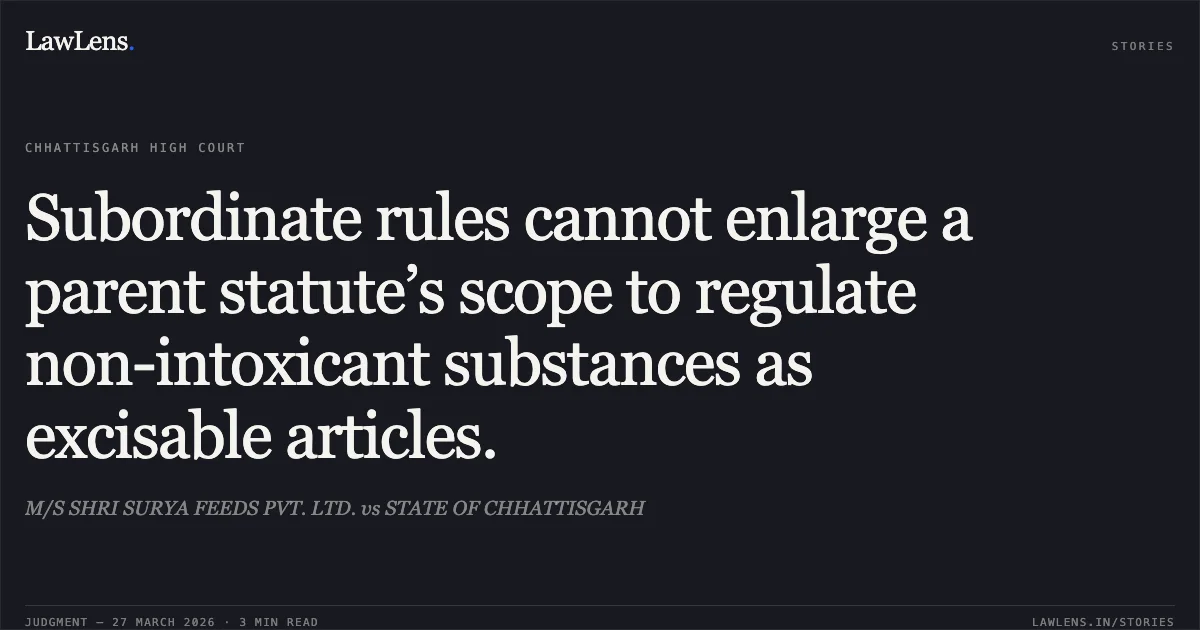
The Court applied the principle that subordinate legislation cannot enlarge the scope of its parent statute or travel beyond its preamble and objects
Source reference: Headnote, para 41It relied on Article 246 and Entries 8 (Intoxicating liquors) and 51 (Excise duties on alcoholic liquors for human consumption) of List II, Seventh Schedule of the Constitution
Source reference: para 26, 28The Court further applied the doctrine of ultra vires as elucidated in Naresh Chandra Agrawal v. ICAI, holding that general rule-making power for "carrying out the purposes of the Act" is strictly ancillary and cannot create substantive obligations not contemplated by the Act itself
Source reference: para 42It also referenced the 9-judge bench decision in State of Uttar Pradesh v. Lalta Prasad Vaish, which distinguished between "intoxicating liquor" (effect-based) and final products that contain alcohol but are not intended for noxious use
Source reference: para 43Reasoning
The Court observed that molasses is a by-product of sugar manufacture and, in its raw form, is neither fit for human consumption nor an intoxicant until it undergoes fermentation
Source reference: para 34, 44Upon examining the Chhattisgarh Excise Act, 1915, the Court found that molasses is not included in the definitions of "excisable article" (Section 2(6)), "intoxicant" (Section 2(11-a)), or "liquor" (Section 2(13))
Source reference: para 33, 44The Act’s Preamble restricts its scope to "intoxicating liquor" and "intoxicating drugs"
Source reference: para 34The Court rejected the State's argument that molasses falls under "any other base" in Section 8(c), ruling that this phrase cannot be stretched to include non-intoxicant substances used for cattle feed or industry
Source reference: para 35, 44Since the parent Act does not treat molasses as an excisable item, the Rules of 2022—which impose licensing and duties—travelled beyond the scope of the Act
Source reference: para 44The Court held that while the State may regulate molasses for distillation (potable alcohol), extending that control to neutral commercial trading violates Article 19(1)(g) and lacks legislative competence under List II
Source reference: para 30, 44Holding
The High Court allowed the writ petitions and declared the Chhattisgarh Molasses Control and Regulation Rules, 2022, ultra vires the parent Act and the Constitution of India
The Court held that the State cannot compel traders dealing in molasses for non-intoxicant purposes to obtain excise licenses or pay excise duties
Source reference: para 44The petitioners were granted consequential relief, including the setting aside of demands or coercive measures initiated under the impugned Rules
Source reference: para 4, 46Original Court PDF
M/S SHRI SURYA FEEDS PVT. LTD.vsSTATE OF CHHATTISGARH
Click to open original judgment
Original judgment, available to read, download and summarize on LawLens.in


![Subsequent exoneration does not retrospectively invalidate a finalized promotion select list.. UNNIKRISHNAN M vs M/o Environment And Forests. CAT - ['Ernakulam']. LawLens](/stories/thumbnails/subsequent-exoneration-does-not-retrospectively-invalidate-a-finalized-promotion-select-li-ce80a0e84f2f4887857271e8b4341c42.webp)