Facts
The appellant, a Home Guards Sainik, was discharged on 15 October 2015 following registration of an FIR, without a departmental enquiry or hearing.
Source reference: para. 2–6He was acquitted on 14 January 2016.
Source reference: para. 2–6After allegedly making representations seeking reinstatement, he filed a writ petition in 2024 challenging the discharge order.
Source reference: para. 2–6The Single Judge dismissed the petition as barred by delay and laches; the appellant appealed and also sought condonation of delay in filing the appeal.
Source reference: para. 2–6Issues
Whether the writ petition challenging the 2015 discharge order was liable to dismissal for delay and laches, despite the appellant’s subsequent acquittal and alleged representations
Source reference: para. 6, 8Whether the discharge order or the Single Judge’s decision disclosed any ground for appellate interference on the merits
Source reference: para. 3, 8–9Law Applied
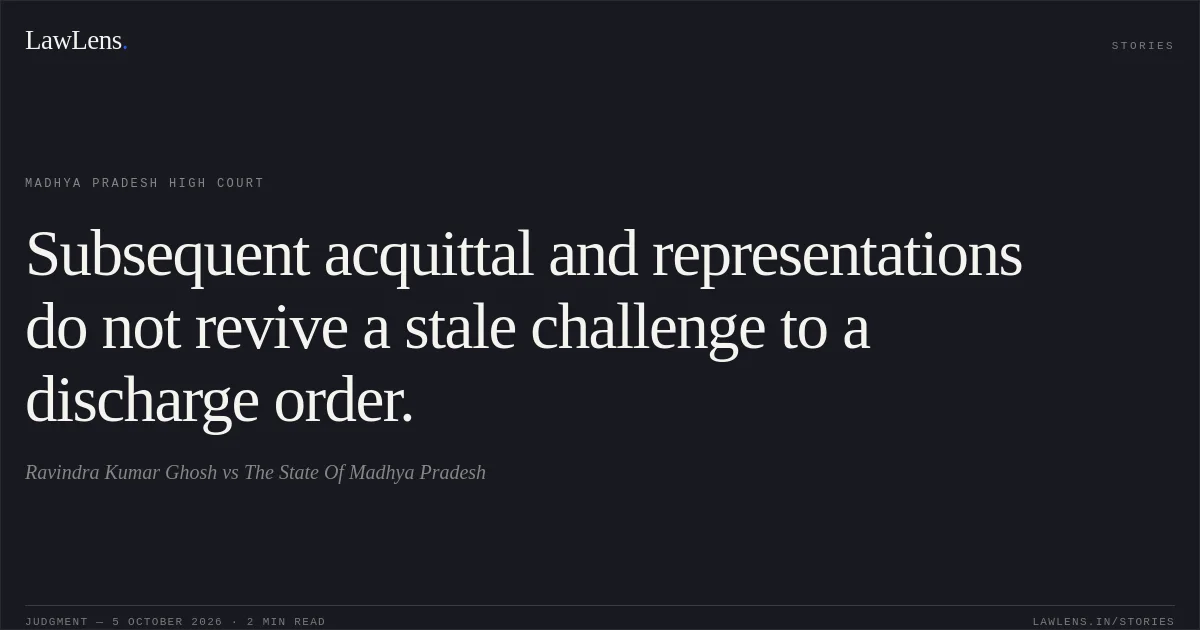
A person who fails to challenge an adverse order within a reasonable time cannot ordinarily invoke writ jurisdiction after an unreasonable delay; successive representations do not, by themselves, revive a stale claim or create a fresh cause of action.
Source reference: para. 8Subsequent acquittal does not automatically undo the consequences of an earlier discharge where the discharge order was not challenged within a reasonable period.
Source reference: para. 8The appellant cited Nar Singh Pal v. Union of India, (2000) 3 SCC 588, and Commissioner of Police v. Sandeep Kumar, (2011) 4 SCC 644; the judgment records those authorities as the appellant’s reliance but does not discuss or apply them in its reasoning.
Source reference: para. 3Reasoning
The discharge order was made on 15 October 2015, but the appellant approached the Court only in 2024, after nearly nine years.
Source reference: para. 8The Court held that neither the subsequent acquittal nor the alleged representations revived the stale claim or supplied a fresh cause of action.
Source reference: para. 8It also found no subsequent order or event capable of invalidating the discharge order and concluded that the appellant had shown no independent ground for interference on the merits.
Source reference: para. 8Holding
The Court answered the issues against the appellant, finding no error in the Single Judge’s dismissal of the writ petition for delay and laches.
It dismissed the writ appeal and disposed of the application for condonation of delay, with no order as to costs.
Source reference: para. 9Original Court PDF
Ravindra Kumar GhoshvsThe State Of Madhya Pradesh
Click to open original judgment
Original judgment, available to read, download and summarize on LawLens.in