Facts
The petitioner, an employee of the Karnataka Power Transmission Corporation Ltd. (KPTCL), was convicted by a Division Bench of the Karnataka High Court on 5 January 2024, following which he was dismissed from service on 21 March 2024.
Source reference: pp. 3–6The Supreme Court subsequently set aside the conviction and restored the trial court’s acquittal on 3 September 2025.
Source reference: pp. 3–6KPTCL withdrew the dismissal and reinstated him from 3 November 2025, but treated the intervening period—from 21 March 2024 to 2 November 2025—as not spent on duty and denied salary for that period.
Source reference: pp. 3–6The petitioner challenged that decision, seeking salary and consequential service benefits
Source reference: pp. 3–6Issues
1. Whether the petitioner was entitled to salary for the period he remained out of service following his conviction, which was later set aside on appeal
Source reference: pp. 7–82. Whether the respondents’ decision to deny salary for that period warranted interference under Article 226 of the Constitution
Source reference: pp. 6–8, 23–24Law Applied
The Court applied the principle of “no work, no pay” and the Supreme Court’s decisions in Union of India v. Jaipal Singh, (2004) 1 SCC 121, SBI v. Mohd. Abdul Rahim, (2013) 11 SCC 67, and Raj Narain v. Union of India, 2019 SCC OnLine SC 452.
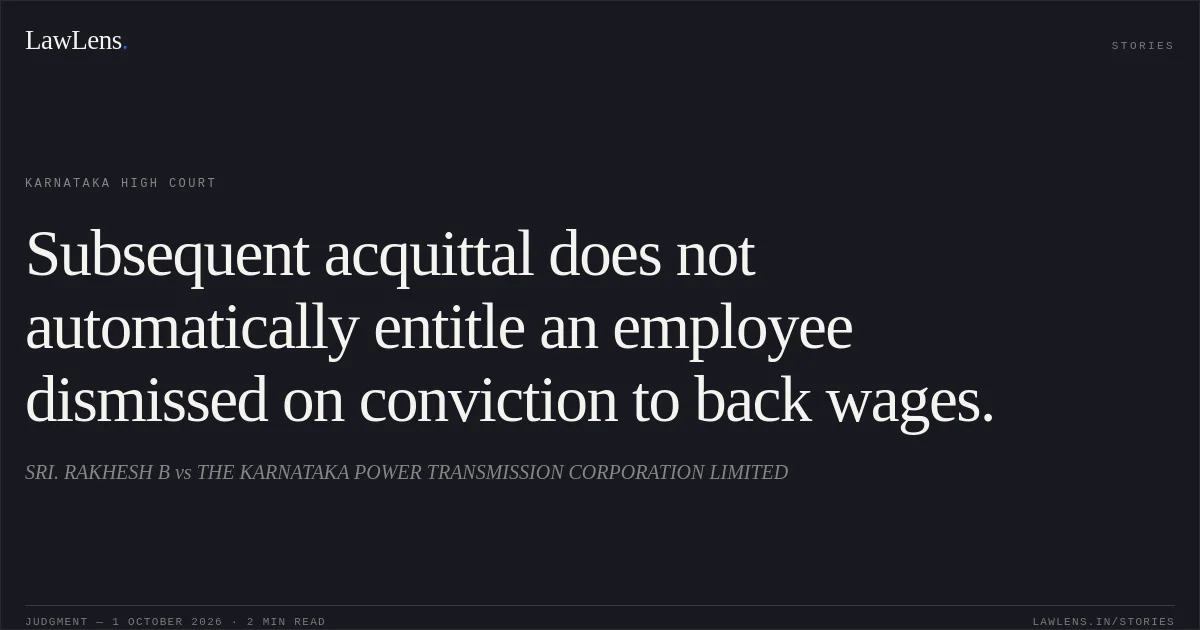
Source reference: pp. 8–14, 15–18, 23These authorities establish that subsequent acquittal does not, by itself, entitle an employee dismissed following a criminal conviction to back wages for the intervening period where the employee’s non-employment was not attributable to the employer.
Source reference: pp. 8–14, 15–18, 23The Court distinguished cases where an employer’s own action prevented the employee from working: in such cases, “no work, no pay” may not apply
Source reference: pp. 8–14, 15–18, 23Reasoning
The petitioner’s dismissal followed his criminal conviction, and the respondents had not independently prevented him from performing his duties.
Source reference: pp. 7–8, 23–24The Court therefore treated his absence from service as resulting from the conviction and the resulting disability to serve, rather than from an employer-caused exclusion.
Source reference: pp. 7–8, 23–24Although the Supreme Court later restored the acquittal and the petitioner was reinstated, that did not make the respondents liable for salary for the period when they could not avail themselves of his services.
Source reference: pp. 7–8, 23–24The Court accordingly applied “no work, no pay” and found no basis to interfere with the impugned endorsement
Source reference: pp. 7–8, 23–24Holding
The Court held that the petitioner was not entitled to salary for the period from 21 March 2024 to 2 November 2025.
Finding no warrant to interfere with the respondents’ decision, it rejected the writ petition
Source reference: p. 24Acts & Sections Cited
5 provisions across 2 statutes referred to in this judgment. Each provision opens on LawLens.
Indian Penal Code, 18604
Dowry Prohibition Act, 19611
Original Court PDF
SRI. RAKHESH BvsTHE KARNATAKA POWER TRANSMISSION CORPORATION LIMITED
Click to open original judgment
Original judgment, available to read, download and summarize on LawLens.in