01Facts
The complainants sought contempt proceedings alleging non-compliance with a 10 December 2025 order in W.P. No. 201198/2024. That order required them to submit documents supporting their ownership claim to the Deputy Commissioner, who was to conduct an enquiry and pass appropriate orders within 90 days of receiving their representation.
p. 3The complainants submitted their representation on 31 December 2025, but the Deputy Commissioner did not decide it within the stipulated period.
p. 4During the contempt proceedings, the Deputy Commissioner filed an affidavit stating that an enquiry had been conducted on 19 September 2026 and the claim rejected by endorsement issued that day; the Deputy Commissioner also tendered an unconditional apology for the delay.
pp. 4–602Issues
i.1. Whether the Deputy Commissioner’s post-deadline enquiry and decision constituted compliance with the order dated 10 December 2025, such that the contempt proceedings should be dropped.
pp. 3–7ii.2. Whether the complainants could challenge the Deputy Commissioner’s endorsement in separate proceedings.
p. 703Law Applied
The petition was brought under Sections 11 and 12 of the Contempt of Courts Act, 1971, which empower the High Court to address and punish contempt of court.
p. 2The operative direction in the underlying writ petition required the Deputy Commissioner to consider the complainants’ representation, conduct an enquiry in accordance with law, and pass appropriate orders within 90 days of its submission.
p. 3The judgment cites no precedent or further legal test for contempt.
Provisions in the judgment · 2 · Linked ones open on LawLens
Contempt of Courts Act, 1971 Section 11Section 12
04Reasoning
The Court considered the Deputy Commissioner’s affidavit and the materials showing that an enquiry had been conducted and an endorsement issued rejecting the claim.
pp. 4–6It concluded that the direction to consider the representation had been complied with, notwithstanding the acknowledged delay, and noted the Deputy Commissioner’s unconditional apology.
p. 7Since the contempt petition concerned compliance with the writ-court direction—not the merits of the rejection—the Court left the complainants free to challenge the endorsement separately.
p. 705Holding
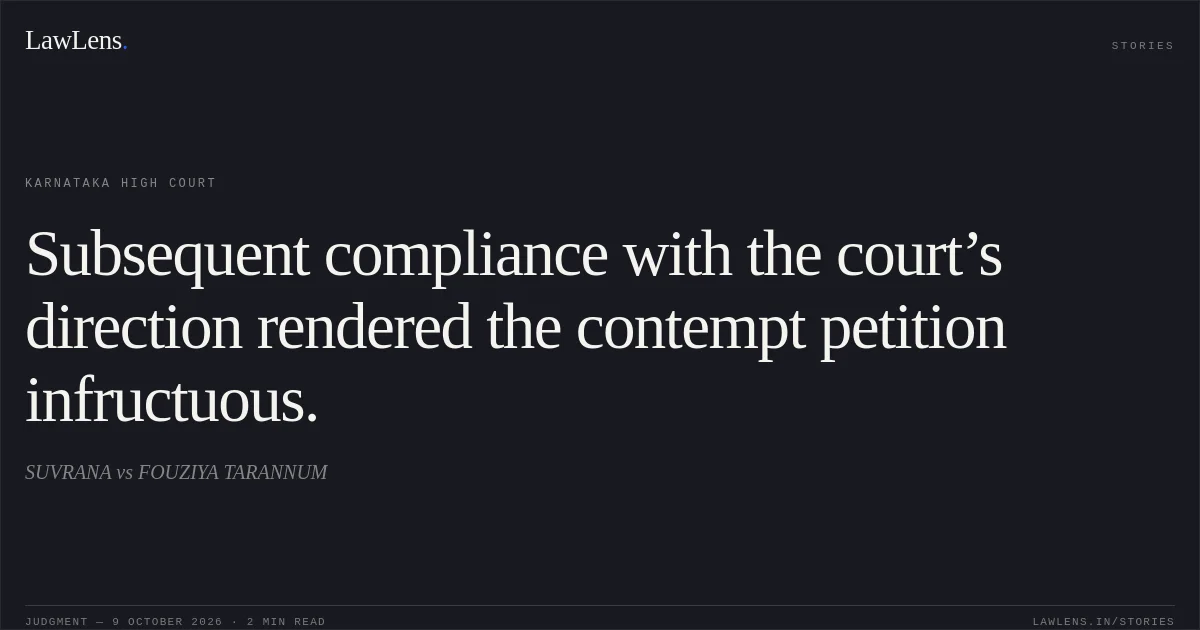
The Court held that the contempt petition no longer survived for consideration because the writ-court order had been complied with.
p. 7It took the compliance affidavit on record, dropped the contempt proceedings, discharged the notice, and reserved liberty to the complainants to challenge the Deputy Commissioner’s endorsement, if advised.
p. 7Original Court PDF
SUVRANAvsFOUZIYA TARANNUM
Click to open original judgment
Original judgment, available to read, download and summarize on LawLens.in



