Facts
The Petitioner-firm was awarded two contracts for internal electrification and repair works in 2006 and 2007
Source reference: para 3.1, 4.1Disputes arose regarding the handing over of sites and payment for executed works, which led the Respondents to cancel the contracts on 24.09.2012
Source reference: para 3.3, 4.3The Petitioner initially invoked the arbitration clause through notices dated 19.06.2013 and 20.06.2013, followed by a reminder on 05.04.2016, but the Respondents did not appoint an arbitrator
Source reference: para 3.7, 4.7, 5.7The Petitioner issued fresh notices in May 2024 and February 2025, and subsequently filed these petitions under Section 11(6) of the Arbitration and Conciliation Act, 1996, in November 2025
Source reference: para 3.4, 3.8, 5.7In its pleadings, the Petitioner suppressed the 2013 and 2016 invocation letters
Source reference: para 5.7, 5.10Issues
1. Whether the petitions for appointment of an arbitrator under Section 11(6) of the Act are barred by the limitation period prescribed under the Limitation Act, 1963
Source reference: para 5.22. Whether subsequent correspondence or a failure by the Respondents to respond to fresh invocation notices after several years extends the period of limitation
Source reference: para 5.8, 5.9Law Applied
The court applied Section 11(6) of the Arbitration and Conciliation Act, 1996
Source reference: para 02Article 137 of the Limitation Act, 1963, which mandates a three-year limitation period for applications from the date the right to apply accrues
Source reference: para 5.4It relied on Arif Azim Company Ltd v. Aptech Limited (2024), establishing that the limitation period for Section 11(6) begins after the lapse of 30 days from a valid notice of invocation if the other party fails or refuses to act
Source reference: para 5.4It further cited Aslam Ismail Khan Deshmukh v. Asap Fluids Pvt. Ltd. (2025), affirming that referral courts must conduct a limited inquiry to ensure the application is filed within three years
Source reference: para 5.5Section 9 of the Limitation Act was applied to hold that once time begins to run, subsequent disabilities or inability to sue do not stop it
Source reference: para 5.6Reasoning
The court determined that the "breaking point" or cause of action for filing the Section 11(6) petitions arose in July 2013, exactly thirty days after the Petitioner first invoked the arbitration clause in June 2013
Source reference: para 5.6, 5.9Consequently, the limitation period under Article 137 expired in 2016
Source reference: para 5.7The court rejected the Petitioner's reliance on 2024 correspondence, holding that once the limitation clock starts, it cannot be reset by repeating or reiterating invocation notices
Source reference: para 5.8The court noted that the Petitioner was guilty of suppressio veri by concealing the 2013 and 2016 notices to create a false impression that the cause of action arose in 2024
Source reference: para 5.7, 5.10It held that a lack of response by the Respondents to the original notice constituted a deemed denial, requiring the Petitioner to approach the court within the three-year statutory window
Source reference: para 5.9Holding
The court held that the petitions were "hopelessly barred by time" as they were filed more than twelve years after the initial invocation of the arbitration clause
The court found that the Petitioner failed to provide any legal basis to extend the limitation from the original 2013 cause of action
Source reference: para 5.10Both Arbitration Petitions (Arb P Nos. 98/2025 and 99/2025) were dismissed as barred by limitation
Source reference: para 6.2Original Court PDF
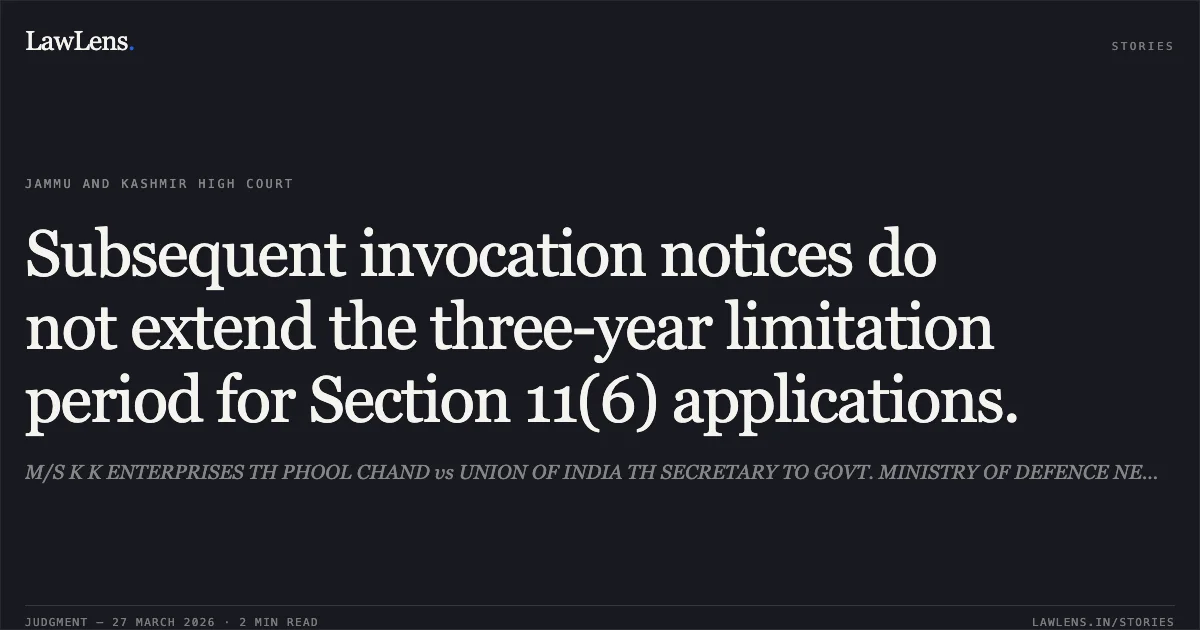
M/S K K ENTERPRISES TH PHOOL CHANDvsUNION OF INDIA TH SECRETARY TO GOVT. MINISTRY OF DEFENCE NEW DELHI AND OTHERS
Click to open original judgment
Original judgment, available to read, download and summarize on LawLens.in