01Facts
Petitioner No. 2 is the proprietor of "M.P. Security Force," an establishment supplying manpower to government and semi-government institutions
¶ 2Following an inquiry under Section 7A of the Employees' Provident Funds and Miscellaneous Provisions Act, 1952 ("the Act"), for the period of February 2008 to March 2012, authorities determined that the establishment failed to deposit both employees' and employer's provident fund contributions within the statutory timeframe
¶ 3Consequently, the Provident Fund Inspector filed criminal complaints before the Judicial Magistrate First Class, Bhopal, under Sections 6, 14(1-A), and 14A of the Act
¶ 4The Magistrate took cognizance and issued process
¶ 5The petitioners approached the High Court under Section 482 of the CrPC (Section 528 of the Bharatiya Nagarik Suraksha Sanhita, 2023) seeking quashment of these proceedings on the grounds that the entire dues (Rs. 1,76,76,311/-) had been subsequently deposited and that multiple complaints based on a single inquiry report were unsustainable
¶ 1, 6, 702Issues
i.1. Whether the subsequent deposit of statutory provident fund dues after the initiation of prosecution extinguishes criminal liability and justifies quashing the proceedings under Section 482 CrPC
¶ 11/16ii.2. Whether filing separate criminal complaints for different months/periods based on a single inquiry report is legally permissible under the Act
¶ 2003Law Applied
Section 6 of the Employees' Provident Funds and Miscellaneous Provisions Act, 1952, which mandates the timely deposit of contributions
¶ 13Section 14(1-A) regarding penalties for defaults
¶ 14The principle that the Act is a beneficial social welfare legislation intended to provide financial security to employees
¶ 12/15State of Haryana v. Bhajan Lal, which restricts quashing to cases where no offence is disclosed
¶ 17Neeharika Infrastructure Pvt. Ltd. v. State of Maharashtra, which cautions against appreciating evidence at the quashing stage
¶ 18Provisions in the judgment · 2 · Linked ones open on LawLens
Code of Criminal Procedure, 1973 Section 482
Bharatiya Nagarik Suraksha Sanhita, 2023 Section 528
04Reasoning
The court reasoned that the obligation to deposit provident fund contributions is mandatory and that an offence is "complete the moment the employer fails to deposit the contributions within the time prescribed"
¶ 15, 16It held that while subsequent payment might serve as a mitigating factor during sentencing, it does not erase the offence already committed
¶ 16, 22The court rejected the petitioners' argument regarding multiple complaints, clarifying that under the statutory scheme, an employer is required to deposit contributions monthly; thus, "each month's failure to deposit the contribution constitutes a distinct default" and a separate offence
¶ 20The court observed that allowing quashment solely based on subsequent payment would encourage employers to withhold funds until detected, thereby defeating the object of the welfare legislation
¶ 21Financial constraints or delays from principal employers were deemed matters of trial and not grounds for quashing
¶ 2205Holding
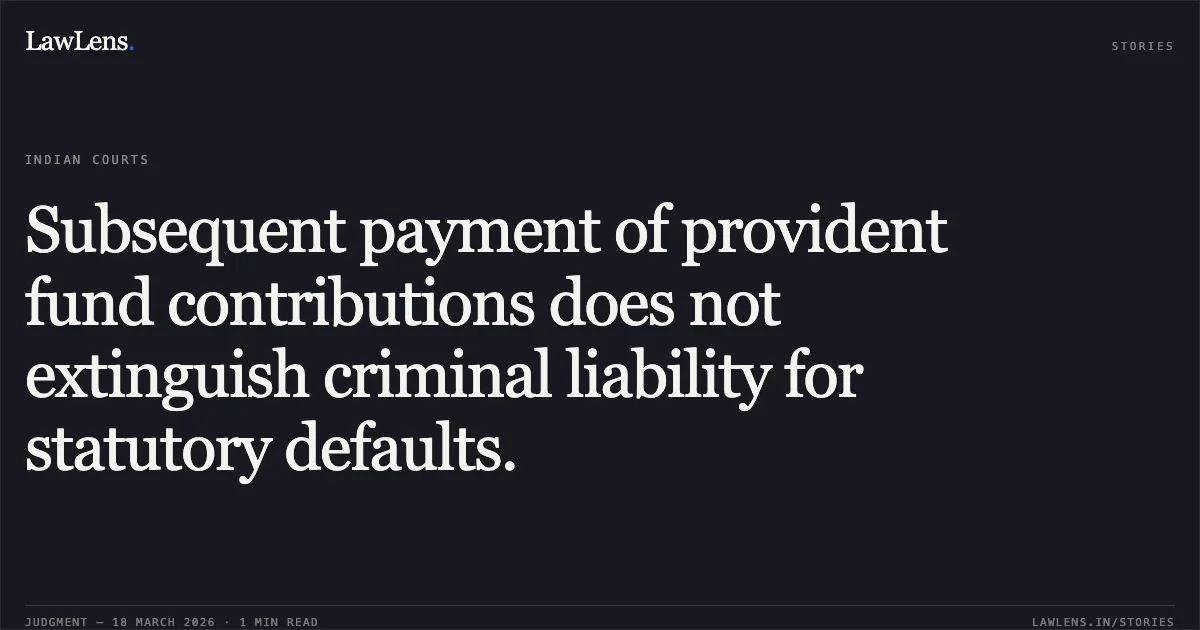
The High Court dismissed the petitions, holding that the subsequent deposit of dues does not extinguish criminal liability arising from statutory defaults
¶ 22, 24The court found that the complaints disclosed the commission of offences under the Act and that the prosecution was not frivolous or an abuse of process
¶ 23The Trial Court was directed to proceed with the matters in accordance with the law and decide the cases on their own merits expeditiously
¶ 25Original Court PDF
Measures M.P. Security ForcevsEnforcement Officer
Click to open original judgment
Original judgment, available to read, download and summarize on LawLens.in