Facts
The petitioner-college applied online on 30 June 2016 for recognition to conduct the B.Ed. course; the application was received by the Eastern Regional Committee (“ERC”) of the NCTE on 8 July 2016.
Source reference: para. 5The ERC initially refused recognition on 13 November 2017, citing absence of a No Objection Certificate, non-depiction of the multipurpose hall in the building plan, and non-submission of the building completion certificate.
Source reference: para. 9On appeal, the matter was remanded on 16 May 2018. Thereafter, the ERC issued a Letter of Intent on 31 October 2018 under Regulation 7(13) of the NCTE Regulations, 2014, requiring, inter alia, compliance regarding faculty qualifications and furnishing of fixed deposits of ₹5 lakh towards the Endowment Fund and ₹7 lakh towards the Reserve Fund.
Source reference: para. 10The petitioner allegedly failed to comply within the extended period granted by the ERC, and recognition was ultimately refused by order dated 1 March 2019 following a show-cause notice.
Source reference: para. 11The petitioner’s appeal was rejected by the NCTE Member Secretary on 5 July 2019.
Source reference: para. 2Issues
Whether the petitioner was entitled to recognition for the B.Ed. programme on the basis of its 2016 application, the alleged delay in processing, the Letter of Intent, and its claimed compliance with the applicable requirements?
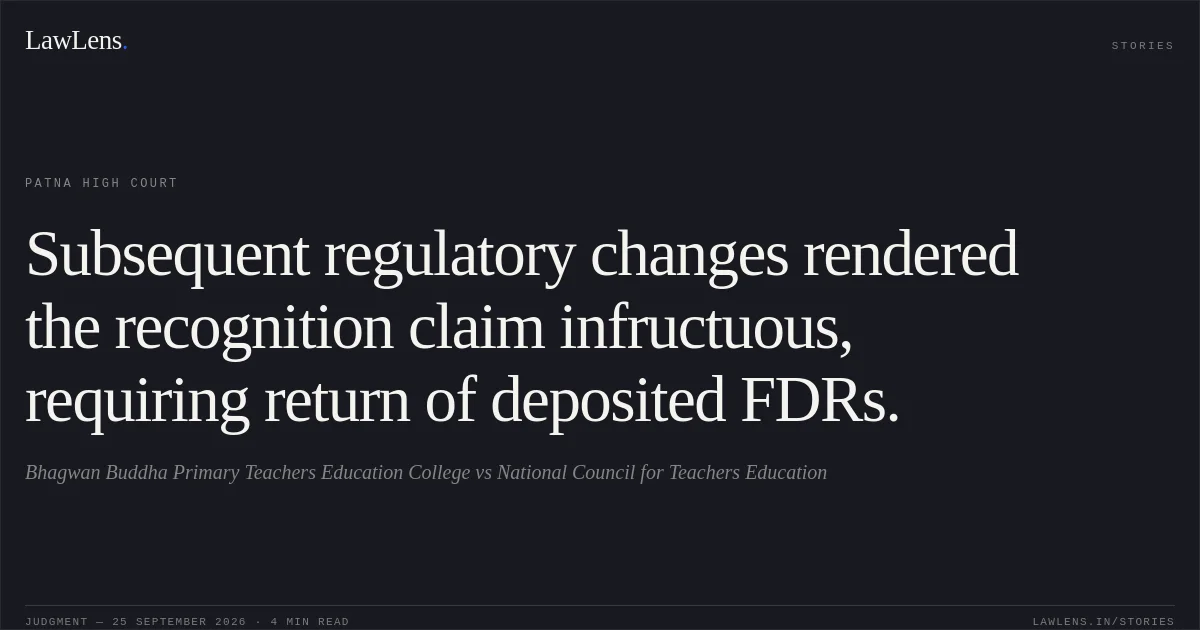
Source reference: paras. 3–6, 14–19Whether the subsequent changes in the regulatory framework pursuant to NEP 2020 rendered adjudication of the petitioner’s original claim for recognition ineffective or infructuous?
Source reference: paras. 14–19Whether the NCTE could retain the FDRs of ₹5 lakh and ₹7 lakh furnished pursuant to the Letter of Intent after the original recognition proceedings had lost practical efficacy?
Source reference: paras. 20–28Whether the petitioner should be permitted to submit a fresh application under the regulatory framework prevailing on the date of such application?
Source reference: para. 29Law Applied
The Court considered Regulation 5(1) of the NCTE (Recognition Norms and Procedure) Regulations, 2014, concerning the manner and time for submitting an application, and Regulation 7(6), prescribing the processing timeline and communication of the decision on recognition applications.
Source reference: paras. 4–5Regulation 7(13) governed the issuance of the Letter of Intent and the subsequent compliance requirements.
Source reference: para. 10Section 15(3)(b) of the National Council for Teacher Education Act was invoked in relation to the show-cause process preceding refusal of recognition.
Source reference: para. 11The Court also considered the principle of time-bound processing recognised in Maa Vaishno Devi Mahila Mahavidyalaya v. State of U.P., (2013) 2 SCC 617.
Source reference: para. 6However, the Court applied the doctrine that a court need not adjudicate a dispute where intervening events have rendered the relief ineffective or the controversy has substantially lost its practical significance.
Source reference: paras. 17–19It further held that requirements arising at the post-application or Letter-of-Intent stage could not, in the circumstances, be treated as an initial defect or incompleteness in the application so as to justify retention of the FDRs.
Source reference: paras. 22–26Reasoning
The Court noted that the regulatory regime governing teacher education had materially changed after the petitioner’s 2016 application, particularly following NEP 2020 and the NCTE’s move towards multidisciplinary institutions and integrated teacher-education programmes.
Source reference: paras. 14–16Consequently, even if the Court examined the petitioner’s allegations regarding delayed processing, the Letter of Intent, or non-compliance with the earlier framework, a favourable determination could not realistically result in recognition under a regulatory regime that had since changed substantially.
Source reference: paras. 17–19The Court therefore declined to undertake an adjudication of the original recognition dispute.
Source reference: paras. 17–19In contrast, the claim for return of the FDRs remained capable of effective adjudication.
Source reference: paras. 20–26The FDRs were furnished only pursuant to subsequent requirements arising during processing and after issuance of the Letter of Intent, rather than being documents whose absence rendered the original application incomplete.
Source reference: paras. 23–25Once the original proceedings could no longer yield recognition under the earlier framework, continued retention of the FDRs was held unjustified.
Source reference: para. 26Holding
The Court did not decide the petitioner’s substantive claim to recognition under the earlier regulatory framework, holding that the dispute had substantially lost its practical efficacy because of intervening regulatory changes and NEP 2020.
It directed the concerned NCTE authority to return or release the FDRs/amounts of ₹5 lakh and ₹7 lakh furnished towards the Endowment Fund and Reserve Fund, respectively, within eight weeks from receipt or production of the order.
Source reference: paras. 27–28The petitioner was granted liberty to submit a fresh application for recognition, subject to compliance with all rules, regulations, notifications, norms and criteria applicable on the date of the fresh application.
Source reference: para. 29The writ petition was accordingly disposed of.
Source reference: para. 30Acts & Sections Cited
1 provisions across 1 statute referred to in this judgment. Each provision opens on LawLens.
Rehabilitation Council of India Act, 19921
Original Court PDF
Bhagwan Buddha Primary Teachers Education CollegevsNational Council for Teachers Education
Click to open original judgment
Original judgment, available to read, download and summarize on LawLens.in