Facts
The Applicant, an "Ex-Grinder" at the Ordnance Factory Medak since 1988, was issued a charge sheet on 30.08.2021 under Rule 14 of the CCS (CCA) Rules, 1965, for gross misconduct
Source reference: p.3It was alleged that between 2007 and 2020, he fraudulently claimed medical reimbursement (₹7,91,824) and Leave Travel Concession (LTC) (₹93,487) for his mother by falsely declaring her as a dependent
Source reference: p.3Investigations revealed the mother had been receiving a family pension from the Government of Telangana since 1995, which exceeded the prescribed dependency income limits of ₹3,500 (VI CPC) and ₹9,000 (VII CPC)
Source reference: p.4The Applicant admitted his guilt, claiming ignorance of rules, and refunded the principal amount of ₹13,35,844 (including interest)
Source reference: p.4-5On 07.03.2022, the Disciplinary Authority imposed the penalty of compulsory retirement with 2/3rd pension and gratuity
Source reference: p.2, 4This was confirmed by the Appellate Authority on 12.12.2022
Source reference: p.2The Applicant challenged these orders, seeking their quashment on grounds of disproportionality and lack of mala fide intention
Source reference: p.2Issues
1. Whether the penalty of compulsory retirement was disproportionate to the misconduct, especially given the Applicant's repayment of the defrauded amount and his plea of ignorance
Source reference: p.2, 62. Whether the Applicant had exhausted all statutory remedies, including revision and review petitions, before approaching the Tribunal
Source reference: p.6Law Applied
Rule 14 of the CCS (CCA) Rules, 1965, regarding disciplinary procedures for major penalties
Source reference: p.3Rule 3(1)(i) and (iii) of the CCS (Conduct) Rules, 1964, which mandates maintaining absolute integrity and acting in a manner becoming of a government servant
Source reference: p.3Union of India v. M. Duraiswami, holding that subsequent repayment of defrauded amounts does not necessitate a lenient view
Source reference: p.7B.C. Chaturvedi v. Union of India and Chairman Managing Director, V.S.P. v. Goparaju Sri Prabhakara Hari Babu, which restrict the scope of judicial review over the proportionality of punishment unless the penalty is "shocking to the conscience" of the court
Source reference: p.6-7Reasoning
The Tribunal found that the Applicant deliberately suppressed facts by signing a declaration stating his mother’s income did not exceed the dependency threshold, despite her receiving a continuous state pension and medical allowance
Source reference: p.4-5The court dismissed the Applicant's plea of ignorance of English and rules, noting that his official correspondence and representations were written in English
Source reference: p.5It observed that the fraud was sustained over a long period (1995–2017) and only ceased upon discovery
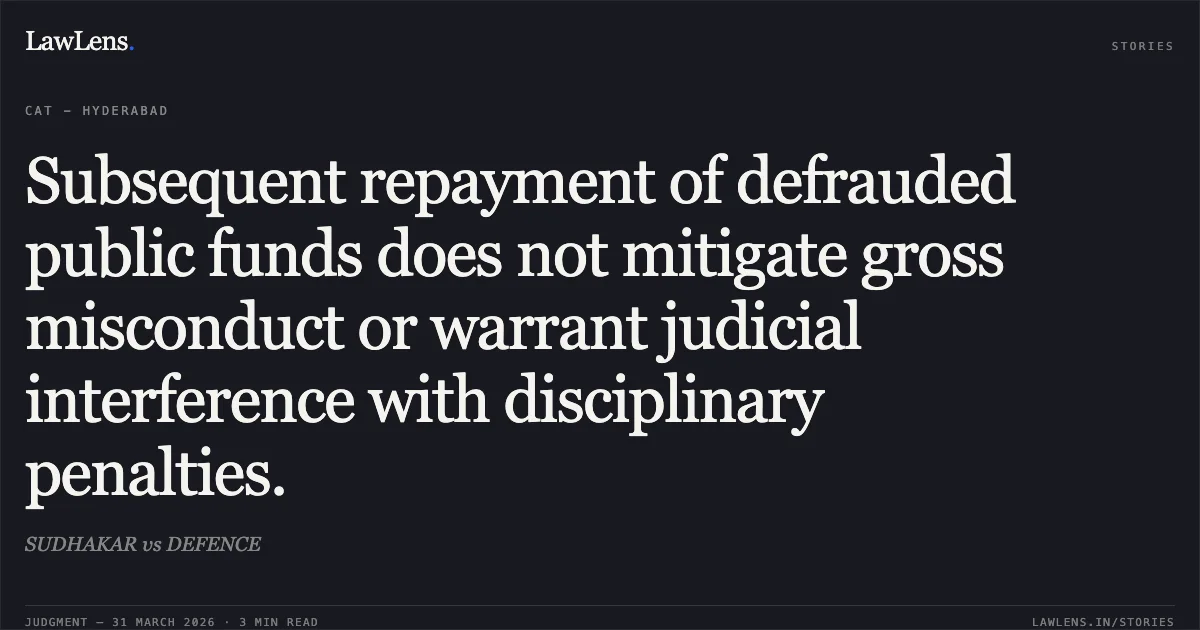
Source reference: p.5Applying the ratio in M. Duraiswami, the Tribunal held that the restitution of funds does not absolve the employee of the underlying misconduct
Source reference: p.7Regarding the quantum of punishment, the Tribunal noted that the Disciplinary Authority had already taken a "lenient view" by opting for compulsory retirement instead of dismissal, thereby preserving 2/3rd of his pensionary benefits
Source reference: p.4, 6Since the procedural requirements were met and the misconduct (fraud on the public exchequer) was proved, the Tribunal declined to interfere with the competent authority's discretion
Source reference: p.7Holding
The Tribunal answered both issues in the negative, holding that the punishment was commensurate with the gravity of the fraud and that the Applicant had failed to exhaust all alternative remedies
The Tribunal concluded that sympathy cannot override legal parameters when misconduct is proved
Source reference: p.7The Original Application was dismissed, and the orders of the Disciplinary and Appellate Authorities were upheld
Source reference: p.8No costs were ordered
Source reference: p.8Original Court PDF
SUDHAKARvsDEFENCE
Click to open original judgment
Original judgment, available to read, download and summarize on LawLens.in