Facts
The appellant, a manufacturer of potassium chlorate, received electricity subsidy of ₹16,20,745 for Assessment Year 1997–98 under the Government of Pondicherry’s Power Subsidy Scheme.
Source reference: para. 1The subsidy was calculated as a percentage of actual electricity charges for a limited period after production commenced.
Source reference: para. 1The Assessing Officer treated it as a revenue receipt under Section 143(3) of the Income-tax Act, 1961; the CIT (Appeals), ITAT and Madras High Court affirmed that treatment.
Source reference: paras. 1–7The appellant appealed to the Supreme Court, claiming the subsidy was a capital receipt.
Source reference: para. 1Issues
Whether the electricity subsidy received under the Pondicherry scheme was a capital receipt or a revenue receipt taxable under the Income-tax Act, 1961
Source reference: para. 9Law Applied
Under the “purpose test,” the character of a subsidy is determined by the purpose for which it is granted, assessed from the scheme as a whole; its timing, source and form are not decisive.
Source reference: paras. 10–12Assistance intended to enable an assessee to conduct business more profitably is a revenue receipt, whereas assistance intended to establish a new unit or substantially expand an existing one is a capital receipt (*Sahney Steel & Press Works Ltd. v. CIT*; *CIT v. Ponni Sugars and Chemicals Ltd.*).
Source reference: paras. 10–12The scheme’s operative provisions—not merely a general policy statement or its stated label—must disclose the purpose and effect of the assistance (*CIT-I, Kolhapur v. Chaphalkar Brothers, Pune*).
Source reference: paras. 13–14Section 143(3) was the provision under which the assessment was completed.
Source reference: para. 3Reasoning
The subsidy was available for five years from commencement of production, tapered over that period, and was calculated by reference to actual power charges incurred in manufacturing.
Source reference: paras. 15–16Its immediate effect was to reduce an ordinary operating expense; it was not linked to capital investment, repayment of capital borrowing, or creation of an asset.
Source reference: para. 18The scheme’s broader aim of fostering industrial growth did not alter the character of this particular assistance, and neither the timing of payment nor the possibility that the resulting savings could be used for other business purposes was determinative.
Source reference: paras. 17, 19, 21–22The subsidy therefore fell within the operational-assistance principle in *Sahney Steel*, rather than the capital-purpose category in *Ponni Sugars* or *Chaphalkar Brothers*.
Source reference: paras. 16, 20Holding
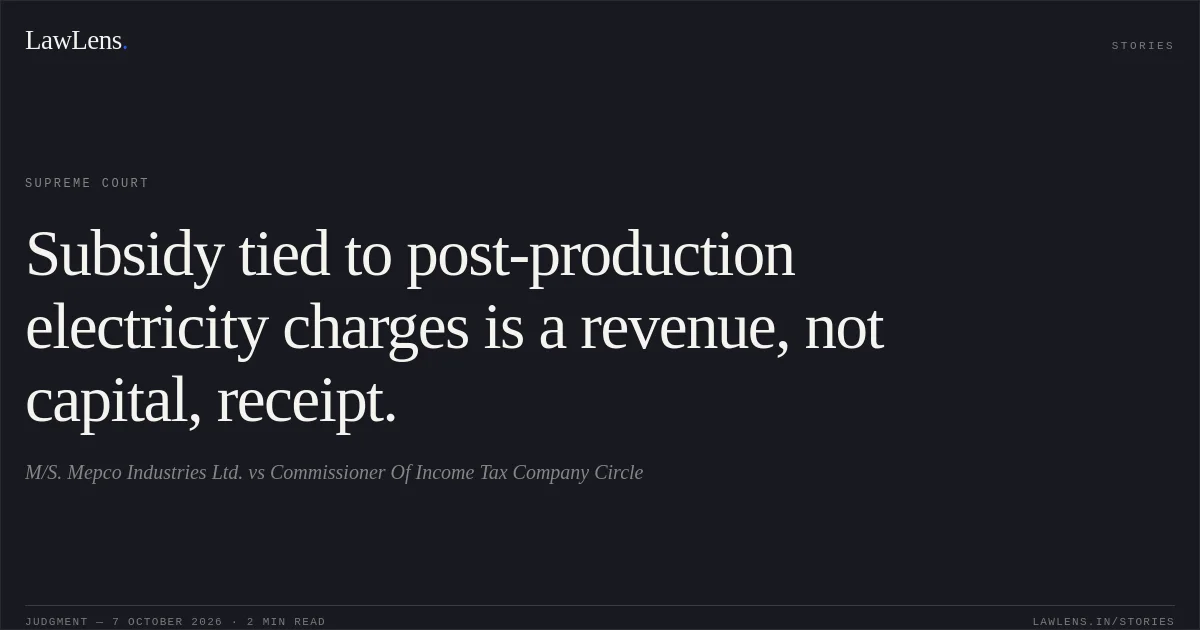
The Court held that the electricity subsidy was a revenue receipt because it reduced the appellant’s power costs after production began and was not shown to contribute to capital outlay or create a capital asset.
It affirmed the concurrent decisions below and dismissed the appeal.
Source reference: para. 24Acts & Sections Cited
1 provisions across 1 statute referred to in this judgment. Linked provisions open on LawLens.
Income Tax Act, 19611
Original Court PDF
M/S. Mepco Industries Ltd.vsCommissioner Of Income Tax Company Circle
Click to open original judgment
Original judgment, available to read, download and summarize on LawLens.in