Facts
Respondent no. 1 held a 13-decimal share in a 26-decimal suit property and transferred 12.5 decimals to the appellants by a deed accompanied by a plan depicting a demarcated portion.
Source reference: para. 3–7, 11, 21The appellants obtained a sanction plan and began construction on the transferred portion; the Commissioner’s report recorded that 11 pillars had been constructed.
Source reference: para. 3–7, 11, 21Respondent no. 1 later instituted a partition suit and obtained an order directing status quo. The appellants appealed that order.
Source reference: para. 3–7, 11, 21Respondent no. 1 disputed consenting to the construction and sought demolition, alleging that it violated the status quo order.
Source reference: para. 3–7, 11, 21The High Court modified the order on appeal.
Source reference: para. 25–29Issues
Whether the status quo order should be modified to permit the appellants to complete construction on the portion transferred to them, having regard to the parties’ competing claims and the progress of construction.
Source reference: para. 8–12, 15–23Whether the appellants should be restrained from creating third-party interests in the property, and whether the appeal should affect the pending demolition application.
Source reference: para. 24–28Law Applied
The Court applied the principles governing interim injunctive relief, weighing the balance of convenience and inconvenience and considering whether refusal of an injunction would cause irreparable injury.
Source reference: para. 8, 17–23It also considered the need to preserve the subject matter of a partition suit and the parties’ rights pending its determination.
Source reference: para. 10, 24–28The judgment cites no statute or precedent by name.
Source reference: no citationReasoning
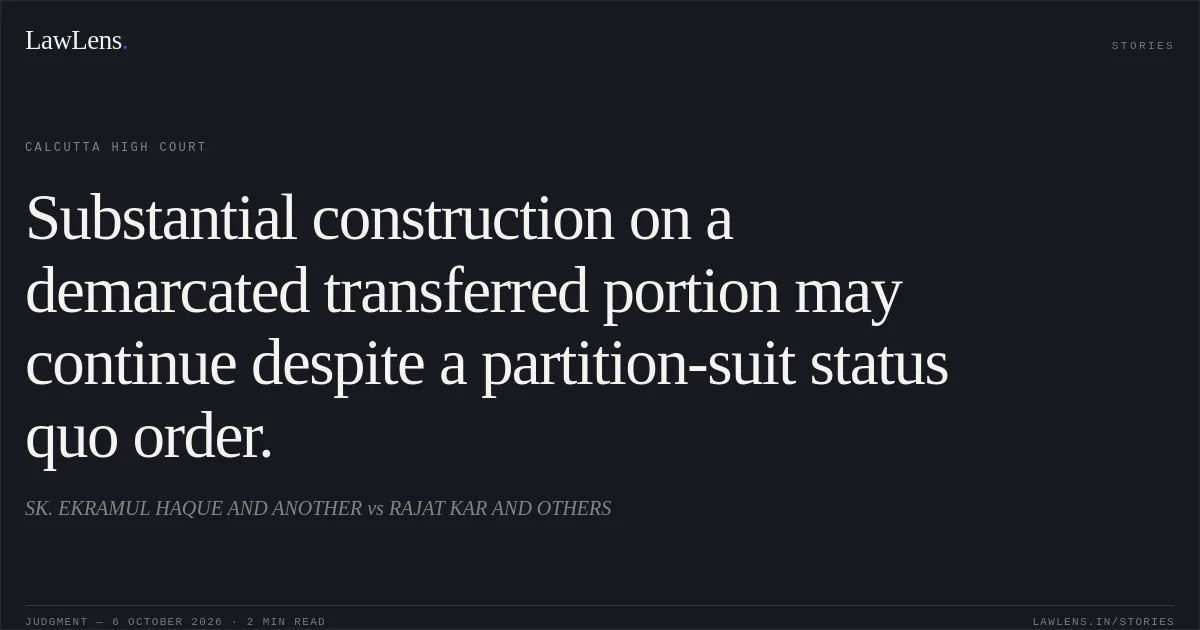
The Court found that the deed plan bore respondent no. 1’s signature and indicated an intention to transfer a demarcated portion, even though the property had not been partitioned by metes and bounds. It held that respondent no. 1 could not resile from that position at the interim stage.
Source reference: para. 13–14The appellants had commenced substantial construction in reliance on the transfer, obtained sanction, and incurred expense; stopping the work at that advanced stage would substantially prejudice them, while respondent no. 1 would suffer no irreparable injury from its continuation.
Source reference: para. 15–20, 23Given the competing partition claims, however, the Court barred the appellants from creating third-party interests and made clear that the appeal would not determine the pending demolition application.
Source reference: para. 24, 28Holding
The appeal was partially allowed, modifying the trial court’s status quo order.
The appellants may complete construction but may not create third-party interests in the suit property until disposal of the suit.
Source reference: para. 25–30If the constructed portion is ultimately allotted to another party, the appellants must demolish it at their own expense if directed by the trial court; they may claim no special equity for the construction.
Source reference: para. 25–30The order remains subject to the outcome of respondent no. 1’s pending demolition application concerning the alleged breach of the status quo order.
Source reference: para. 25–30CAN 1 of 2026 was disposed of, with no order as to costs.
Source reference: para. 25–30Original Court PDF
SK. EKRAMUL HAQUE AND ANOTHERvsRAJAT KAR AND OTHERS
Click to open original judgment
Original judgment, available to read, download and summarize on LawLens.in
![HRA parity claims must be assessed against similarly situated employees, with reasoned orders where parity is denied.. Shaphaba Thokchom vs DY. COMPTROLLER AND AUDITOR GENERAL OF INDIA. CAT - ['Guwahati']. LawLens](/stories/thumbnails/hra-parity-claims-must-be-assessed-against-similarly-situated-employees-with-reasoned-orde-a9c45995b0704be18e4bcf7b91c8e507.webp)
![Article 311(2)(c) dismissal is valid where relevant material shows an inquiry would endanger security sources.. Mohd Rafi vs GENERAL ADMINITRATIVE DEPARTMENT. CAT - ['Jammu']. LawLens](/stories/thumbnails/article-311-2-c-dismissal-is-valid-where-relevant-material-shows-an-inquiry-would-endanger-58dabaa9372a4b41bd304e91e9ebe890.webp)