Facts
The three appellants were convicted by the Trial Court on 24.09.2005 for offences under Sections 324 and 323 read with Section 34 of the Indian Penal Code
Source reference: p. 1However, instead of a prison sentence, the court released them under Section 4(1) of the Probation of Offenders Act, 1958, contingent upon executing a bond of Rs. 2,000 for a one-year period of good behaviour
Source reference: p. 2During the pendency of this 2005 appeal, Appellant Nos. 1 and 2 (Rajkumar Singh and Dhruv Singh) passed away, leading to the abatement of the appeal against them
Source reference: p. 3The appeal proceeded solely regarding Appellant No. 3, Hare Ram Singh, who successfully completed his probation period without violation
Source reference: p. 5Issues
1. Whether a conviction coupled with a release on probation under Section 4 of the Probation of Offenders Act continues to act as a disqualification or stigma against the offender
Source reference: p. 6 / para. 92. Whether the court should adjudicate the merits of an appeal if the probation period has been successfully served and the primary concern is the removal of the stigma of conviction
Source reference: p. 6 / para. 10Law Applied
The court primarily applied Section 11 of the Probation of Offenders Act, 1958, which empowers appellate courts to make or modify orders passed under the Act
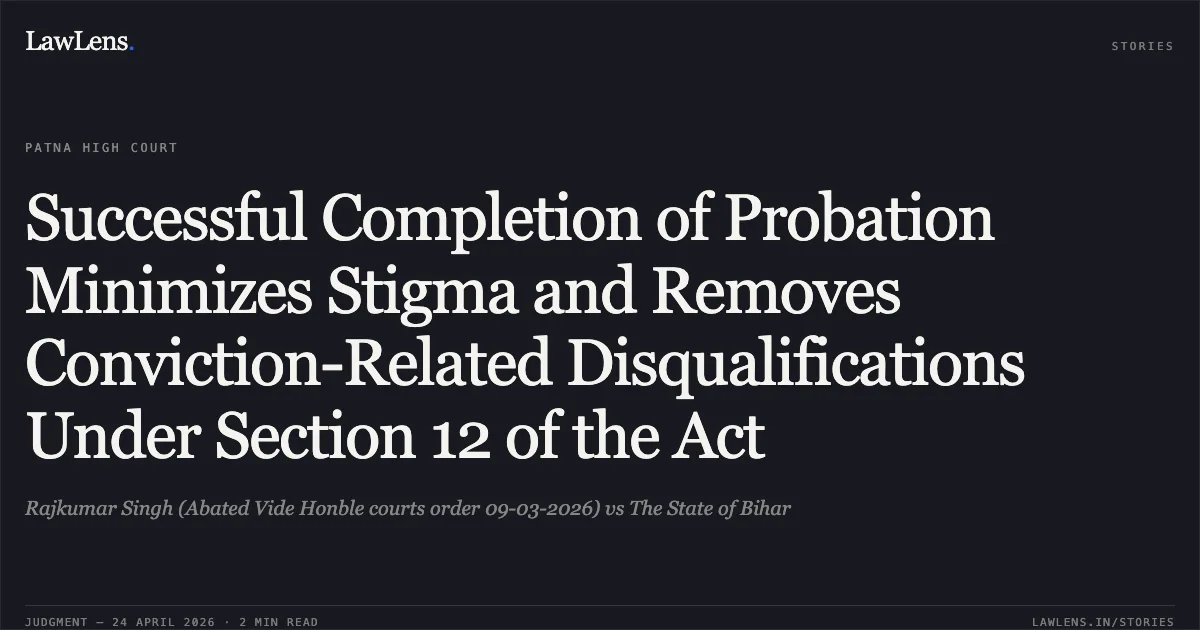
Source reference: p. 3Section 12 of the same Act, which mandates that a person dealt with under Section 3 or 4 shall not suffer any disqualification attaching to a conviction
Source reference: p. 5-6The court emphasized the rehabilitative intent of the Act, noting that the legislative purpose is to facilitate reformation rather than punishment
Source reference: p. 6Reasoning
The Court observed that since Appellant No. 3 had successfully completed the one-year probation period without any adverse reports or violations, the punitive aspect of the proceedings was effectively concluded
Source reference: p. 5The Court reasoned that the "object of the Act is rehabilitative" and that a decision to grant probation signifies the judiciary's finding of an individual’s capacity for reformation
Source reference: p. 6It was determined that if the stigma of conviction were allowed to persist and hinder the appellant's professional or personal life, the very "legislative intent" and "purpose of the Act" would be frustrated
Source reference: p. 6Consequently, the Court found it unnecessary to delve into the merits of the original criminal charges, focusing instead on the legal protection afforded by Section 12 to ensure the appellant's reintegration into society
Source reference: p. 6-7Holding
The Court held that in view of the successful completion of the probation, the conviction shall not be treated as a "disqualification" for any benefits, as per Section 12 of the Act
The High Court specifically ordered that the Trial Court’s findings shall not operate as a stigma on the appellant's character nor hinder his career prospects
Source reference: p. 7The appeal was disposed of with these directions without a formal reversal on merits
Source reference: p. 7Acts & Sections Cited
7 provisions across 2 statutes referred to in this judgment. Each provision opens on LawLens.
Indian Penal Code, 18603
Probation of Offenders Act, 19584
Original Court PDF
Rajkumar Singh (Abated Vide Honble courts order 09-03-2026)vsThe State of Bihar
Click to open original judgment
Original judgment, available to read, download and summarize on LawLens.in