Facts
The petitioner applied for admission to NLUO’s three-year LL.B. course for the academic year 2026–2027 under the Odisha Domicile Reservation Category.
Source reference: p.2, paras. 2–3She was permitted to sit for the entrance examination, secured All India Rank 61 and Odisha Domicile Rank 6, and was issued a provisional admission offer.
Source reference: p.2, paras. 2–3During counselling, the University required domicile-category candidates to have passed their undergraduate or equivalent examination from a recognised college or university located in Odisha.
Source reference: p.2, para. 2; p.5, para. 7The petitioner had passed her Class XII examination in Odisha but had completed her graduation from Kalinga University, Raipur, Chhattisgarh.
Source reference: p.2, para. 3; p.7, para. 10She relied on an earlier University webpage, which stated that a domicile candidate was required to have passed the Class XII examination from Odisha with at least 60% marks.
Source reference: p.2, para. 4The University contended that the webpage related to an earlier academic year and that the eligibility requirement had been corrected from the 2025–2026 academic session onwards.
Source reference: p.4, paras. 6–7The petitioner paid ₹30,000 and ₹20,000 towards provisional admission fees, which were subsequently refunded after deduction of a nominal amount.
Source reference: p.3, paras. 4–6During the proceedings, the University stated that all seats had been filled but undertook to consider her admission if a vacancy arose.
Source reference: p.5, para. 8Issues
1. Whether the petitioner satisfied the eligibility requirement for admission under the Odisha Domicile Reservation Category when she had completed graduation outside the State of Odisha?
Source reference: p.6–7, paras. 9–102. Whether the petitioner’s participation in the entrance examination, successful ranking, provisional admission offer, and payment of fees created an enforceable right to admission or attracted the doctrine of promissory estoppel against the University?
Source reference: p.7–9, paras. 11–123. Whether the Court could direct her admission despite the absence of an available seat, and what consequential relief ought to be granted?
Source reference: p.9–10, para. 13Law Applied
The Court exercised jurisdiction under Articles 226 and 227 of the Constitution of India.
Source reference: p.1It applied the eligibility condition contained in the University’s admission notification for 2026–2027, which required an Odisha domicile candidate to have passed an undergraduate programme or equivalent examination from a recognised college or university in Odisha, with the prescribed marks.
Source reference: p.5–7, paras. 7, 9The Court relied on the principle that participation in an entrance examination or selection by mistake does not override a mandatory eligibility condition and does not confer a right to admission.
Source reference: p.7–8, para. 11In this regard, it referred to Central Airmen Selection Board v. Surender Kumar Das, (2003) 1 SCC 152, concerning the inapplicability of promissory estoppel where selection is contrary to the governing advertisement or rules.
Source reference: p.7–8, para. 11Professional Examination Board, Madhya Pradesh v. Prashant Agrawal, (2010) 15 SCC 756, which held that successful performance in an entrance examination does not prevent refusal of admission where the candidate was disqualified from appearing in the examination itself.
Source reference: p.8–9, para. 12Reasoning
The Court found that the applicable 2026–2027 admission notification, read with the 2025–2026 prospectus, clearly required completion of the undergraduate programme from a recognised institution in Odisha.
Source reference: p.6–7, para. 9Since the petitioner had graduated from Kalinga University in Raipur, Chhattisgarh, she did not satisfy the mandatory domicile-category eligibility condition, notwithstanding that she had completed her Class XII education in Odisha.
Source reference: p.7, para. 10The Court acknowledged that the University had mistakenly permitted her to take the entrance examination, rank successfully, pay provisional fees, and receive a provisional admission offer without any fault or misrepresentation on her part.
Source reference: p.7, para. 10However, applying the principle that an administrative mistake cannot validate an otherwise ineligible admission, the Court held that the petitioner’s participation and provisional selection could not create a vested right or invoke promissory estoppel against the mandatory admission criteria.
Source reference: p.7–9, paras. 11–12The Court also declined to displace an already admitted candidate because all seats were occupied.
Source reference: p.9, para. 13Holding
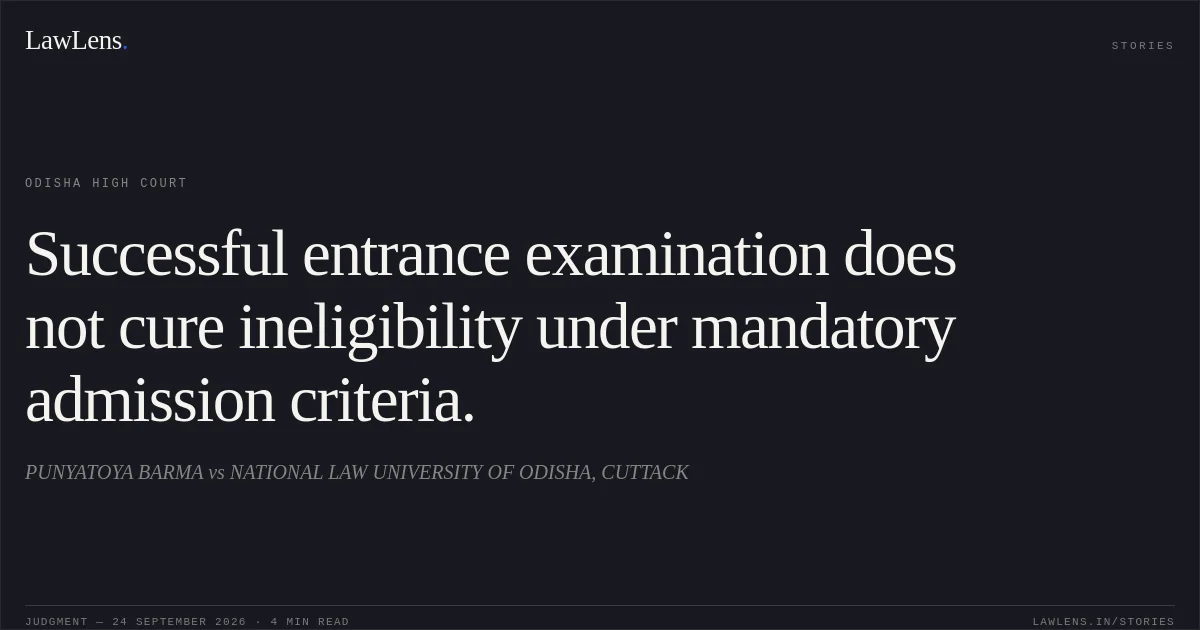
The Court held that the petitioner was ineligible for admission under the Odisha Domicile Reservation Category because she had completed her graduation outside Odisha.
Her participation in the entrance examination, rank, provisional admission offer, and payment of fees did not confer an enforceable right to admission or operate by way of promissory estoppel.
Source reference: p.7–9, paras. 11–12The writ petition was disposed of without directing immediate admission.
Source reference: p.9–10, paras. 13–14The University was directed to offer admission to the petitioner if a seat in the three-year LL.B. course became vacant by the end of November 2026, provided there was no legal impediment.
Source reference: p.9–10, paras. 13–14If no admission was offered within that period, the University was directed to pay her ₹1 lakh as symbolic compensation for its mistake.
Source reference: p.9–10, paras. 13–14The Court clarified that the direction would not operate as a precedent.
Source reference: p.9–10, paras. 13–14Original Court PDF
PUNYATOYA BARMAvsNATIONAL LAW UNIVERSITY OF ODISHA, CUTTACK
Click to open original judgment
Original judgment, available to read, download and summarize on LawLens.in