Facts
The Appellant, a 75-year-old widow, filed FIR No. 10/2025 alleging that her son (Accused No. 1) and daughter-in-law (Accused No. 2) cheated her by transferring family properties into her name via a settlement deed, selling the land at a significantly higher price than disclosed, and withdrawing approximately ₹9.65 crore from her bank account
Source reference: para. 3The Appellant further alleged that the Accused received an additional ₹22 crore in undisclosed payments and rendered her homeless after seizing her residence
Source reference: para. 4After two lower courts and the High Court (on 04.08.2025) denied anticipatory bail citing the necessity of custodial interrogation
Source reference: paras. 5-6the Accused filed a third petition within a month. Despite an intervention by the Appellant, the High Court granted anticipatory bail on 15.09.2025
Source reference: para. 6Subsequently, the Accused obtained an interim stay on the FIR proceedings
Source reference: para. 8Issues
1. Whether the High Court was justified in granting anticipatory bail in a successive application without a change in circumstances or consideration of prior dismissals
Source reference: para. 6, 112. Whether the nature of the allegations involving the exploitation of a senior citizen and lack of cooperation in financial investigations warranted the exercise of discretionary relief under the law
Source reference: para. 9, 12Law Applied
The Court considered Sections 406 (Criminal breach of trust) and 420 (Cheating) of the Indian Penal Code, 1860, and Section 24 of the Maintenance and Welfare of Parents and Senior Citizens Act, 2007
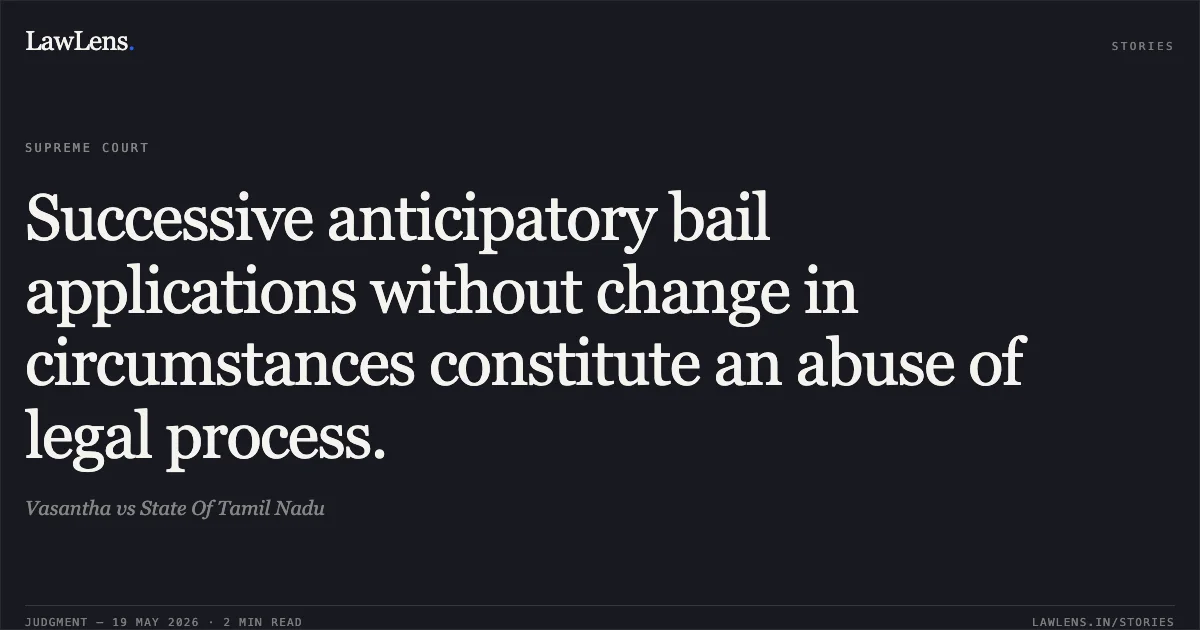
Source reference: para. 3The Court emphasized that filing successive bail applications in quick succession without changed circumstances constitutes an "abuse of process" and reduces the legal safeguard of personal liberty to a "mere gamble"
Source reference: para. 11the principles governing Section 438 of the CrPC (now Section 482 of BNSS, 2023) regarding the discretionary grant of anticipatory bail.
Source reference: no citationSection 528 of the Bharatiya Nagarik Suraksha Sanhita, 2023, regarding the quashing of proceedings
Source reference: para. 8Reasoning
The Court observed that the High Court failed to address the dismissal of the previous bail application by a different Bench only a month prior, thereby ignoring the requirement to identify a "change in circumstances"
Source reference: para. 6It criticized the High Court for oversimplifying the matter as a "mere real estate business" dispute over land prices, failing to recognize the gravity of the elder abuse and the financial fraud alleged by the mother
Source reference: para. 7, 12The Supreme Court noted that the Accused failed to cooperate with investigators by withholding documents despite the bail conditions
Source reference: para. 9The Court reasoned that the rapid filing of three petitions in three months followed immediately by a stay on the investigation brought the case to a "grinding halt," which was an inappropriate outcome given the need for custodial interrogation to trace the flow of funds
Source reference: para. 9, 11Holding
The Court held that this was not a fit case for anticipatory bail due to the deceptive nature of the transactions against a septuagenarian and the lack of bona fides shown by the Accused
The Supreme Court allowed the appeal and set aside the High Court’s order dated 15.09.2025
Source reference: para. 13The order granting anticipatory bail was cancelled to allow the investigation to proceed unhindered.
Source reference: no citationActs & Sections Cited
4 provisions across 3 statutes referred to in this judgment. Each provision opens on LawLens.
Indian Penal Code, 18602
Maintenance and Welfare of Parents and Senior Citizens Act, 20071
Bharatiya Nagarik Suraksha Sanhita, 20231
Original Court PDF
VasanthavsState Of Tamil Nadu
Click to open original judgment
Original judgment, available to read, download and summarize on LawLens.in