Facts
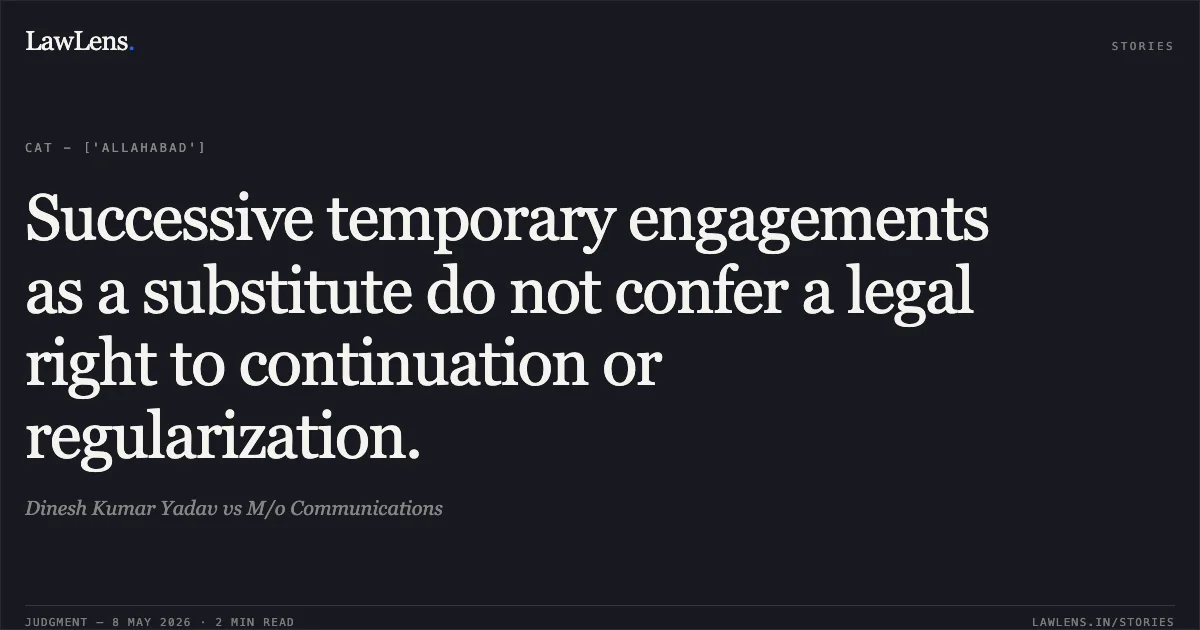
The applicant was engaged as a substitute Gramin Dak Sevak (GDS) Mail Carrier/Mail Distributor at the Kusumhi Branch Post Office starting April 1, 2017
Source reference: p. 2, para 3.1His engagement was based on successive, fixed-term orders of 88 days each, separated by brief "artificial breaks"
Source reference: p. 2, para 3.1Upon the expiry of his last term on March 18, 2019, the respondents discontinued his engagement despite the alleged continued availability of work and the engagement of other temporary staff
Source reference: p. 2, para 3.3The applicant challenged this discontinuation, seeking a direction to continue in service until a regular appointment is made
Source reference: p. 1, para 2The respondents contended that the engagement was purely contractual, stop-gap, and conferred no right to permanency
Source reference: p. 4, para 4.2Issues
1. Whether repeated temporary engagements as a substitute for fixed durations confer a legal right to continuity of service or regularisation
Source reference: p. 6, para 72. Whether a temporary or substitute employee has a legal right to prevent the employer from replacing them with another temporary arrangement when the initial engagement was conditional and time-bound
Source reference: p. 6, para 8Law Applied
The Tribunal primarily applied the Constitutional principles of public employment under Articles 14 and 16
Source reference: p. 7, para 12It relied heavily on the landmark precedent of Secretary, State of Karnataka v. Umadevi (2006) 4 SCC 1, which established that temporary, contractual, or ad-hoc employees do not acquire a right to regularisation or continuation merely by length of service unless supported by statutory rules
Source reference: p. 6-7, para 9Furthermore, the Tribunal applied the principle that mala fides must be specifically pleaded and proved with credible evidence to vitiate an administrative action
Source reference: p. 7, para 11Reasoning
The Tribunal reasoned that each of the applicant's 88-day engagements constituted a separate, independent contract governed by specific terms that the applicant had voluntarily accepted
Source reference: p. 6, para 6 & 7The Tribunal found that the "artificial breaks" did not create a right to continuity because there was no statutory provision or rule overriding the express conditions of the temporary engagement
Source reference: p. 6, para 7Regarding the replacement of one temporary hand by another, the Tribunal observed that since the applicant was a "substitute" rather than a regular appointee, his presence was contingent upon administrative necessity
Source reference: p. 6, para 8The Tribunal noted that the applicant had been out of service since 2019, further weakening his claim for a mandatory injunction for continuation
Source reference: p. 6, para 8The court concluded that the applicant failed to demonstrate any violation of the constitutional scheme of employment as defined in Umadevi, as he lacked a vested legal right to remain in a post held dehors the recruitment rules
Source reference: p. 7, para 10-12Holding
The Tribunal answered both issues in the negative, holding that the applicant established no enforceable legal right to seek continuation in a purely temporary, need-based role
The Original Application was dismissed as devoid of merit. However, the Tribunal granted the applicant liberty to participate in any future regular recruitment process, where his candidature must be considered according to applicable rules without preference for his past temporary service
Source reference: p. 7, para 14 & p. 7-8, para 15Acts & Sections Cited
1 provisions across 1 statute referred to in this judgment. Each provision opens on LawLens.
Administrative Tribunals Act, 19851
Original Court PDF
Dinesh Kumar YadavvsM/o Communications
Click to open original judgment
Original judgment, available to read, download and summarize on LawLens.in