Facts
The petitioner challenged certain resolutions of the Cantonment Board, Jabalpur, passed between April 2013 and June 2015, particularly the resolution dated 28 May 2015, alleging unauthorised expenditure of public funds and facilitation of encroachment on defence land. He also sought quashing of the communication dated 10 August 2017, a Central Vigilance Commission inquiry, recovery of the alleged loss from the then Executive Officer, and consequential directions concerning public expenditure and accounts.
Source reference: para. 1The petitioner had previously pursued the same grievance in four proceedings. In W.P. No. 13049/2015 (PIL), the Court directed him to approach the competent departmental authorities. His representation was rejected on merits by the Principal Director, Defence Estates, on 11 April 2016, who found that the petitioner was himself in unauthorised occupation of defence land bearing GLR Survey No. 165-A, Jabalpur Cantonment.
Source reference: para. 3W.P. No. 15405/2016 (PIL) challenging that rejection was dismissed on 16 September 2016, with limited liberty to approach vigilance authorities or the competent CBI authority. The petitioner thereafter complained to the Central Vigilance Commission, and his complaint was forwarded to the competent departmental authority through the communication dated 10 August 2017.
Source reference: para. 4A third petition, W.P. No. 241/2018 (PIL), was withdrawn after the Court questioned its maintainability, and a fourth petition, W.P. No. 28893/2019, filed as a regular writ petition on the same grievance, was dismissed on 12 March 2019.
Source reference: paras. 5–6The present petition constituted the petitioner’s fifth round of litigation concerning the same resolutions and allegations.
Source reference: para. 7Issues
Whether the present writ petition was barred by constructive res judicata and the principle of finality, having regard to the petitioner’s earlier proceedings concerning the same Cantonment Board resolutions and grievance?
Source reference: paras. 8–12Whether the communication dated 10 August 2017, forwarding the petitioner’s vigilance complaint for departmental examination, was liable to be quashed?
Source reference: paras. 8, 13, 16Whether the petitioner was entitled to relief against the Cantonment Board resolution dated 28 May 2015 or to directions for inquiry, recovery, and action against the concerned officers?
Source reference: paras. 1, 13–17Law Applied
The Court applied the doctrine of constructive res judicata, derived from Section 11 of the Code of Civil Procedure, 1908, which applies to successive writ petitions and bars not only matters actually decided but also matters that could and ought to have been raised in earlier proceedings.
Source reference: para. 9Relying on Forward Construction Co. v. Prabhat Mandal (Regd.), Andheri, (1986) 1 SCC 100, the Court held that an adjudication is conclusive regarding the subject matter and all issues that the parties might and ought to have litigated.
Source reference: para. 9The Court also applied the principle that repeated and vexatious PILs constitute an abuse of the process of court and that PIL jurisdiction cannot be used to pursue personal grievances, harass public officials, or reopen concluded disputes.
Source reference: paras. 10–12In relation to the land dispute, the Court referred to the General Land Register maintained under Rule 10 of the Cantonment Land Administration Rules, 1937, framed under Section 280 of the Cantonments Act, 1924, and accepted the finding that the land was Government defence land classified as B-3.
Source reference: paras. 3, 14Reasoning
The Court held that the petitioner’s challenge concerned the very same Cantonment Board resolutions and alleged expenditure that had already been examined by the departmental authority in its order dated 11 April 2016 and by the High Court in its order dated 16 September 2016.
Source reference: para. 8The petitioner had also pursued three subsequent proceedings on the same subject, including one withdrawal and one dismissal, without disclosing any fresh fact, document, or independent cause of action.
Source reference: paras. 5–7, 11–12Applying constructive res judicata and the requirement of finality in litigation, the Court concluded that the petitioner could not use a fifth writ petition to obtain a re-trial of the concluded controversy.
Source reference: paras. 8–12The communication dated 10 August 2017 was found to be merely an administrative forwarding of the vigilance complaint to the competent authority pursuant to the limited liberty granted in the earlier order; it was not an adjudicatory order creating an independent cause of action.
Source reference: paras. 4, 8Further, the departmental inquiry had found that the resolutions related to repairs of existing public roads, drains, public group latrines, and other public utilities, and that the Cantonment Board had acted in accordance with applicable rules, statutes, and Government policy.
Source reference: para. 15The petitioner produced no new material demonstrating that the 11 April 2016 report was arbitrary or misconceived.
Source reference: para. 16The Court also considered the petitioner’s unauthorised occupation of defence land and his resulting lack of locus to assert rights concerning that land.
Source reference: paras. 3, 14Holding
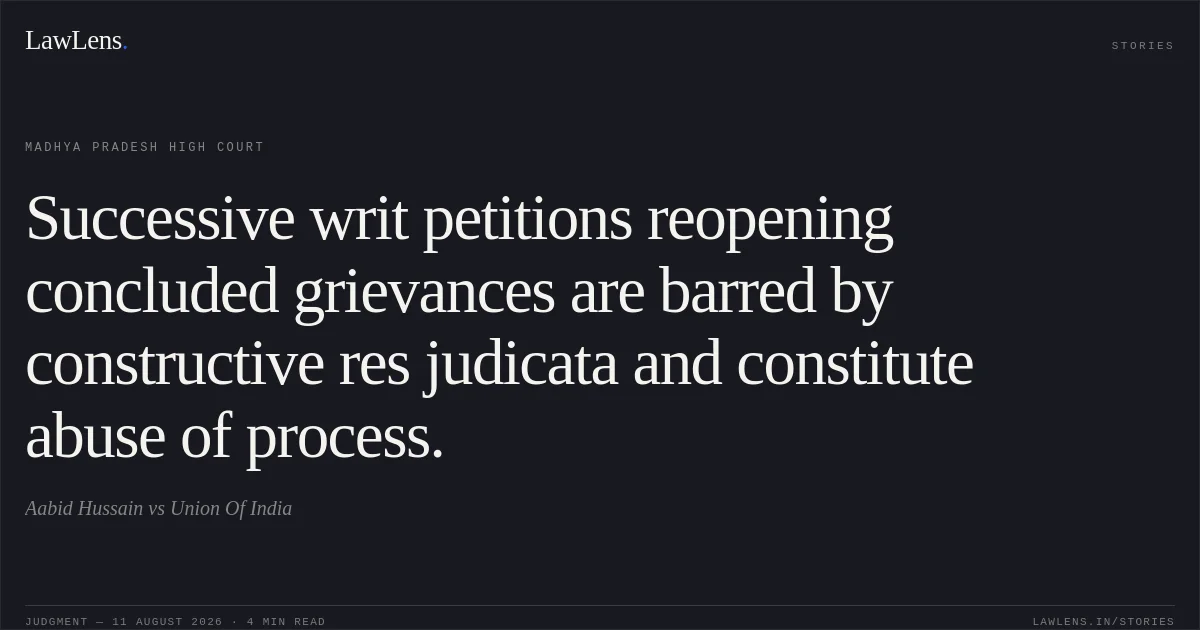
The Court dismissed the writ petition, holding that it was barred by constructive res judicata, sought to reopen matters that had attained finality, and amounted to an abuse of the process of the Court.
The challenge to the communication dated 10 August 2017 failed because the communication merely forwarded the complaint for departmental examination and disclosed no independent legal infirmity.
Source reference: paras. 8, 16No relief was granted against the Cantonment Board resolution dated 28 May 2015, nor were directions issued for further inquiry, recovery, or action against the officers.
Source reference: para. 17The petitioner was directed to pay costs of ₹50,000 to the State Legal Services Authority, Jabalpur.
Source reference: para. 17Acts & Sections Cited
1 provisions across 1 statute referred to in this judgment. Each provision opens on LawLens.
Code of Civil Procedure, 19081
Original Court PDF
Aabid HussainvsUnion Of India
Click to open original judgment
Original judgment, available to read, download and summarize on LawLens.in