Facts
The applicant was engaged as a casual mazdoor/labourer in the Department of Telecommunication (DoT) starting in 1989
Source reference: p. 2Following the transition of DoT to Bharat Sanchar Nigam Limited (BSNL) on October 1, 2000, the applicant continued his service uninterruptedly until May 2017
Source reference: p. 2In 2003, his name was included in a list for the regularization of left-out casual mazdoors, yet he remained unregularized
Source reference: p. 2-3In May 2017, the authorities ceased allowing him to work
Source reference: p. 3The respondents contested the claim, arguing that the applicant was a daily-rated worker not appointed against a sanctioned post, and that regularization was legally impermissible following the decision in Secretary, State of Karnataka v. Uma Devi
Source reference: p. 3-4The respondents further raised objections based on the statute of limitation and res judicata
Source reference: p. 4Issues
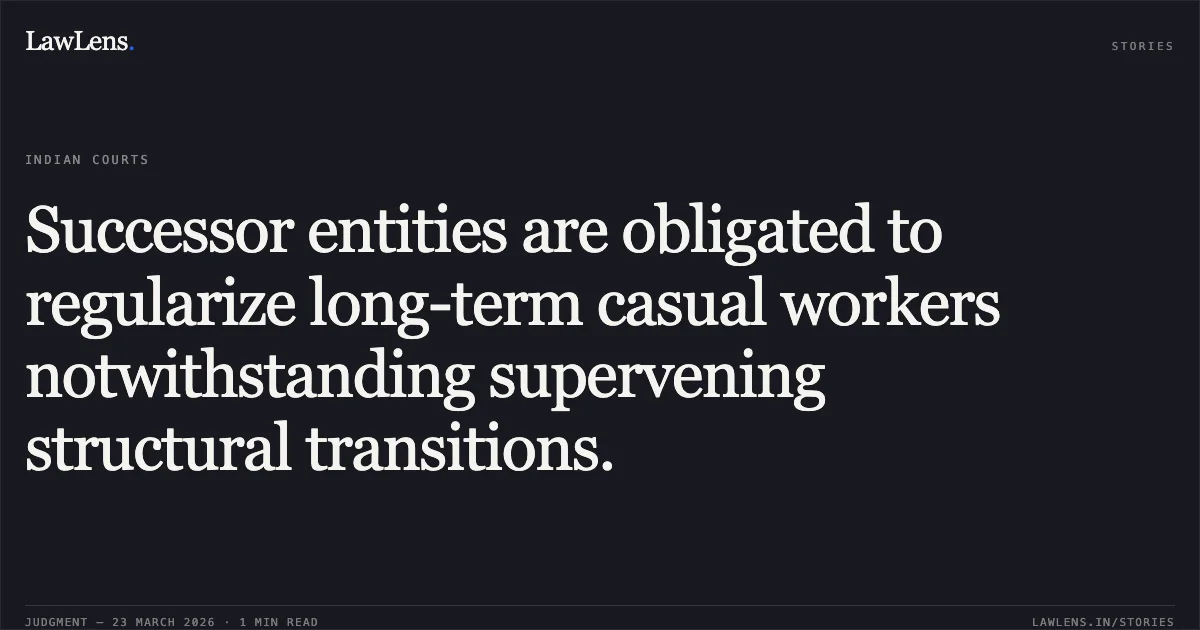
1. Whether BSNL, as the successor to the DoT, is obligated to regularize casual workers engaged prior to its formation
Source reference: p. 82. Whether the Original Application is barred by the law of limitation or the principle of res judicata given the long history of engagement and internal correspondence
Source reference: p. 8-93. Whether recent Supreme Court precedents regarding long-term casual employment override earlier restrictions on regularization
Source reference: p. 11-12Law Applied
The Tribunal primarily relied on the Full Bench decision of the Cuttack Bench in Manoranjan Naik Ors v. UOI Ors (OA No. 654/2015), which established that successor bodies inherit the liabilities and obligations of their predecessors
Source reference: p. 8It applied the principle of Article 141 of the Constitution, asserting that the "law declared" by the Supreme Court is binding on all courts
Source reference: p. 9, 13Key precedents included Jaggo v. Union of India (2024), Vinod Kumar Ors. v. Union of India (2024), Dharam Singh v. State of U.P. (2025), and Bhola Nath v. State of Jharkhand (2026), which collectively favor the regularization of workers continuing on daily wage/casual basis for decades
Source reference: p. 5, 12The court also distinguished the application of delay and laches in cases involving "judgments in rem" touching upon policy matters and Article 14 violations, citing State of UP v. Arvind Kumar Shrivastva
Source reference: p. 9-10Reasoning
The Tribunal found that the facts and legal issues were identical to those decided by the Full Bench in Manoranjan Naik
Source reference: p. 7It reasoned that BSNL cannot avoid its responsibility toward workers engaged by the DoT, as the successor body "steps into the shoes" of the predecessor regarding prior obligations
Source reference: p. 8On the issue of limitation, the Tribunal determined that the delay was not intentional but resulted from ongoing internal correspondence and the long history of the applicant’s engagement
Source reference: p. 8Crucially, the court analyzed the shift in judicial trends: while the respondents relied on Uma Devi to argue against regularization, the Tribunal held that recent Supreme Court decisions (Jaggo, Dharam Singh, and Bhola Nath) have created a principle in favor of regularizing individuals who have served for "years together" on a casual or contractual basis
Source reference: p. 13By applying these latest "laws in rem," the Tribunal concluded that the applicant had a fundamental right to be regularized that could not be extinguished by technicalities or structural changes in the organization
Source reference: p. 11-12Holding
The Tribunal allowed the Original Application, holding that the applicant is entitled to regularization based on the principles of equity and the binding precedents of the Supreme Court
The Tribunal directed the respondents to regularize the applicant's services and issue the necessary compliance orders within 180 days of receiving the judgment
Source reference: p. 14All pending Miscellaneous Applications were disposed of, and parties were ordered to bear their own costs
Source reference: p. 14Original Court PDF
S SAHOOvsBharat Sanchal Nigam Limited
Click to open original judgment
Original judgment, available to read, download and summarize on LawLens.in


