Facts
The appellant was convicted by the Sessions Court, Bhavnagar, under Section 302 of the Indian Penal Code (IPC) for the murder of his mother
Source reference: para 1On September 29, 2014, a verbal altercation occurred between the appellant and his mother regarding tea and his employment
Source reference: para 2.1The complainant (the appellant’s father) witnessed the appellant fleeing the house carrying an iron mortar, while the deceased lay in a pool of blood with fatal head injuries
Source reference: para 9Medical evidence confirmed the cause of death as shock and hemorrhage resulting from head injuries inflicted by a hard, blunt object
Source reference: para 11The appellant challenged the conviction, contending the act occurred during a sudden, unpremeditated quarrel
Source reference: para 5Issues
1. Whether the act of the appellant amounts to murder under Section 302 or culpable homicide not amounting to murder under Section 304 of the IPC
Source reference: para 72. Whether the circumstances of the case satisfy the requirements of Exception 4 to Section 300 of the IPC regarding sudden fight and lack of premeditation
Source reference: para 14Law Applied
The court applied the distinction between "murder" and "culpable homicide not amounting to murder" based on the degree of mens rea
Source reference: para 8It relied on Section 300 Exception 4 of the IPC, which mitigates murder to culpable homicide if the act is committed without premeditation in a sudden fight in the heat of passion
Source reference: para 14The court cited Virsa Singh v. State of Punjab regarding the intention to inflict bodily injury
Source reference: para 13Rampal Singh v. State of U.P., which provides a three-stage approach to distinguish Sections 299 and 300
Source reference: para 13It further referenced Nandkumar @ Nandu Manilal Mudaliar v. State of Gujarat to evaluate the grading of punishment under Section 304 Parts I and II based on intention versus knowledge
Source reference: para 13Reasoning
Upon re-appreciation of evidence, the High Court found that the prosecution proved the appellant caused the fatal injury, but failed to establish premeditated intent to kill
Source reference: para 12The court observed that the incident arose from a "sudden and trivial quarrel" over domestic chores between a son and mother residing together
Source reference: para 12There was no evidence of prior enmity or a planned attack
Source reference: para 12The weapon used—an iron mortar—was a common household object picked up at the scene, indicating the assault occurred in the heat of the moment
Source reference: para 5While the appellant possessed the "knowledge" that a blow to the head was likely to cause death, the lack of premeditation and the nature of the sudden provocation brought the case within Exception 4 to Section 300
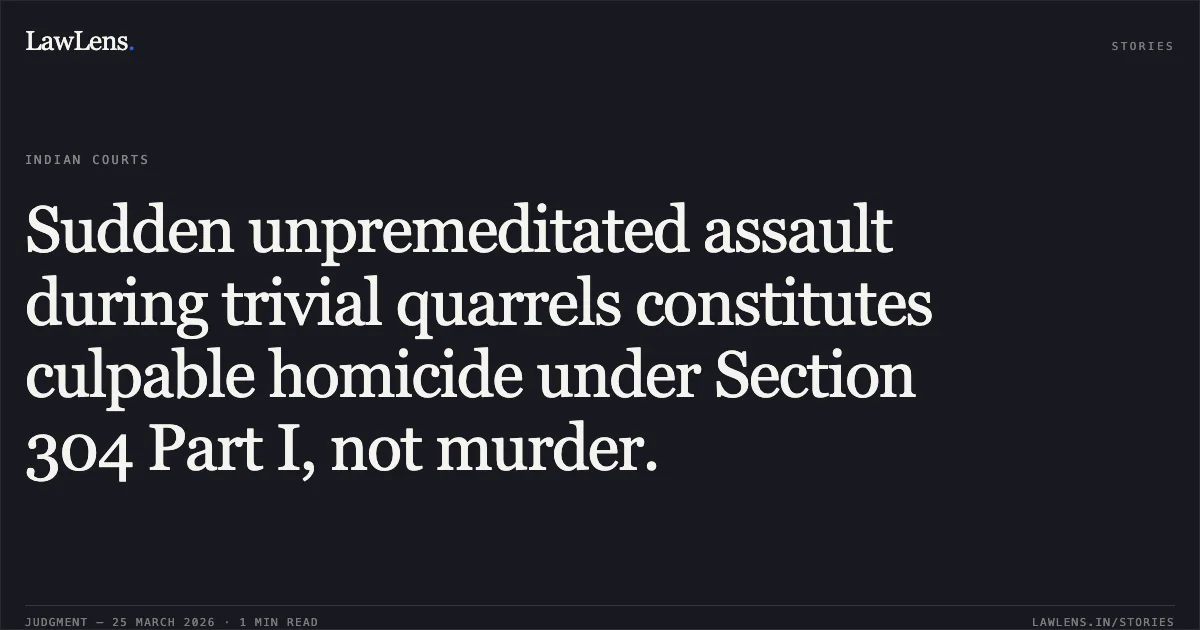
Source reference: para 14Consequently, the court determined the offense was punishable under Section 304 Part I rather than Section 302
Source reference: para 14Holding
The High Court partly allowed the appeal, altering the conviction from Section 302 IPC to Section 304 Part I IPC
The court held that since the appellant had already undergone 11 years and 1 month of actual imprisonment, the sentence of life imprisonment should be modified to the period already undergone
Source reference: para 15(b)The appellant was ordered to be set at liberty forthwith, provided he was not required in any other case, while the fine and default sentence remained unaltered
Source reference: para 15(c)-(d)Acts & Sections Cited
7 provisions across 3 statutes referred to in this judgment. Each provision opens on LawLens.
Gujarat Police Act, 1951.1
Indian Penal Code, 18604
Code of Criminal Procedure, 19732
Original Court PDF
CHETANBHAI RAVJIBHAI CHAUHANvsSTATE OF GUJARAT
Click to open original judgment
Original judgment, available to read, download and summarize on LawLens.in


