Facts
On July 13, 2019, the deceased, Sanjeev Pandey, intervened in a domestic quarrel between the appellant and his wife
Source reference: para. 3, 23After the deceased returned to his own room, the appellant followed him while armed with a kitchen knife
Source reference: para. 23During the ensuing altercation, the deceased struck the appellant on the head with a danda (wooden stick)
Source reference: para. 23, 40The appellant subsequently stabbed the deceased in the chest and thigh, resulting in the victim's death due to hemorrhagic shock from a heart injury
Source reference: para. 3, 24, 30The Trial Court convicted the appellant under Section 302 of the IPC (Murder) and sentenced him to rigorous imprisonment for life
Source reference: para. 1, 2The appellant challenged the conviction, contending the act occurred during a sudden fight without premeditation
Source reference: para. 15Issues
Whether the appellant’s act of stabbing the deceased amounts to murder under Section 302 IPC or culpable homicide not amounting to murder under Section 304 IPC
Source reference: para. 32, 43Whether the case falls within Exception 4 to Section 300 IPC, considering the incident was preceded by a sudden quarrel and an assault by the deceased
Source reference: para. 15, 41Law Applied
The court applied the definitions of "Culpable Homicide" under Section 299 IPC and "Murder" under Section 300 IPC
Source reference: para. 33, 35It specifically scrutinized Exception 1 (grave and sudden provocation) and Exception 4 (sudden fight in the heat of passion) of Section 300 IPC
Source reference: para. 35, 36, 39The court relied on Rampal Singh v. State of U.P., which distinguishes the three degrees of culpable homicide and the distinction between "intention" and "knowledge"
Source reference: para. 38It further cited Dauvaram Nirmalkar v. State of Chhattisgarh regarding the "sustained provocation" and "reasonable man" tests and Mangesh v. State of Maharashtra regarding the assessment of intention based on the force and nature of injuries
Source reference: para. 39, 42Reasoning
The court found that while the appellant caused the fatal injuries, the incident lacked the premeditation required for murder
Source reference: para. 41The court emphasized that the deceased had initiated the physical confrontation by striking the appellant on the head with a danda
Source reference: para. 40, 43Applying the principles from Rampal Singh, the court observed that the incident occurred on the spur of the moment in a "heat of passion" following the deceased’s intervention in the appellant's domestic dispute
Source reference: para. 41Furthermore, citing Mangesh, the court noted that the use of a domestic kitchen knife in the context of a sudden struggle indicated a lack of specific intent to cause death or such bodily injury as is likely to cause death
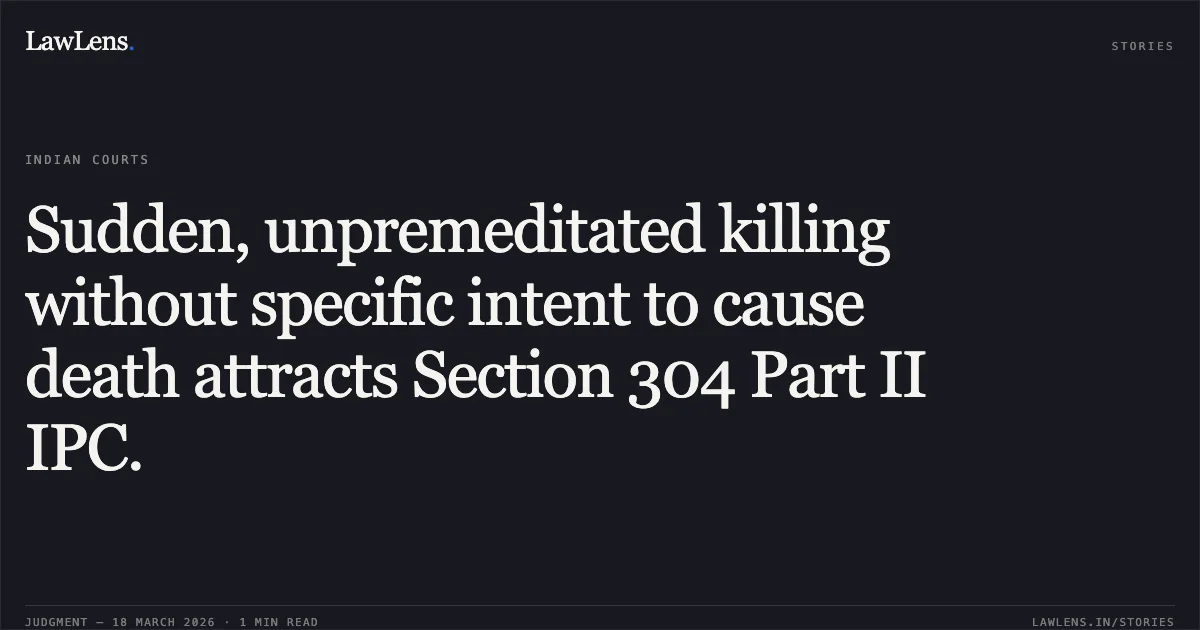
Source reference: para. 42, 43However, the court held that by wielding a knife and stabbing the deceased in a vital area, the appellant possessed the "knowledge" that his act was likely to cause death, thereby satisfying the criteria for Section 304 Part II IPC rather than Section 302 IPC
Source reference: para. 43Holding
The High Court set aside the Trial Court’s judgment of conviction under Section 302 IPC and the corresponding sentence of life imprisonment
The court held the appellant guilty of the offence punishable under Section 304 Part II IPC
Source reference: para. 45Considering the appellant had already served more than seven years of imprisonment (including remissions), the court modified the sentence to the period already undergone and directed his immediate release, provided he was not required in any other case
Source reference: para. 45The fine imposed by the Trial Court was sustained
Source reference: para. 46Acts & Sections Cited
5 provisions across 2 statutes referred to in this judgment. Each provision opens on LawLens.
Indian Penal Code, 18604
Code of Criminal Procedure, 19731
Original Court PDF
Jitan BoravsThe State
Click to open original judgment
Original judgment, available to read, download and summarize on LawLens.in


![Subsequent exoneration does not retrospectively invalidate a finalized promotion select list.. UNNIKRISHNAN M vs M/o Environment And Forests. CAT - ['Ernakulam']. LawLens](/stories/thumbnails/subsequent-exoneration-does-not-retrospectively-invalidate-a-finalized-promotion-select-li-ce80a0e84f2f4887857271e8b4341c42.webp)