Facts
The petitioners (plaintiffs) filed Special Civil Suit No. 52 of 2017, which was dismissed for default on 13.07.2023 due to their non-appearance and failure to submit oral evidence.
Source reference: p. 5The petitioners filed a restoration application (Civil Miscellaneous Application No. 31 of 2024) with a delay of 10 months.
Source reference: p. 3The delay was attributed to the advanced age and heart disease of Plaintiff No. 1, the death of Plaintiff No. 2 in 2019, and disruptions caused by the COVID-19 pandemic.
Source reference: p. 5The Trial Court (Principal Senior Civil Judge, Kheda) rejected the delay condonation application on 13.03.2025, adopting what the petitioners termed a "hyper-technical" approach.
Source reference: p. 4The petitioners challenged this rejection under Article 227 of the Constitution of India.
Source reference: p. 1Issues
1. Whether the Trial Court erred in refusing to condone the 10-month delay in filing the restoration application despite the uncontroverted medical and personal reasons provided by the petitioners.
Source reference: p. 5-62. Whether "sufficient cause" for delay should be interpreted liberally to ensure cases are decided on merits rather than technicalities.
Source reference: p. 6Law Applied
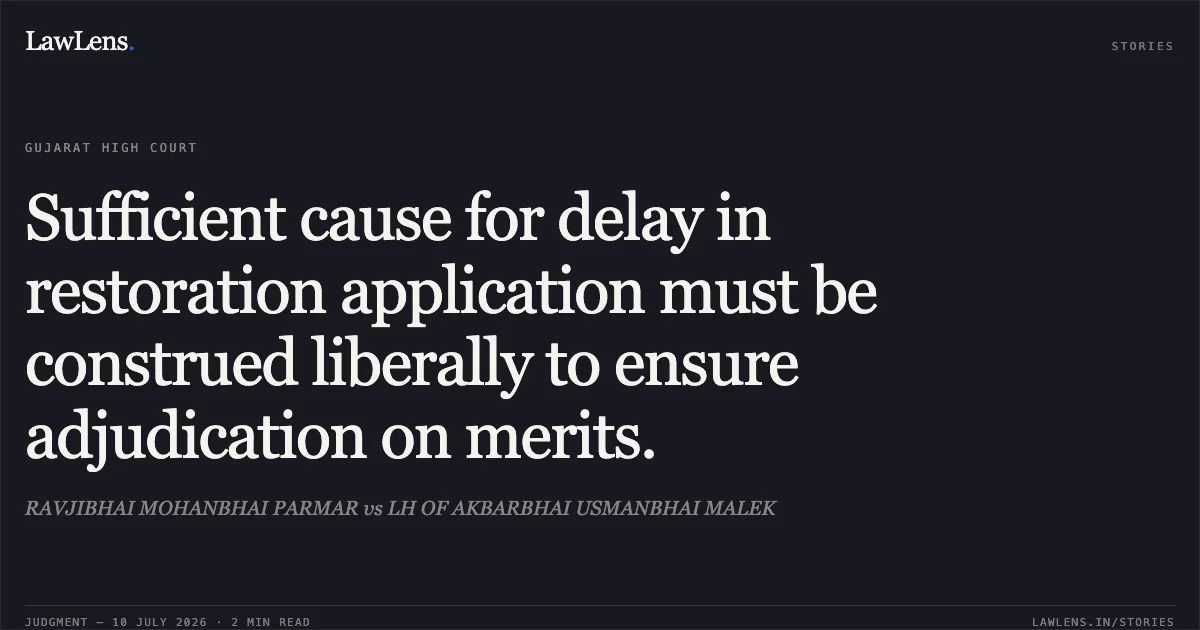
The Court applied the principle of "sufficient cause" under the Limitation Act, emphasizing that it must be construed liberally to advance substantial justice.
Source reference: p. 6The Court relied on the doctrine that a hyper-technical approach should be avoided unless there is evidence of gross negligence, inordinate delay without explanation, or mala fide intentions.
Source reference: p. 6It also considered the discretionary powers under Article 227 of the Constitution of India to correct jurisdictional errors or patent illegalities in subordinate court orders.
Source reference: p. 1Reasoning
The High Court observed that the respondents failed to file a reply to the delay application in the Trial Court, leaving the petitioners' assertions regarding heart disease and the death of a party "uncontroverted".
Source reference: p. 4-5The Court found that the Trial Court failed to appreciate the impact of the COVID-19 pandemic on litigants and the specific health grievances of the elderly plaintiffs.
Source reference: p. 5The Court reasoned that there was no evidenced mala fide intention to delay the trial.
Source reference: p. 5-6It held that instead of dismissing the suit on technical grounds, the Trial Court should have exercised its discretion to condone the delay by compensating the other side with costs, thereby allowing the suit to be heard on its merits.
Source reference: p. 6Holding
The High Court allowed the petition and quashed the Trial Court's order dated 13.03.2025.
The Court condoned the 10-month delay in filing the restoration application.
Source reference: p. 7As a condition previously set by the High Court, the petitioners deposited ₹15,000, which the Court directed to be transferred to the District Legal Services Authority (DLSA), Kheda, rather than the respondents, since the respondents did not appear to contest the matter. The Trial Court is directed to hear and decide the restoration application of Special Civil Suit No. 52 of 2017 on its merits.
Source reference: p. 7Acts & Sections Cited
1 provisions across 1 statute referred to in this judgment. Each provision opens on LawLens.
Code of Civil Procedure, 19081
Original Court PDF
RAVJIBHAI MOHANBHAI PARMARvsLH OF AKBARBHAI USMANBHAI MALEK
Click to open original judgment
Original judgment, available to read, download and summarize on LawLens.in