Facts
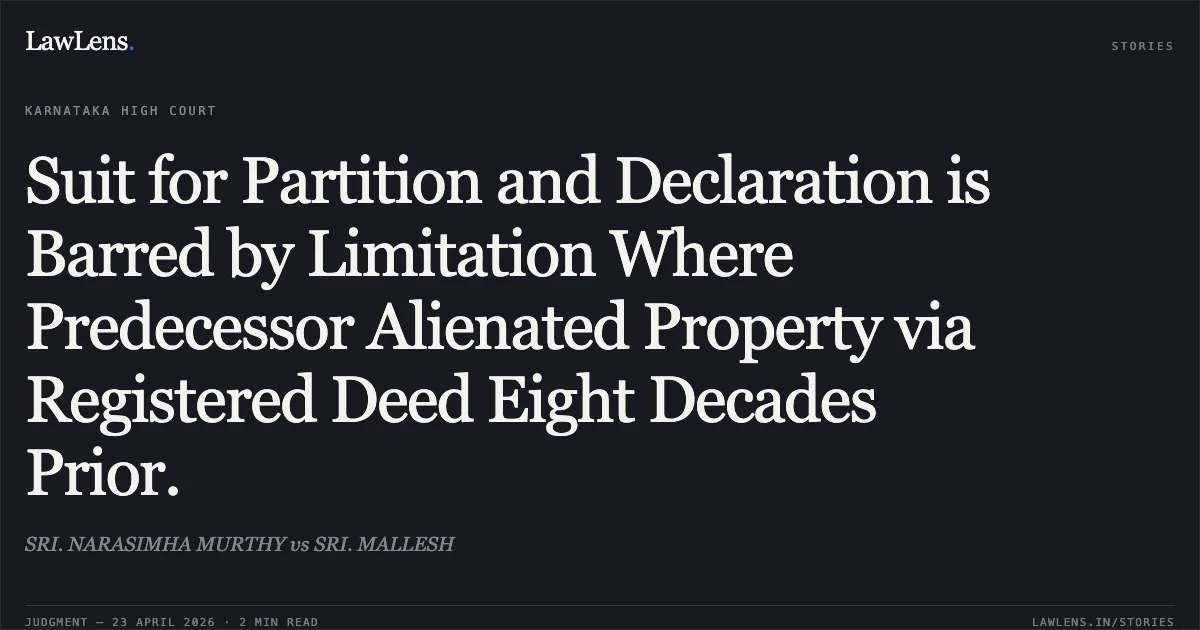
The appellants (plaintiffs), claiming to be the grandchildren of Pandit Narasimhaiya, filed a suit in 2022 for partition of a 47-acre agricultural property and a declaration that three Sale Deeds from 1980 and two Release Deeds from 2020 were not binding on them
Source reference: p. 4, paras. 2, 3They alleged the property was ancestral and the documents were forged
Source reference: p. 7, para. 9Respondents 6 and 7 moved an application under Order VII Rule 11 of the CPC for rejection of the plaint, contending that the property was sold by the grandfather in 1944 via a registered deed—a fact suppressed by the plaintiffs—and that the suit was barred by limitation and lacked a cause of action
Source reference: p. 5, para. 4; p. 11, para. 14The Trial Court rejected the plaint on February 24, 2023
Source reference: p. 3, para. 1Issues
1. Whether the learned Trial Court erred in rejecting the plaint under Order VII Rule 11 of the CPC on the grounds of limitation and lack of cause of action?
Source reference: p. 9, para. 11Law Applied
The court applied Order VII Rule 11 (a), (b), and (d) of the Code of Civil Procedure, 1908, regarding the rejection of a plaint that fails to disclose a cause of action or is barred by law
Source reference: p. 3, para. 1It relied on the precedent Dahiben v. Arvindbhai Kalyanji Bhanusali (Gajra) (2020) 7 SCC 366, which establishes that "clever drafting" creating an illusory cause of action should be terminated at the threshold to prevent sham litigation
Source reference: p. 20, para. 21; p. 22, para. 21.1The court also invoked Articles 58 and 59 of the Limitation Act, 1963, which prescribe a three-year period for seeking a declaration or setting aside an instrument from the time the right to sue first accrues or the facts become known
Source reference: p. 24, para. 23Reasoning
On a meaningful reading of the plaint and the documents specifically annexed by the plaintiffs (the 2020 Release Deeds), the court found that the title had already been transferred by the grandfather via a registered Sale Deed in 1944
Source reference: p. 18, para. 17; p. 25, para. 24The court noted that the appellants, who were not even born in 1944, failed to challenge the original 1944 alienation or any subsequent transactions leading up to the 1980 deeds
Source reference: p. 18, para. 18; p. 25, para. 25The court determined that the allegations of "fraud" were vague, unspecified, and lacked necessary particulars
Source reference: p. 19, para. 19Since the registration of a sale deed constitutes constructive notice, the challenge brought 42 years after the 1980 deeds (and 78 years after the 1944 deed) was held to be a result of "clever drafting" to bypass the three-year limitation period under Articles 58 and 59
Source reference: p. 22, para. 21.1; p. 25, para. 25Holding
The High Court affirmed the Trial Court's decision, holding that the suit was "hopelessly barred by limitation" and the plaint failed to disclose a legitimate cause of action
The court held that the litigation was vexatious and meritless, justifying rejection at the threshold under Order VII Rule 11 of the CPC. The appeal was dismissed, and the costs imposed on the appellants were reduced to Rs. 10,000
Source reference: p. 26, para. 26; p. 26, para. 27; p. 27, para. 27.1Acts & Sections Cited
3 provisions across 2 statutes referred to in this judgment. Each provision opens on LawLens.
Code of Civil Procedure, 19081
KARNATAKA COURT-FEE AND SUITS VALUATION ACT, 1958.2
Original Court PDF
SRI. NARASIMHA MURTHYvsSRI. MALLESH
Click to open original judgment
Original judgment, available to read, download and summarize on LawLens.in