Facts
Zubair Ahmed was a non-executive director of Raheja Developers Ltd. from 20 August 2009 until his resignation took effect on 21 August 2015.
Source reference: paras. 2–6In 2014, the complainants booked a residential unit and entered into an Agreement to Sell and a Memorandum of Understanding with the company.
Source reference: paras. 2–6After seeking cancellation and alleging non-repayment, they complained to the police; an FIR was registered under Sections 406, 420 and 120B IPC.
Source reference: paras. 2–6The investigating agency, which examined Ahmed’s role, filed a charge-sheet against other persons and the company, placing Ahmed in Column No. 12; it recorded that he was not involved in the company’s day-to-day affairs and that no incriminating evidence had emerged against him.
Source reference: para. 7On the complainant’s request, the Magistrate summoned Ahmed and others named in Column No. 12, reasoning that the charge-sheet disclosed their active participation.
Source reference: paras. 8–10Ahmed challenged the summoning order under Section 528 BNSS.
Source reference: para. 1Issues
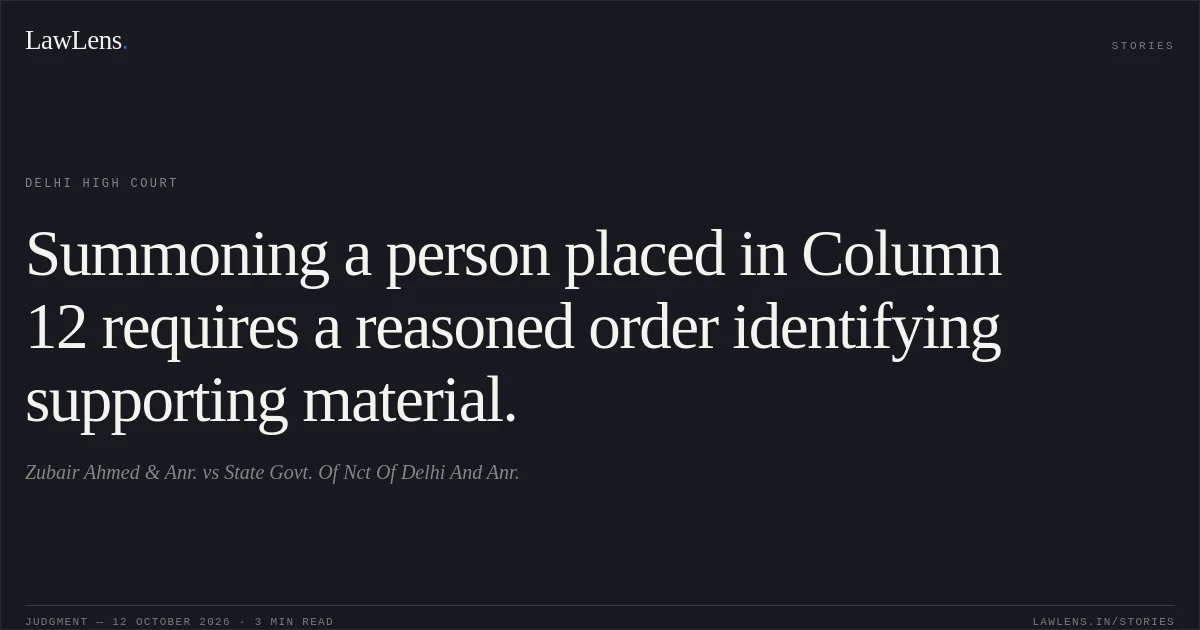
Whether the Magistrate’s order issuing process against Ahmed, who had been placed in Column No. 12, demonstrated the requisite application of judicial mind and disclosed sufficient grounds for proceeding against him.
Source reference: para. 24Whether the High Court should set aside the summoning order outright or remit the matter for fresh consideration.
Source reference: paras. 33–36Law Applied
Sections 190 and 204 CrPC govern taking cognizance and issuing process; the Magistrate must apply judicial mind to the material and be satisfied that sufficient ground exists for proceeding, though a detailed order is not required.
Source reference: paras. 25–26Under Sunil Bharti Mittal v. CBI, an order issuing process must reflect that satisfaction and may be set aside if it gives no reasons or relies on reasons that are ex facie incorrect.
Source reference: para. 26A Magistrate may disagree with the investigating agency and summon a person placed in Column No. 12, but must identify the prima facie material supporting that person’s alleged role and give reasons for departing from the agency’s conclusion.
Source reference: paras. 27–28The High Court’s inherent jurisdiction is not barred merely because revision is available, although it must be exercised with restraint, as recognised in Prabhu Chawla v. State of Rajasthan.
Source reference: para. 37Where the summoning order is deficient, remand for fresh consideration may be appropriate; the Court relied on Shiv Jatia v. Gian Chand Malick and Sanjit Bakshi v. State (NCT of Delhi).
Source reference: paras. 34–35Reasoning
The charge-sheet recorded that Ahmed was a non-executive director, received only sitting fees, had no day-to-day role and was not implicated by incriminating evidence.
Source reference: paras. 7, 30The allegations that he regularly attended board meetings, knew of the conspiracy and acted in furtherance of it appeared in the complainant’s synopsis, not the charge-sheet.
Source reference: paras. 29–30Although the Magistrate could consider the synopsis and depart from the investigating agency’s view, the order did not identify supporting material or explain how it established Ahmed’s individual role; instead, it reproduced allegations and reached a collective conclusion about persons in Column No. 12.
Source reference: paras. 31–32The order was therefore non-speaking as to Ahmed.
Source reference: paras. 31–32The High Court declined to assess the evidence in the first instance and remitted the issue to the Magistrate.
Source reference: paras. 33, 36Holding
The petition was partly allowed.
The summoning order dated 7 February 2025 was set aside only insofar as it directed issuance of process against Ahmed, and the matter was remitted for fresh consideration on the complete record, followed by a reasoned order.
Source reference: paras. 38–40The Court expressed no view on whether the material ultimately justified proceeding against him; the case and proceedings against the other accused remained unaffected.
Source reference: paras. 41–43Acts & Sections Cited
12 provisions across 3 statutes referred to in this judgment. Each provision opens on LawLens.
Bharatiya Nagarik Suraksha Sanhita, 20233
Indian Penal Code, 18602
Code of Criminal Procedure, 19737
Original Court PDF
Zubair Ahmed & Anr.vsState Govt. Of Nct Of Delhi And Anr.
Click to open original judgment
Original judgment, available to read, download and summarize on LawLens.in
![Excess-pay recovery from retired Group C employees is impermissible absent fraud or misrepresentation.. SATYA NAND YADAV vs NORTH EASTERN RAILWAY. CAT - ['Allahabad']. LawLens](/stories/thumbnails/excess-pay-recovery-from-retired-group-c-employees-is-impermissible-absent-fraud-or-misrep-c357cbdd195c44d68331385eea2a3c9a.webp)
![A different Tribunal Bench cannot adjudicate claims seeking implementation of another Bench’s order.. KAMLA DEVI vs NORTH CENTRAL RAILWAY. CAT - ['Allahabad']. LawLens](/stories/thumbnails/a-different-tribunal-bench-cannot-adjudicate-claims-seeking-implementation-of-another-benc-cca646896f904d429d1270d122130c8b.webp)