Facts
The petitioner, a transport corporation driver, was initially punished on 23 July 2019 by withholding one increment for one year with cumulative effect over an accident alleged to have occurred on 14 May 2018.
Source reference: p.2; p.3In 2024, following his conviction in a criminal case arising from the accident, the General Manager enhanced the punishment to dismissal by an order dated 16 August 2024.
Source reference: p.2; p.3The petitioner appealed against the conviction and was acquitted on 25 October 2025.
Source reference: p.3The authority also rejected approval of the dismissal on 6 May 2026.
Source reference: p.3; p.5He challenged the dismissal order under Article 226, seeking reinstatement and consequential benefits.
Source reference: p.1Issues
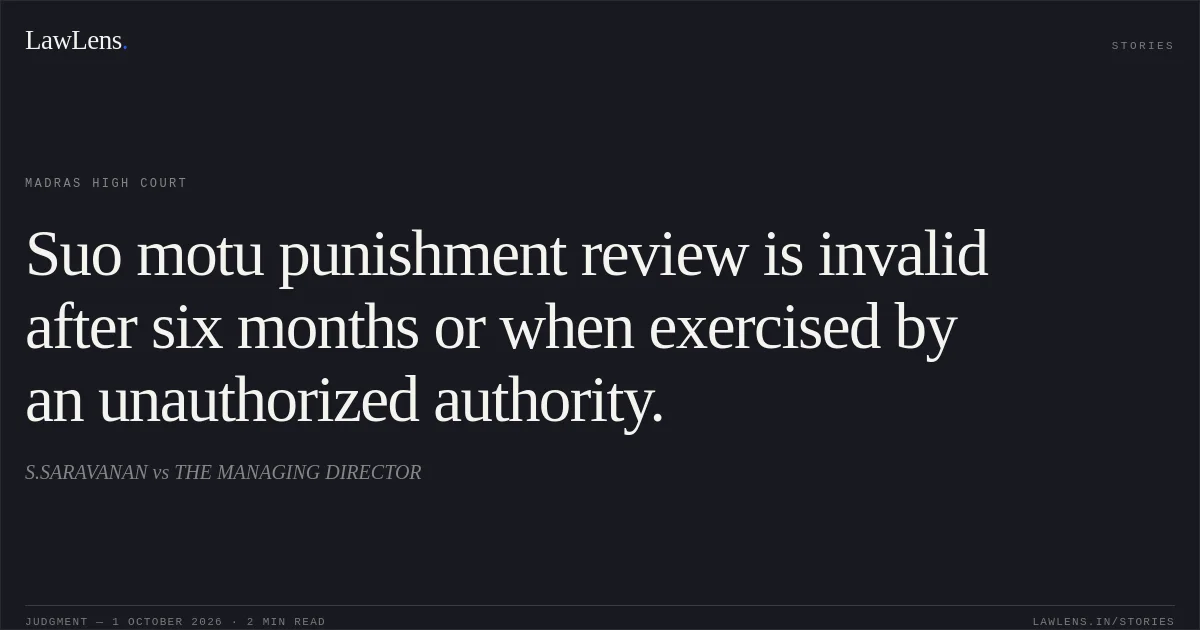
Whether the General Manager could exercise suo motu review to enhance the petitioner’s punishment after the six-month period prescribed by Rule 23 of the Common Service Rules
Source reference: p.4–5Whether the General Manager was competent to exercise that review power
Source reference: p.5Whether the petitioner was entitled to reinstatement, continuity of service and back wages in light of his acquittal and the rejection of approval for the dismissal
Source reference: p.5Law Applied
Rule 23 of the Common Service Rules permits suo motu review within six months of the imposition of punishment, and the Court held that the power in question could be exercised only by the Corporation’s Managing Director.
Source reference: p.4–5The Court also relied on *Jaipur Zila Sahakari Bhoomi Vikas Bank Ltd. v. Ram Gopal Sharma*, 2002 (2) SCC 244, for the principle that, where approval of the dismissal is rejected, the employee is to be treated as continuing in service.
Source reference: p.5Reasoning
The initial punishment was imposed on 23 July 2019, but the review resulting in dismissal was undertaken in 2024—well beyond Rule 23’s six-month limit.
Source reference: p.4–5Further, the impugned order was made by the General Manager rather than the Managing Director, rendering the review defective both for delay and want of authority.
Source reference: p.4–5The criminal conviction that prompted the enhanced punishment had subsequently been set aside on appeal, and approval of the dismissal had also been rejected.
Source reference: p.5Applying *Jaipur Zila*, the Court treated the petitioner as continuing in service.
Source reference: p.5It noted that no enquiry had preceded the initial punishment, but considered that point immaterial because the petitioner had not seriously challenged that lesser punishment.
Source reference: p.6Holding
The Court quashed the dismissal order dated 16 August 2024 and directed the respondents to reinstate the petitioner with continuity of service, back wages and all attendant benefits within eight weeks of receiving a copy of the order.
The writ petition was allowed; the connected miscellaneous petition was closed, with no order as to costs.
Source reference: p.6Acts & Sections Cited
2 provisions across 1 statute referred to in this judgment. Each provision opens on LawLens.
Indian Penal Code, 18602
Original Court PDF
S.SARAVANANvsTHE MANAGING DIRECTOR
Click to open original judgment
Original judgment, available to read, download and summarize on LawLens.in