Facts
On 16 August 1976, Harkishan Lal submitted a declaration under Section 9 of the Haryana Ceiling of Land Holdings Act, 1972 (“1972 Act”). The Prescribed Authority accepted the declaration and, by order dated 16 June 1979, held that no surplus land was held by him. The declaration submitted by his mother, Jamuna Bai, was also accepted.
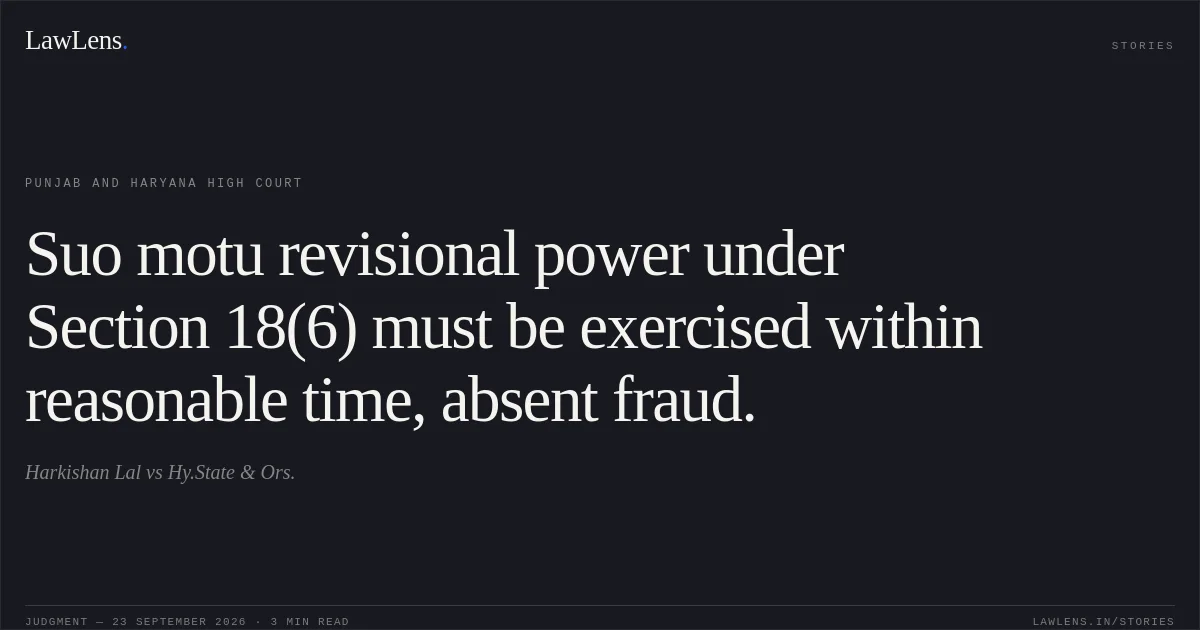
Source reference: para. 2In 1998, the State requested the Financial Commissioner to exercise suo motu revisional jurisdiction under Section 18(6) of the 1972 Act.
Source reference: para. 3The State alleged that a decree in favour of the petitioner’s mother, passed after the appointed day, had been wrongly accepted and that the petitioner’s son had incorrectly been treated as a separate unit despite allegedly being a minor.
Source reference: para. 6Despite the petitioner’s objection that the proceedings were initiated after an unexplained delay of approximately 19 years and after the death of the original landowner, the Financial Commissioner set aside the 1979 order and remanded the matter to the Prescribed Authority by order dated 24 June 2000.
Source reference: para. 4Issues
Whether the Financial Commissioner could exercise suo motu revisional jurisdiction under Section 18(6) of the 1972 Act after a delay of approximately 19 years merely because the provision authorises exercise of the power “at any time”.
Source reference: paras. 5, 8–12Whether, in the absence of fraud or misrepresentation, the Financial Commissioner was justified in unsettling the 1979 order on the basis of the alleged legal errors concerning the decree in favour of the petitioner’s mother and the age of his son.
Source reference: paras. 6, 12–13Law Applied
Section 18(6) of the Haryana Ceiling of Land Holdings Act, 1972 empowers the Financial Commissioner to call for the record of proceedings or orders of subordinate authorities suo motu “at any time” to examine their legality or propriety.
Source reference: para. 8However, the expression “at any time” does not confer an unlimited or perpetual power; revisional jurisdiction must ordinarily be exercised within a reasonable time.
Source reference: paras. 9–11The Court relied on State of Gujarat v. Patel Raghav Natha, which held that the reasonable period depends on the facts and nature of the order; Loku Ram v. State of Haryana, which rejected unlimited revisional power despite the statutory expression “at any time”; and Latoor Singh v. State of Haryana and State of Haryana v. Chandgi Ram, which applied the same principle to delayed exercise of Section 18(6) powers.
Source reference: paras. 9–11The Court further held that fraud constitutes an exception: where an order was obtained by fraud, delay may not bar correction of the order.
Source reference: para. 12Reasoning
Although Section 18(6) contains the words “at any time,” the Court interpreted them consistently with the requirement that revisional power be exercised within a reasonable period.
Source reference: paras. 3–5, 12–13The 1979 order was challenged only in 1998, after approximately 19 years, and the Financial Commissioner’s order did not rest on any finding that the petitioner had procured the earlier decision through fraud or misrepresentation.
Source reference: paras. 3–5, 12–13The alleged facts—the date of the decree and the relationship of Jamuna Bai to the petitioner—had been disclosed in the landowner’s declaration and were therefore not concealed circumstances.
Source reference: paras. 6, 13Consequently, the State’s contention that the Prescribed Authority had committed errors in applying the definition of “family” or in determining the son’s entitlement could not justify reopening a settled matter after such prolonged delay.
Source reference: paras. 6, 13In the absence of fraud and considering the 19-year delay, the exercise of suo motu revisional jurisdiction was held to be legally impermissible.
Source reference: paras. 12–13Holding
The Court held that the expression “at any time” in Section 18(6) does not permit the Financial Commissioner to exercise suo motu revisional jurisdiction indefinitely and that such power must be exercised within a reasonable time, subject to the exception of fraud.
Since the proceedings were initiated after approximately 19 years, without any allegation or finding of fraud or misrepresentation, the order dated 24 June 2000 setting aside the 1979 order and remanding the matter was quashed.
Source reference: paras. 13–14The writ petition was allowed, and the pending miscellaneous application, if any, was disposed of.
Source reference: paras. 15–16Acts & Sections Cited
1 provisions across 1 statute referred to in this judgment. Each provision opens on LawLens.
Maharashtra Land Revenue Code, 19661
Original Court PDF
Harkishan LalvsHy.State & Ors.
Click to open original judgment
Original judgment, available to read, download and summarize on LawLens.in