Facts
The petitioner in SCA 2876/2014, Vinubhai Shah, was issued an agriculturist certificate in 1966.
Source reference: para 6.1Based on this, he purchased land in 1966 and 1988.
Source reference: para 6.2, 6.6Revenue authorities initiated show-cause notices (SCN) under Section 54 read with Section 75 of the Saurashtra Gharkhed Tenancy Settlement and Agricultural Land Ordinance, 1949, in 1984 and 2006, alleging the petitioner was not a bona fide agriculturist; however, both proceedings were dropped/withdrawn by the Deputy Collector after verifying the petitioner’s documents.
Source reference: para 6.5, 6.9Subsequently, the heirs of the original seller (Respondent 3) challenged the 2010 withdrawal.
Source reference: para 6.10In 2011, the Collector allowed the appeal, quashed the Deputy Collector's order, and directed the land to be vested in the Government.
Source reference: para 6.10, 6.12In the connected SCA 2919/2014, similar suo motu proceedings were initiated against Ramniklal Shah regarding 1985 entries after a delay of approximately 21 years.
Source reference: para 7.3, 49In SCA 6700/2016, a subsequent purchaser challenged the SSRD's rejection of his revision against the Collector’s 2011 order.
Source reference: para 8.4Issues
1. Whether the revenue authorities can exercise suo motu revisional powers after an inordinate delay (specifically 21 years) where no statutory limitation is prescribed?
Source reference: para 11, 502. Whether the principle of res judicata applies to revenue proceedings where the same issue was previously adjudicated and dropped?
Source reference: para 14, 333. Whether the heirs of a seller, who have already received sale consideration, qualify as "aggrieved persons" with locus standi to challenge revenue orders in favor of the purchaser?
Source reference: para 20, 354. Whether a writ petition under Article 226 is maintainable despite the availability of an alternative remedy (Revision to SSRD)?
Source reference: para 43Law Applied
The Court applied Sections 54 and 75 of the Saurashtra Gharkhed Ordinance, 1949, regarding restrictions on land transfer to non-agriculturists.
Source reference: para 3, 22It relied on the doctrine of res judicata as codified in Section 11 of the CPC to prevent multiplicity of proceedings.
Source reference: para 33Regarding the exercise of suo motu powers, the Court followed State of Gujarat v. Patel Raghav Natha (1969), establishing that such powers must be exercised within a "reasonable time".
Source reference: para 50On the issue of "aggrieved persons," it applied Ayaaubkhan Noorkhan Pathan v. State of Maharashtra (2013), holding that a stranger or person without legal injury cannot meddle in proceedings.
Source reference: para 37Finally, it applied Whirlpool Corporation v. Registrar of Trade Marks (1998) regarding the maintainability of writs when fundamental rights are violated or jurisdiction is exceeded.
Source reference: para 44Reasoning
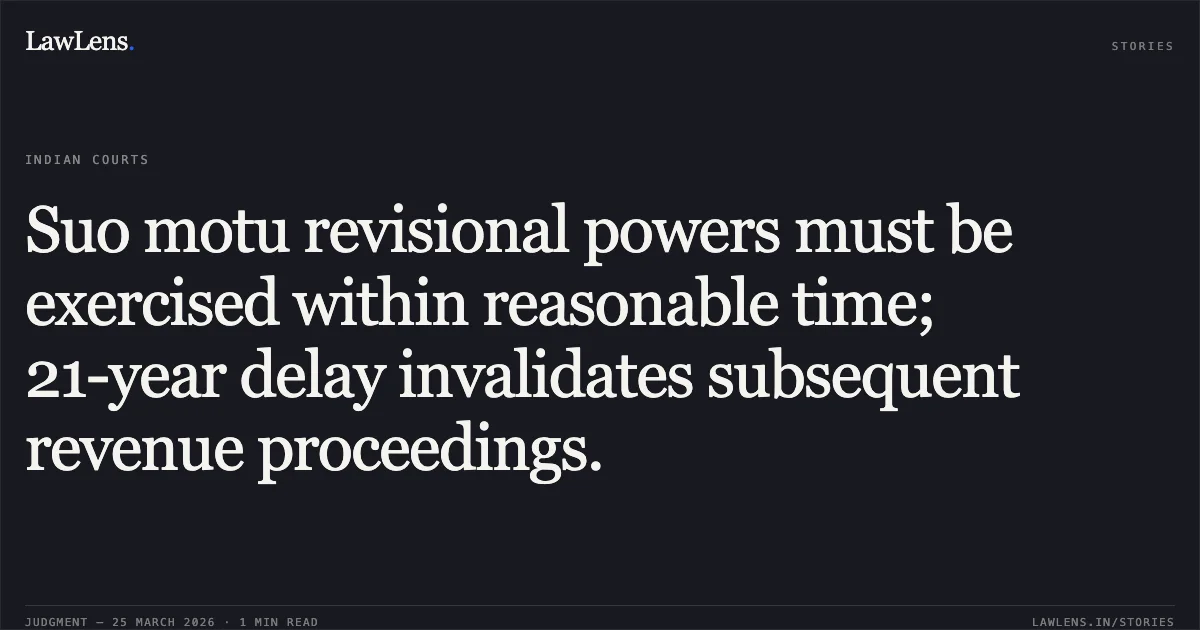
The Court reasoned that while the Ordinance does not prescribe a limitation period, suo motu powers must be exercised within a reasonable timeframe to prevent settled titles from being perpetually uncertain; a delay of 21 years was deemed unreasonable.
Source reference: para 51-53The Court found that since the Deputy Collector had twice dropped the proceedings after considering the same merits, the authorities were barred by res judicata from reopening the matter.
Source reference: para 33, 40Regarding locus standi, the Court held that the sellers' heirs were not "aggrieved persons" as the original owner had pocketed the sale consideration and never challenged the sale deed during his lifetime; thus, they could not use revenue proceedings to reclaim land.
Source reference: para 40-42Regarding maintainability, the Court held that because the Collector's order was passed in violation of fundamental rights and was "wholly without jurisdiction" due to the delay and prior adjudications, the "rule of alternate remedy" was not a bar.
Source reference: para 47Holding
The High Court allowed SCA 2919/2014 and SCA 6700/2016, quashing the orders of the SSRD, Collector, and Deputy Collector.
SCA 2876/2014 was partly allowed; the Court quashed the Collector's 2011 order vesting the land in the Government.
Source reference: para 54The Court declined to quash the 2013 eviction orders against the petitioner's daughter and grandson (Smitaben and Setul) as they were not petitioners in the present case, though it granted them liberty to pursue independent legal recourse.
Source reference: para 54The Court reaffirmed that transactions remaining valid for a considerable period cannot be unsettled by delayed revenue interference.
Source reference: para 52Acts & Sections Cited
5 provisions across 3 statutes referred to in this judgment. Each provision opens on LawLens.
Code of Civil Procedure, 19081
Bombay Tenancy and Agricultural Lands Act-19481
Saurashtra Gharkhed, Tenancy Settlement and Agricultural Lands Ordinance, 19493
Original Court PDF
VINUBHAI MANGALBHAI SHAHvsDISTRICT COLLECTOR - SURENDRANAGAR
Click to open original judgment
Original judgment, available to read, download and summarize on LawLens.in