Facts
The petitioner, an agricultural laborer holding a valid certificate issued by the Mamlatdar, purchased agricultural land via a registered sale deed on August 3, 2007
Source reference: p. 3Mutation Entry No. 2189 was recorded and certified by revenue authorities on November 2, 2007
Source reference: p. 4Ten years later, on June 16, 2017, the District Collector, Botad, issued a consolidated show-cause notice (No. RO/suo-moto-revision/Case No. 15/17) to the petitioner and several others, alleging that the transactions lacked prior permission from competent authorities and were in contravention of statutory provisions
Source reference: p. 4, 8The petitioner challenged this notice under Article 226 of the Constitution, contending it was issued after an inordinate delay and lacked specific particulars
Source reference: p. 1-2Issues
1. Whether the revenue authority can exercise suo motu revision powers after a lapse of ten years from the date of certification of mutation entries
Source reference: p. 5 / para. 4.22. Whether a consolidated show-cause notice covering multiple independent transactions across different villages without specific particulars is legally sustainable
Source reference: p. 8 / para. 6.1Law Applied
The Court primarily applied the principle of "reasonable period" for the exercise of suo motu powers where no statutory limitation is prescribed.
Source reference: p. 11It relied on State of Gujarat v. Patel Raghav Natha (1969), which established that power must be exercised within a reasonable time determined by the facts of the case
Source reference: p. 11It further applied Bharatbhai Naranbhai Vegda v. State of Gujarat (2016), which held that even "void" transactions cannot be unsettled after an inordinate delay, especially if rights have vested or the delay is unexplained
Source reference: p. 10, 12The Court also emphasized that a show-cause notice must contain specific grounds to satisfy the principles of natural justice
Source reference: p. 9Reasoning
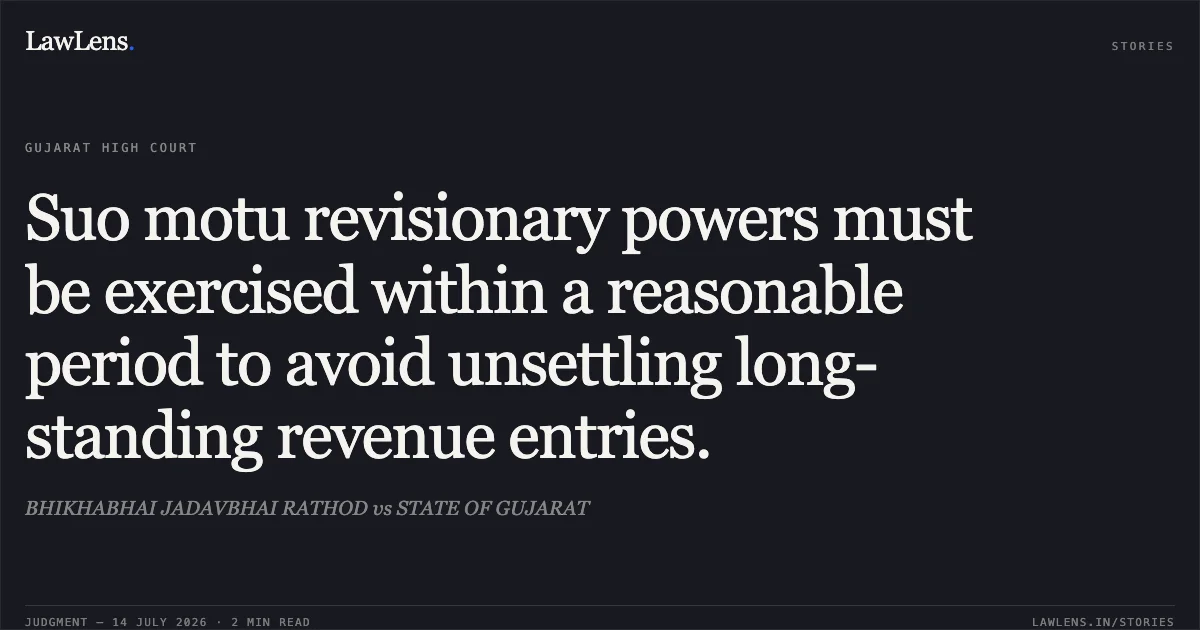
The Court observed that while the statute does not prescribe a fixed limitation for suo motu revision, it is settled law that such power must be invoked within a reasonable timeframe
Source reference: p. 9In this case, the ten-year delay between the 2007 certification and the 2017 notice was deemed inordinate and unexplained
Source reference: p. 9The Court noted that the Collector failed to provide specific allegations regarding the petitioner’s particular transaction; instead, the authority issued a "generalized" consolidated notice for multiple parties and different parcels of land
Source reference: p. 8Applying the precedents in Bharatbhai Vegda and Bhanji Devshibhai Luhar, the Court reasoned that allowing the authority to unsettle a decade-old transaction—where the petitioner had maintained the land status—would be contrary to the interests of justice and equity
Source reference: p. 15-18Holding
The Court answered the issues in the negative, holding that the the show-cause notice was without jurisdiction due to the bar of delay and laches and a lack of specific particulars
The High Court allowed the petition and quashed the impugned show-cause notice No. RO/suo-moto-revision/Case No. 15/17 dated June 16, 2017. Rule was made absolute
Source reference: p. 19 / para. 7Acts & Sections Cited
3 provisions across 1 statute referred to in this judgment. Each provision opens on LawLens.
Bombay Tenancy and Agricultural Lands Act-19483
Original Court PDF
BHIKHABHAI JADAVBHAI RATHODvsSTATE OF GUJARAT
Click to open original judgment
Original judgment, available to read, download and summarize on LawLens.in