Facts
The petitioner filed a civil suit for declaration of title and permanent injunction regarding property in Raipur, asserting it was ancestral property in which she held an equal share as the daughter of respondent No. 1
Source reference: para 3Conversely, the respondents contended the property was the self-acquired asset of respondent No. 1 via a registered will dated 08.02.2001, which he subsequently gifted to respondents No. 2 and 3
Source reference: para 6Along with the suit, the petitioner sought a temporary injunction under Order 39 Rules 1 & 2 of the CPC to restrain the respondents from alienating the property
Source reference: para 3The Trial Court dismissed the application on 28.02.2026, finding no prima facie case, balance of convenience, or irreparable loss
Source reference: para 3, 6This was upheld by the IIIrd Additional District Judge, Raipur, in a Miscellaneous Civil Appeal on 11.03.2026
Source reference: para 2, 3The petitioner then moved the High Court under its supervisory jurisdiction
Source reference: para 2Issues
1. Whether the lower courts exercised their discretion arbitrarily or perversely in refusing the grant of a temporary injunction under Order 39 Rules 1 & 2 of the CPC
Source reference: para 82. Whether the High Court should interfere with the concurrent findings of the lower courts under the supervisory jurisdiction of Article 227 of the Constitution of India
Source reference: para 9Law Applied
The court applied Order 39 Rules 1 & 2 of the CPC, which governs the discretionary grant of temporary injunctions based on the tripartite test of a prima facie case, balance of convenience, and irreparable loss
Source reference: para 3, 8It relied on the principle established in Wander Ltd. v. Antox India P. Ltd., which dictates that an appellate court shall not substitute its own discretion for that of the trial court unless the original exercise of power was arbitrary, capricious, or perverse
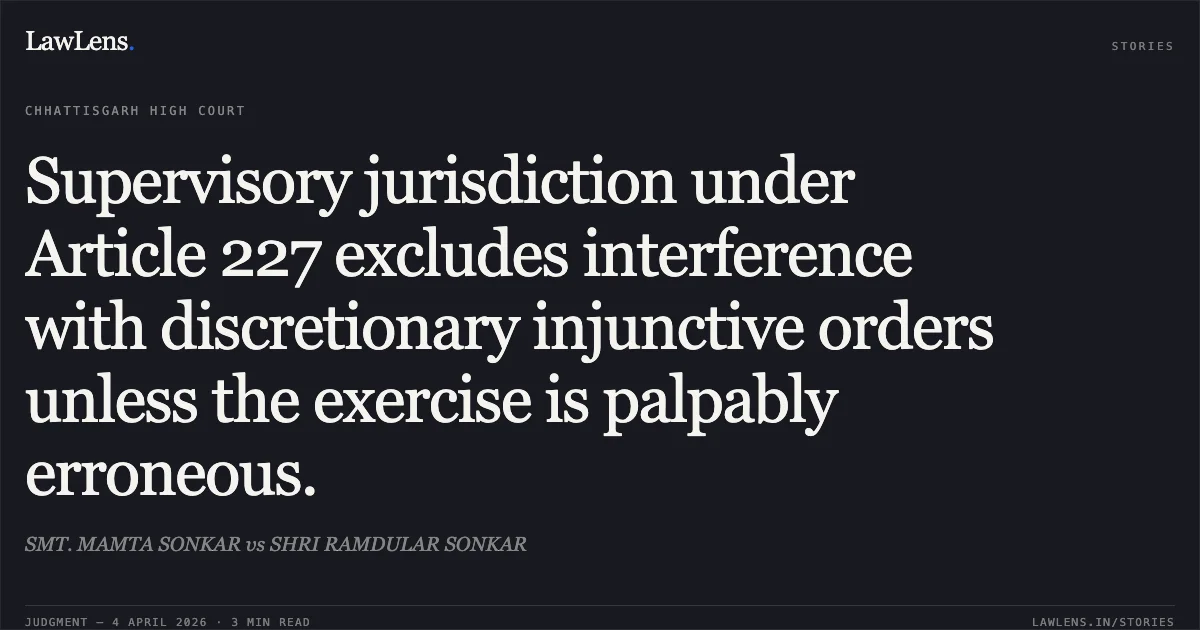
Source reference: para 8Furthermore, the court invoked the limited scope of Article 227 of the Constitution, citing Estralla Rubber v. Dass Estate (P) Ltd. and Garment Craft v. Prakash Chand Goel, which restrict supervisory interference to cases of "palpably erroneous" jurisdictional errors
Source reference: para 7, 9The court also noted the statutory protection offered by the principle of lis pendens
Source reference: para 6Reasoning
The court observed that the petitioner failed to establish a prima facie case, as the respondents produced evidence (a registered will) suggesting the property was self-acquired rather than ancestral
Source reference: para 6The High Court emphasized that injunctive relief is a discretionary remedy, not an inherent right
Source reference: para 8Applying the Wander Ltd. doctrine, the court reasoned that because the Trial Court’s view was "reasonably possible" based on the material provided, the appellate court was correct not to interfere
Source reference: para 8The court further noted that the petitioner’s interests are protected by the doctrine of lis pendens, which renders any alienation during litigation subject to the final outcome of the suit, thereby obviating the absolute necessity for a specific restraining order
Source reference: para 6Under Article 227, the High Court’s role is limited to correcting jurisdictional errors; since the lower courts' orders were not "palpably erroneous," no intervention was warranted
Source reference: para 9-10Holding
The High Court held that there was no error in the concurrent findings of the Trial and Appellate courts regarding the lack of a prima facie case and the absence of irreparable loss
The court affirmed that the discretionary power under Order 39 was exercised reasonably and in a judicial manner
Source reference: para 8Consequently, the writ petition was dismissed, and the orders of the lower courts refusing the temporary injunction were upheld
Source reference: para 10Acts & Sections Cited
2 provisions across 1 statute referred to in this judgment. Each provision opens on LawLens.
Code of Civil Procedure, 19082
Original Court PDF
SMT. MAMTA SONKARvsSHRI RAMDULAR SONKAR
Click to open original judgment
Original judgment, available to read, download and summarize on LawLens.in


![Subsequent exoneration does not retrospectively invalidate a finalized promotion select list.. UNNIKRISHNAN M vs M/o Environment And Forests. CAT - ['Ernakulam']. LawLens](/stories/thumbnails/subsequent-exoneration-does-not-retrospectively-invalidate-a-finalized-promotion-select-li-ce80a0e84f2f4887857271e8b4341c42.webp)