Facts
The petitioner was appointed as a Constable in the Bihar Military Police on 8 July 2015 after qualifying in the recruitment process.
Source reference: para. 3Before his appointment, he had been implicated, along with family members, in Sikraul P.S. Case No. 31 of 2011 under Section 304-B of the Indian Penal Code. He did not disclose the pendency of that case in his character-verification form.
Source reference: paras. 4, 20–21At the relevant time, the petitioner was a juvenile, and his case was tried by the Juvenile Justice Board, which acquitted him on 29 August 2015.
Source reference: paras. 5, 21, 24A departmental charge was framed on 27 January 2019 alleging suppression of a material fact. The Inquiry Officer found the charge proved, and, after considering the petitioner’s response to the inquiry report, the disciplinary authority dismissed him from service on 8 September 2019.
Source reference: paras. 4, 6–7His departmental appeal and memorial were rejected on 6 December 2019 and 8 January 2021, respectively. The petitioner challenged all three orders before the High Court.
Source reference: para. 8Issues
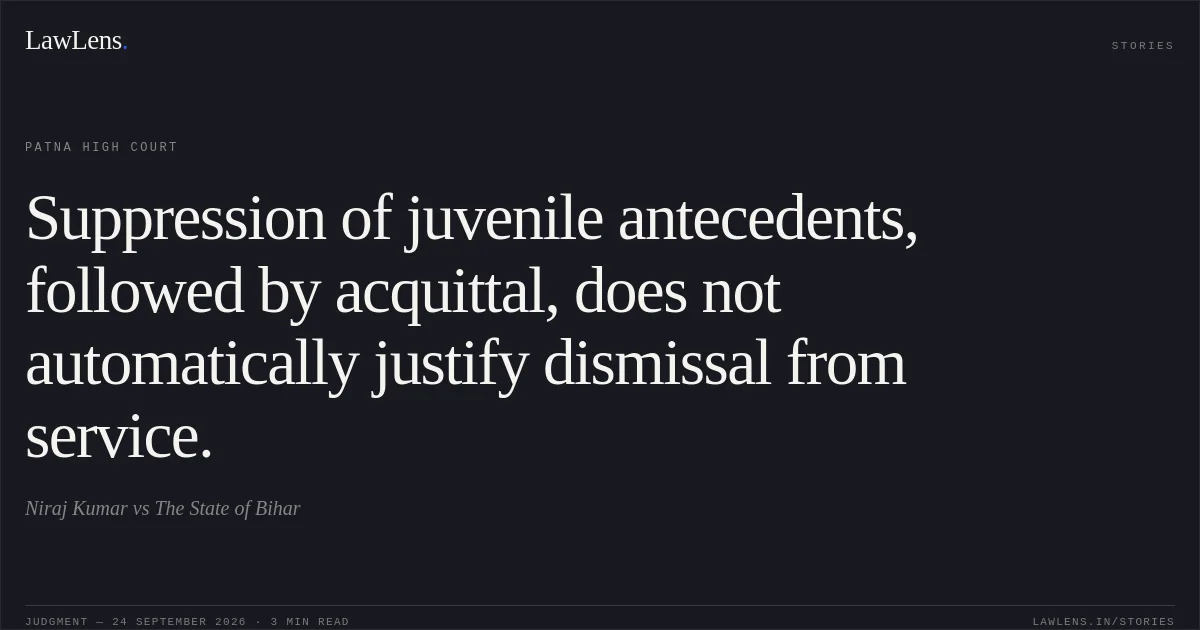
Whether the petitioner’s failure to disclose the pending criminal proceeding in the character-verification form constituted misconduct warranting disciplinary action, notwithstanding that he was a juvenile and was subsequently acquitted by the Juvenile Justice Board?
Source reference: paras. 36–38, 41–43Whether dismissal from service was a proportionate and legally sustainable consequence of the non-disclosure in the peculiar circumstances of the case?
Source reference: paras. 44–46Whether the disciplinary and appellate authorities adequately considered the petitioner’s juvenility, the nature of his implication, his acquittal, and the rehabilitative principles under the Juvenile Justice Act, 2015?
Source reference: paras. 39–45Law Applied
The Court applied Sections 3(xiv) and 24(1) of the Juvenile Justice (Care and Protection of Children) Act, 2015, embodying the principles of fresh start, non-stigmatization, rehabilitation and protection against disqualification attaching to conviction for an offence dealt with under the juvenile justice system.
Source reference: paras. 39–40It relied on Avtar Singh v. Union of India, which requires an objective and contextual consideration of suppression or false disclosure and recognises that knowledge of the suppressed fact must be attributable to the candidate before suppressio veri or suggestio falsi is established.
Source reference: paras. 27–29Commissioner of Police v. Sandeep Kumar and Union of India v. Ramesh Bishnoi support a rehabilitative approach in cases involving youthful indiscretion and offences committed during juvenility.
Source reference: paras. 25–26, 30Ram Kumar v. State of Uttar Pradesh, Pawan Kumar v. Union of India, and Ravindra Kumar v. State of U.P. establish that non-disclosure does not automatically mandate termination and that the nature of the offence, circumstances of implication, acquittal, wording of the verification form, and reasons of the authority must be considered.
Source reference: paras. 31–33The Court also considered Satish Chandra Yadav v. Union of India, recognising the employer’s legitimate concern regarding suitability, public confidence and integrity in disciplined forces, while requiring scrutiny on the facts of each case.
Source reference: para. 34Reasoning
The Court held that the petitioner had failed to make a truthful declaration because the criminal proceeding was pending when he submitted the verification form; his subsequent acquittal could not retrospectively validate the earlier omission.
Source reference: paras. 37, 41However, the lapse could not be examined mechanically or in isolation. The petitioner was a juvenile when the alleged offence occurred, had not been attributed any specific overt act, and had been acquitted by the Juvenile Justice Board after the prosecution witnesses failed to support the case.
Source reference: paras. 22–24, 38, 42These circumstances attracted the rehabilitative and non-stigmatizing objectives of the Juvenile Justice Act.
Source reference: no citationAlthough suppression remained a relevant lapse, the disciplinary authority substantially treated it as independently justifying dismissal and failed to adequately consider the petitioner’s juvenility, the nature of his implication, the juvenile proceedings and the acquittal.
Source reference: paras. 44–45The extreme penalty was therefore disproportionate and inconsistent with the requirement of an objective, fact-sensitive decision under Avtar Singh and the subsequent authorities.
Source reference: paras. 43–46Holding
The High Court held that the non-disclosure was established but that dismissal from service was unsustainable in the peculiar facts of the case.
It set aside the dismissal order dated 8 September 2019, the appellate order dated 6 December 2019, and the memorial order dated 8 January 2021.
Source reference: para. 47The respondents were directed to reinstate the petitioner within three months of receipt or production of the judgment.
Source reference: para. 48The period out of service would not entitle him to salary or other monetary benefits, but would count for other service purposes subject to the applicable service rules.
Source reference: para. 49The writ petition was accordingly allowed.
Source reference: para. 50Acts & Sections Cited
6 provisions across 2 statutes referred to in this judgment. Each provision opens on LawLens.
Indian Penal Code, 18603
Juvenile Justice (Care and Protection of Children) Act, 2015.3
Original Court PDF
Niraj KumarvsThe State of Bihar
Click to open original judgment
Original judgment, available to read, download and summarize on LawLens.in