Facts
The Respondent was selected as a Police Constable in 2005. Following complaints of recruitment irregularities, a medical re-test in 2007 found the Respondent unfit due to a "knock knee deformity," leading to his termination
Source reference: p. 3A second medical board in 2009, constituted under High Court directions, confirmed this unfitness
Source reference: p. 4Parallelly, a group of candidates challenged en-masse recruitment cancellations in the Pawan Kumar case, leading to a Supreme Court interim order for provisional appointments
Source reference: p. 4-5In 2013, seeking parity with one Nitin Kumar Upadhyay (who was reinstated despite unfitness), the Respondent obtained provisional reinstatement without disclosing his prior medical disqualifications
Source reference: p. 6, 14Upon discovering the non-disclosure, the State initiated disciplinary proceedings, resulting in the Respondent’s termination in 2017
Source reference: p. 7The State Public Services Tribunal and the Allahabad High Court set aside the termination, holding that there was no evidence of misrepresentation as the Respondent’s re-appointment was "with open eyes"
Source reference: p. 2-3, 9Issues
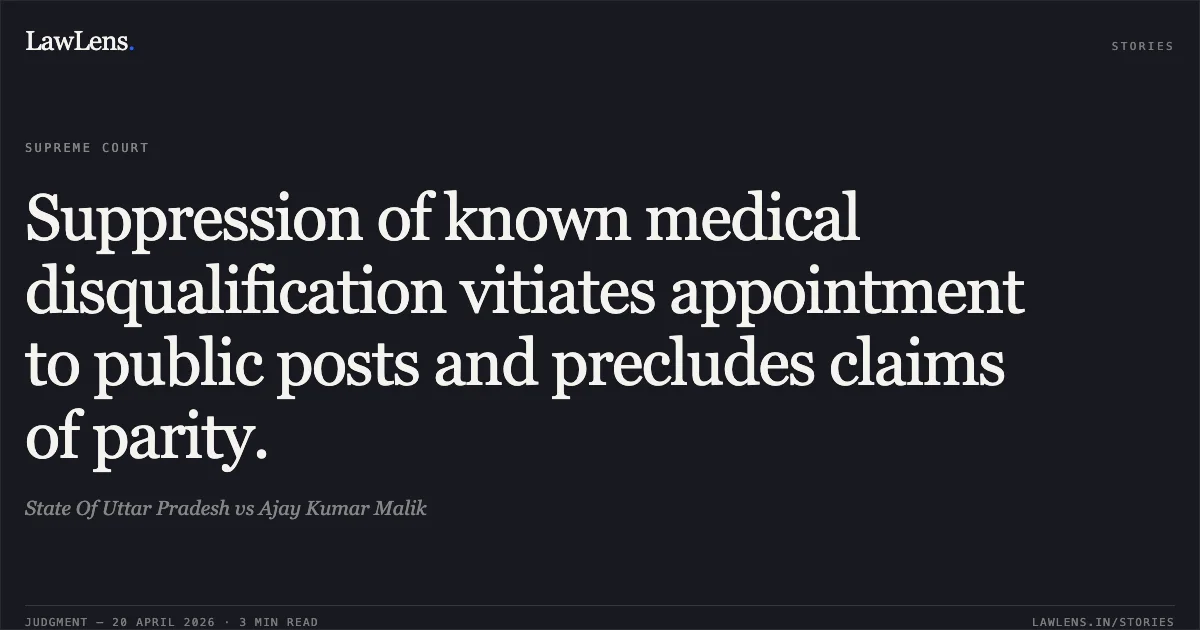
1. Whether a candidate who is fundamentally ineligible due to medical unfitness can retain an appointment obtained through the non-disclosure of material facts
Source reference: para. 14, 18.12. Whether the principle of parity or negative equality can be invoked to sustain an appointment that is otherwise contrary to eligibility criteria
Source reference: para. 7, 20Law Applied
The Court applied the fundamental principle that "fraud unravels everything," as established in Vishnu Vardhan v. State of Uttar Pradesh
Source reference: para. 7It reinforced the doctrine that there is no concept of "negative equality" under Article 14 of the Constitution, relying on Chandigarh Administration v. Jagjit Singh and Gursharan Singh v. New Delhi Municipal Committee, which establish that a wrong order in favor of one person does not entitle others to claim similar relief
Source reference: para. 7the Court emphasized the principles of suppressio veri (suppression of truth) and suggestio falsi (suggestion of falsehood), holding that a candidate for public office has an affirmative duty to disclose all material facts affecting eligibility
Source reference: para. 18.1Reasoning
The Court reasoned that the Respondent’s failure to disclose his knock knee deformity—despite knowing his appointment had been cancelled twice for that specific reason—constituted deliberate suppression
Source reference: para. 18.1The Court critiqued the Services Tribunal and the High Court for adopting a "simplistic" and "technical" approach by focusing on whether the Respondent committed a "positive act" to mislead, rather than addressing the core issue of his fundamental ineligibility
Source reference: para. 21-22The Court held that for uniformed services, scrutiny of medical fitness must be rigorous; an appointment rooted in a lack of basic eligibility cannot be sustained regardless of the State’s procedural lapses in re-verifying the candidate’s status
Source reference: para. 19, 21The Court further clarified that even if others like Nitin Kumar Upadhyay remained in service through similar misrepresentations, the Respondent could not claim parity, as equality cannot be invoked to perpetuate an illegality
Source reference: para. 20, 22Holding
The Supreme Court allowed the appeals, setting aside the judgments of the High Court and the Services Tribunal, and restored the Respondent’s termination
The Court held that lack of eligibility goes to the root of the matter and a wrongly made appointment cannot be sustained once ineligibility comes to light
Source reference: para. 21To balance equities, the Court directed that wages already paid for periods of actual service should not be recovered, and any outstanding wages for actual work must be paid within four weeks with 6% interest
Source reference: para. 24the Court directed the State to review the appointment of Nitin Kumar Upadhyay on the same touchstone of eligibility
Source reference: para. 20The Appellants were also directed to deposit ₹5,000 to the Supreme Court Bar Clerks Association Welfare Fund Trust for filing excessive written submissions
Source reference: para. 25-26Acts & Sections Cited
1 provisions across 1 statute referred to in this judgment. Linked provisions open on LawLens.
Persons With Disabilities (Equal Opportunities, Protection Of Rights And Full Participation) Act, 19951
Original Court PDF
State Of Uttar PradeshvsAjay Kumar Malik
Click to open original judgment
Original judgment, available to read, download and summarize on LawLens.in