Facts
Recruitment for the post of Aanganwadi Worker was conducted at village Sahaba, District Vidisha. In the merit list, Respondent No. 5 was ranked first and the Appellant second.
Source reference: para. 2The Appellant objected to Respondent No. 5's candidature, alleging she suppressed the fact that she was a regular B.Sc student. The objection was sustained, Respondent No. 5 was disqualified, and the Appellant was appointed.
Source reference: para. 2Respondent No. 5 appealed to the Collector, who set aside the Appellant's appointment. However, the Commissioner later reversed the Collector’s order, restoring the Appellant's position.
Source reference: para. 2Respondent No. 5 then filed a writ petition (W.P. No. 9453/2018), which the Single Judge allowed. The Appellant subsequently filed this intra-court appeal challenging the Single Judge’s order.
Source reference: para. 1-2Issues
1. Whether the suppression of the fact that a candidate is pursuing a regular degree course, in the absence of a prohibitory rule in the guidelines or advertisement, justifies the rejection of their candidature.
Source reference: para. 5 & 82. Whether suppression of a non-material fact results in the disqualification of a candidate.
Source reference: para. 8Law Applied
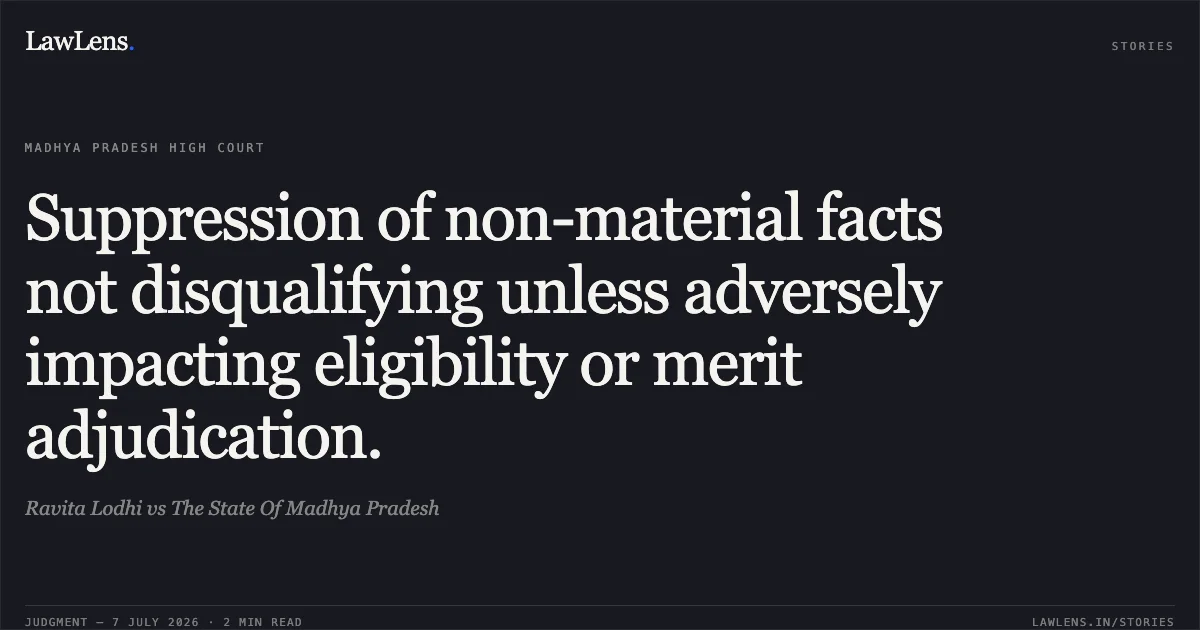
The court applied the principle that only the suppression of a material fact—one that has an adverse bearing on the outcome or determination of the dispute—disentitles a litigant to relief.
Source reference: para. 8It relied on Arunima Baruah v. Union of India, which distinguishes between general suppression and material suppression.
Source reference: para. 8It further cited Dalip Singh v. State of Uttar Pradesh, K.D. Sharma v. Steel Authority of India Limited, and Bhaskar Laxman Jadhav v. Karamveer Kakasaheb Wagh Education Society, emphasizing that while litigants must approach the court with "clean hands," the penalty of dismissal is reserved for the concealment of facts relevant to the grant or denial of relief.
Source reference: para. 8Reasoning
The court observed that the Appellant's counsel conceded there was no provision in the recruitment guidelines or the advertisement prohibiting a candidate from pursuing a degree course while holding the post.
Source reference: para. 5Consequently, the court reasoned that the fact of Respondent No. 5 being a student was not a "material fact" because it did not affect her eligibility or create a legal disqualification.
Source reference: para. 8Since the suppression did not impact the merits of the appointment, it did not warrant the rejection of the most meritorious candidate.
Source reference: para. 8The court further rejected the Appellant's plea for protection based on long service, stating that an appointment made by wrongly disqualifying a more meritorious candidate cannot be protected, as equity follows the law.
Source reference: para. 11-12Holding
The High Court held that since pursuing higher education was not a disqualification under the rules, its non-disclosure was not a suppression of material fact.
The High Court dismissed the appeal and upheld the Writ Court's order in favor of Respondent No. 5, ruling that the Appellant has no substantive right to remain in the post at the expense of a more meritorious candidate.
Source reference: para. 11, 14Acts & Sections Cited
2 provisions across 2 statutes referred to in this judgment. Linked provisions open on LawLens.
M.P. Uchcha Nyayalaya (Khand Nyayapeeth Ko Appeal) Adhiniyam, 20051
Land Acquisition Act, 18941
Original Court PDF
Ravita LodhivsThe State Of Madhya Pradesh
Click to open original judgment
Original judgment, available to read, download and summarize on LawLens.in


![Authorities must decide pensionary and retiral-benefit claims through a reasoned order within eight weeks.. Habibullah khan vs HOME DEPARTMENT. CAT - ['Srinagar']. LawLens](/stories/thumbnails/authorities-must-decide-pensionary-and-retiral-benefit-claims-through-a-reasoned-order-wit-d0cbe8a8119c48fbabe7df9f2d353488.webp)