Facts
The petitioners purchased ground-floor units, G-1 to G-4, in “The Royal Peace Apartment,” Agartala, developed by Respondent No. 5, for commercial purposes in 2020.
Source reference: p. 3, para. 2They alleged that the developer constructed two toilets/latrines beyond the approved municipal building plan and erected a brick-wall/tin-shed guard room obstructing ingress and egress.
Source reference: p. 3, para. 2The petitioners complained to the Agartala Municipal Corporation and the Tripura Real Estate Regulatory Authority (T-RERA), which passed orders directing removal/demolition of the allegedly unauthorised constructions.
Source reference: pp. 4–5, paras. 3–4They thereafter filed the present writ petition seeking enforcement of those orders, initiation of proceedings for violation of building laws, compensation, and costs.
Source reference: pp. 3–4, para. 2Respondent No. 5 contended that the petitioners had themselves converted residential premises into commercial establishments, that the toilets were common facilities, and that the developer had attempted demolition but was obstructed by other flat owners.
Source reference: pp. 5–6, paras. 5–6The Municipal Corporation argued that the petitioners had pursued parallel remedies before the Corporation and T-RERA and had suppressed the fact that they had already initiated execution proceedings before T-RERA.
Source reference: p. 6, para. 7Issues
Whether the writ petition under Article 226 was maintainable when the petitioners had pursued parallel remedies before the Municipal Corporation and T-RERA in respect of the same cause of action.
Source reference: p. 7, para. 10Whether the petitioners were entitled to a writ of mandamus directing enforcement of the demolition orders against the developer.
Source reference: pp. 4–5, paras. 3–4Whether the petitioners’ use of residential premises for commercial activities and their alleged suppression of the T-RERA execution proceedings disentitled them to equitable relief under Article 226.
Source reference: p. 7, para. 10Whether the disputed toilets and guard room could be ordered to be demolished without considering their alleged status as common facilities and the objections of other flat owners.
Source reference: p. 8, para. 11Law Applied
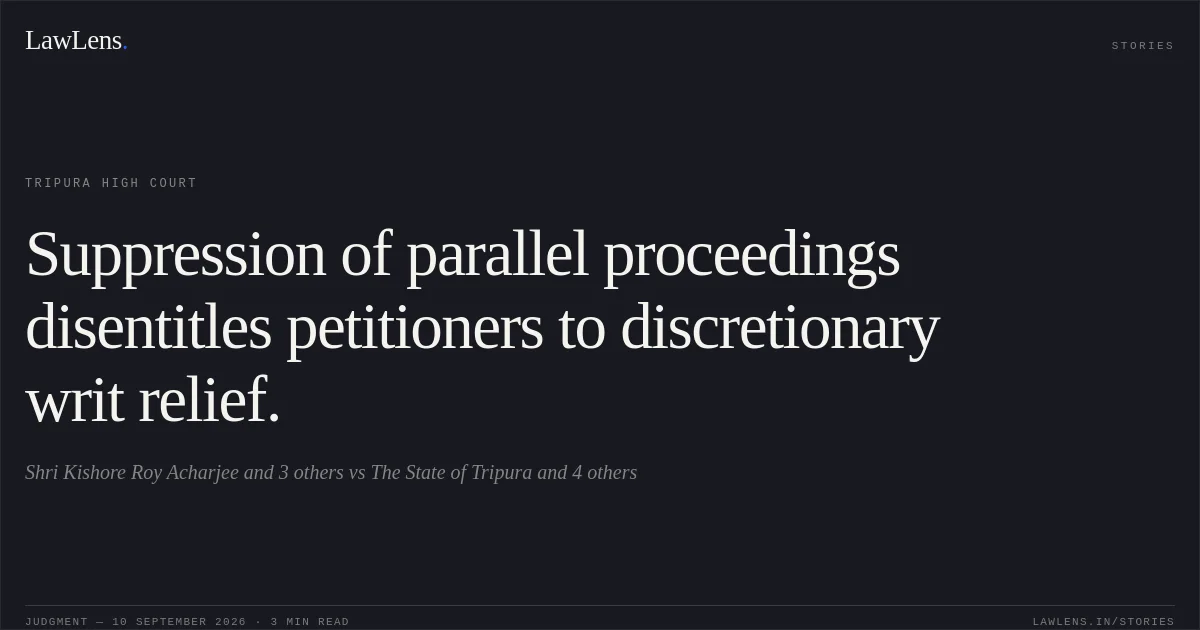
The Court exercised its discretionary jurisdiction under Article 226 of the Constitution and applied the principle that a litigant cannot simultaneously pursue concurrent remedies for the same cause of action after electing one remedy.
Source reference: p. 7, para. 10Relying on M/s. Kabra and Associates & Ors. v. Rekha Rajkumar Hemdev & Ors., Civil Appeal No. 6936 of 2023, and Ireo Grace Realtech Pvt. Ltd. v. Abhishek Khanna, (2021) 3 SCC 241, the Court held that election of one of two concurrent remedies prevents simultaneous pursuit of the other for the same cause of action.
Source reference: p. 7, para. 10The Court further applied the equitable principle that a party seeking writ relief must approach the Court with clean hands and must disclose material proceedings and facts.
Source reference: p. 7, para. 10It also considered the applicable municipal building permissions and the alleged residential-use restriction under the conveyance deeds, as well as the nature of a common toilet as a basic facility for building staff and service providers.
Source reference: p. 8, para. 11Reasoning
The Court found that the petitioners were using the ground-floor premises for a pathology laboratory and eye clinic, despite the premises and conveyance documentation indicating residential use; this was treated as a violation of the applicable building permission and deed conditions.
Source reference: p. 7, para. 9It further held that the petitioners had pursued proceedings before both the Municipal Corporation and T-RERA and had also initiated execution proceedings before T-RERA before filing the writ petition, without adequately disclosing that fact.
Source reference: p. 7, para. 10Applying the rule against simultaneous pursuit of concurrent remedies, the Court concluded that the petitioners had not approached it with clean hands.
Source reference: p. 7, para. 10Additionally, the Court considered that the toilets were located on the ground floor and served security personnel, caretakers, plumbers, electricians, and domestic workers, making them a basic common facility.
Source reference: p. 8, para. 11It therefore found that the authorities had proceeded toward demolition without sufficiently examining the ground realities and the competing interests of the other occupants.
Source reference: p. 8, para. 11In these circumstances, the discretionary remedy of mandamus was held to be unwarranted.
Source reference: p. 8, para. 11Holding
The Court dismissed the writ petition and declined to grant the requested directions for demolition, initiation of proceedings, compensation, or costs against the respondents.
It directed each of the four petitioners to pay ₹10,000, totalling ₹40,000, to the High Court Bar Associations within one month and to obtain receipts, with a copy of the order to be marked to the President of the High Court Bar Associations.
Source reference: p. 8, para. 12Any pending miscellaneous applications were also closed.
Source reference: p. 8, para. 14Acts & Sections Cited
1 provisions across 1 statute referred to in this judgment. Each provision opens on LawLens.
Real Estate (Regulation and Development) Act, 2016.1
Original Court PDF
Shri Kishore Roy Acharjee and 3 othersvsThe State of Tripura and 4 others
Click to open original judgment
Original judgment, available to read, download and summarize on LawLens.in